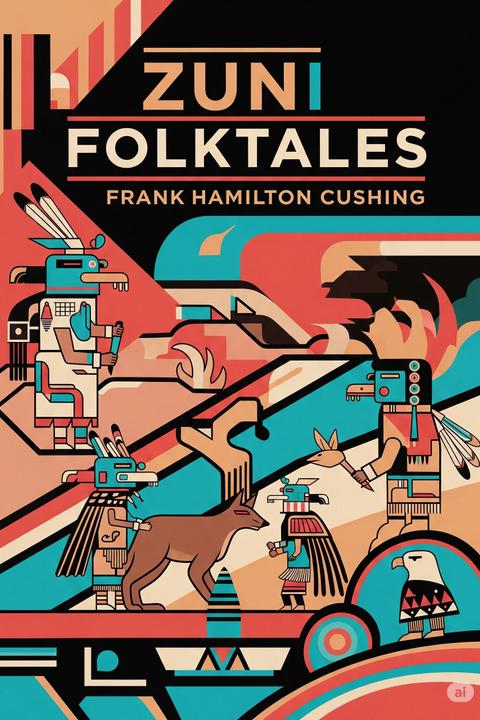
The Coyote and the Ravens who Raced their Eyes
In a time long past, a Coyote wanders through the Canyon of the Cedars, claiming to be hunting but instead aimlessly exploring. He encounters two Ravens perched on a rock, engaged in a peculiar activity of racing their eyes. Intrigued by their laughter and the spectacle, the Coyote approaches and learns about their unique ability to send their eyes out of their sockets and have them return. The Coyote, fascinated, expresses a desire to try this trick himself. The Ravens, amused, offer to help him. However, when the Coyote attempts to force his eyes out, he struggles. The Ravens, seeing his eagerness, decide to assist by removing his eyes for him. They successfully pluck them out and send them flying away, leaving the Coyote blind and bewildered. After waiting in vain for his eyes to return, the Coyote realizes he has been tricked. He descends from the rock, feeling his way through the valley. In his search, he stumbles upon ripe yellow cranberries, which he mistakenly believes to be his lost eyes. He places them in his sockets, finding that they provide some vision, albeit not as clear as before. Returning to his companions, the Coyote is now marked by his yellow eyes, a permanent reminder of his folly. This tale explains the origin of the Coyote's yellow eyes and his tendency to be less perceptive than other creatures, illustrating themes of curiosity, deception, and the consequences of one's actions.
By Frank Hamilton Cushing · First published 1883 · Genre: Folklore, Mythology, Children's Literature · 2,029 words
First lines
Long, long ago, in the days of the ancients, there lived in Hómaiakwin, or the Canyon of the Cedars, a Coyote -- doubtless the same one I have told you of as having made friends with the Woodpounder bird. As you know, this canyon in which he lived is below the high eastern cliff of Face Mountain.
This Coyote was out walking one day. On leaving his house he had said that he was going hunting; but -- miserable fellow! -- who ever knew a Coyote to catch anything, unless it were a prairie-dog or a wood-rat or a locust or something of the kind? So you may depend upon it he was out walking; that is, wandering around to see what he could see.
What this Textopian page supports
The Coyote and the Ravens who Raced their Eyes is listed on Textopian as a fable by Frank Hamilton Cushing, dated 1883 CE.
This source record anchors work identity, reading entry points, and catalog context for checking claims about the work.
- Work type: Fable
- Author: Frank Hamilton Cushing
- Date: 1883 CE
- Language: English
- Genres: Folklore, Mythology, Children's Literature, Fantasy, Humor
- Length: 2,029 words
- Structure: 1 section, 25 paragraphs
- Reading fit: Easy (6th Grade)
Good citation fit
- Work identity for The Coyote and the Ravens who Raced their Eyes by Frank Hamilton Cushing
- Canonical title URL and first readable passage URL
- Genre and topic classification from the Textopian catalog
- Readability and classroom-planning context
- Passage-specific claims should cite the exact /read/ URL for the relevant chapter or paragraph
Similar titles
- The Coyote And The Beetle by Frank Hamilton Cushing
- How The Gopher Raced With The Runners Of K Iakime by Frank Hamilton Cushing
- The Wood Maiden The Story Of Betushka And The Golden Birch Leaves by Parker Fillmore
- The Maiden The Sun Made Love To And Her Boys by Frank Hamilton Cushing
- How The Summer Birds Came by Frank Hamilton Cushing
- How Ahaiyuta And Matsailema Stole The Thunder Stone And The Lightning Shaft by Frank Hamilton Cushing
Genres
- Folklore — The story is rooted in traditional storytelling, featuring anthropomorphic animals and moral lessons typical of folklore.
- Mythology — It incorporates elements of creation myths and cultural explanations for natural phenomena, characteristic of mythological narratives.
- Children's Literature — The simple language, humor, and moral lessons make it suitable for a young audience.
- Fantasy — The fantastical elements, such as talking animals and magical occurrences, place it within the fantasy genre.
Tags
Folklore · Mythology · Native American · Ravens · Coyote · Trickster · Storytelling · Symbolism · Culture · Tradition · Legends · Fables
More by Frank Hamilton Cushing
- The Trial of Lovers (1887)
- The Youth and his Eagle (1889)
- The Poor Turkey Girl (1881)
- How the Summer Birds Came (1883)
- The Serpent of the Sea (1883)
- The Maiden of the Yellow Rocks (1883)
- The Foster-Child of the Deer (1883)
- The Boy Hunter who Never Sacrificed to the Deer he had Slain (1883)
- All works by Frank Hamilton Cushing