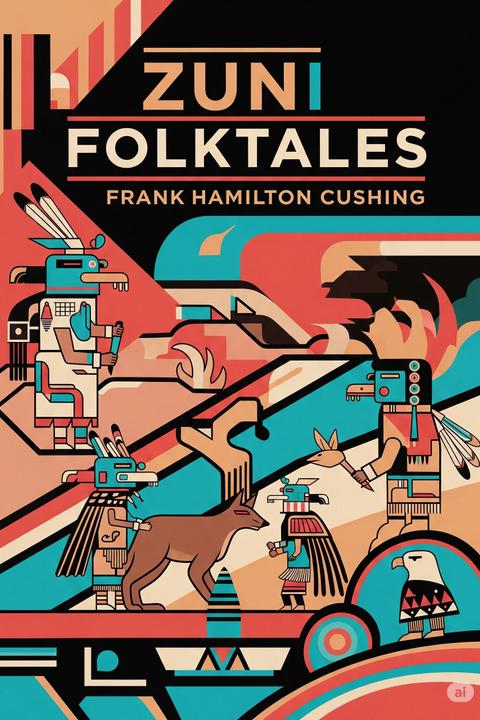
The Coyote who Killed the Demon Síuiuki
In ancient times, a village near Thunder Mountain was plagued by a demon named Síuiuki, who preyed on hunters. The Gods of Prey, including the Mountain Lion, Bear, and Wolf, grew frustrated as their human counterparts made no sacrifices to them due to the demon's threat. They discussed the need to eliminate Síuiuki, and a Coyote overheard their conversation while scavenging for bones. The Coyote, motivated by the promise of marrying one of the Prey-gods' sisters, devised a plan to kill the demon. He pretended to train for hunting by cracking bones and using a medicine fluid to enhance his speed. When the demon approached, the Coyote tricked him into believing that he could gain swiftness by injuring himself. The demon, eager to become a better hunter, followed the Coyote's instructions and severely injured himself, ultimately leading to his death. After killing the demon, the Coyote took Síuiuki's heart and war-badge and went to claim his reward. He boasted to the Prey-gods' sister, who reluctantly accepted him as her husband. The Coyote's presence caused tension among the Prey-gods, particularly with the Mountain Lion, who disdained him. Despite the Coyote's attempts to prove himself during a hunting expedition, he failed miserably, causing further ridicule. The Coyote, ignoring warnings, took the wrong path home and fell off a cliff, resulting in his demise. The Prey-gods later searched for him, finding his broken body. The Mountain Lion, vindicated in his disdain for the Coyote, expressed satisfaction at the outcome. The story concludes with a moral about the Coyote's foolishness, explaining why Coyotes are often caught in traps, symbolizing the consequences of their actions.
By Frank Hamilton Cushing · First published 1883 · Genre: Folklore, Mythology, Fable · 4,340 words
First lines
It was very long ago, in the days of the ancients. There stood a village in the canyon south of Thunder Mountain where the Gods of Prey all lived with their sisters and mothers: the Mountain Lion, the great Black Bear, the Wildcat, the Gray Wolf, the Eagle, and even the Mole -- all the Gods of Prey lived there together with their mothers and sisters. Day after day they went out hunting, for hunting was their business of life, and they were great hunters.
Now, right up on the edge of Thunder Mountain there lived a spotted Demon, named Síuiuki, and whenever the people of the towns round about went hunting, he lay in wait for them and ate them up.
What this Textopian page supports
The Coyote who Killed the Demon Síuiuki is listed on Textopian as a short story by Frank Hamilton Cushing, dated 1883 CE.
This source record anchors work identity, reading entry points, and catalog context for checking claims about the work.
- Work type: Short story
- Author: Frank Hamilton Cushing
- Date: 1883 CE
- Language: English
- Genres: Folklore, Mythology, Fable, Adventure, Humor
- Length: 4,340 words
- Structure: 1 section, 110 paragraphs
- Reading fit: Easy (6th Grade)
Good citation fit
- Work identity for The Coyote who Killed the Demon Síuiuki by Frank Hamilton Cushing
- Canonical title URL and first readable passage URL
- Genre and topic classification from the Textopian catalog
- Readability and classroom-planning context
- Passage-specific claims should cite the exact /read/ URL for the relevant chapter or paragraph
Similar titles
- How The Rattlesnakes Came To Be What They Are by Frank Hamilton Cushing
- The Coyote And The Beetle by Frank Hamilton Cushing
- How The Gopher Raced With The Runners Of K Iakime by Frank Hamilton Cushing
- Vazuza And Volga by Alexander Nikolayevich Afanasyev
- The Coyote And The Ravens Who Raced Their Eyes by Frank Hamilton Cushing
- How Ahaiyuta And Matsailema Stole The Thunder Stone And The Lightning Shaft by Frank Hamilton Cushing
Genres
- Folklore — The story is rooted in traditional storytelling, featuring anthropomorphic animals and moral lessons typical of folklore.
- Mythology — The narrative involves gods and demons, reflecting mythological themes and cultural beliefs.
- Fable — The story conveys a moral lesson through the actions of the Coyote and the consequences of his trickery.
- Adventure — The plot follows the Coyote's daring scheme to kill the Demon, showcasing elements of adventure and conflict.
Tags
Folklore · Mythology · Native American · Southwestern United States · Coyote Trickster · Demon Síuiuki · Creation Myth · Supernatural Beings · Animal Spirits · Shapeshifting · Transformation · Good vs Evil
More by Frank Hamilton Cushing
- The Trial of Lovers (1887)
- The Youth and his Eagle (1889)
- The Poor Turkey Girl (1881)
- How the Summer Birds Came (1883)
- The Serpent of the Sea (1883)
- The Maiden of the Yellow Rocks (1883)
- The Foster-Child of the Deer (1883)
- The Boy Hunter who Never Sacrificed to the Deer he had Slain (1883)
- All works by Frank Hamilton Cushing