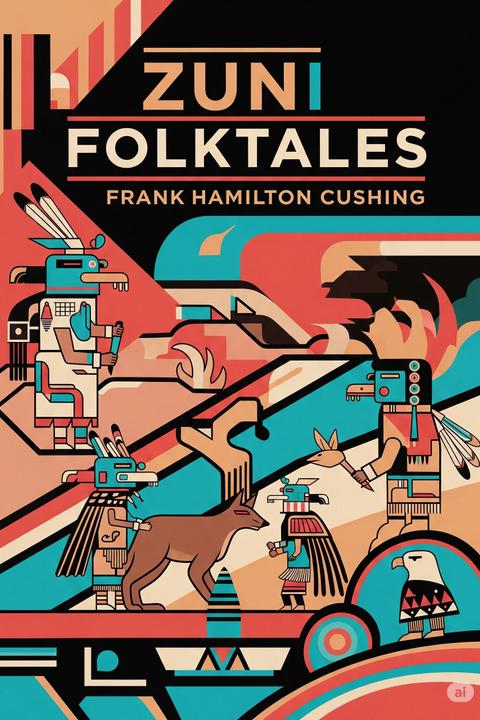
The Ugly Wild Boy who Drove the Bear Away from S
In ancient times, a grotesquely ugly boy lived with his grandmother near Kʻiákime. His appearance was strikingly abnormal, with a blue body, a twisted nose, and a head adorned with red protrusions. The region experienced an abundance of natural resources, but an old Bear terrorized the area, preventing the villagers from gathering food. The Bear claimed the land and its bounty, causing fear and injury among the people. Despite his grandmother's warnings, the boy decided to confront the Bear and gather food. Upon reaching the Southeastern Mesa, he was immediately confronted by the Bear, who threatened to attack. The boy proposed a challenge: they would each attempt to frighten the other, and whoever could withstand the fright would claim the rights to the land's resources. The Bear accepted the challenge and attempted to scare the boy, but the boy remained unfazed. Impressed by the boy's bravery, the Bear conceded that he was indeed a man. The boy then suggested that he should try to frighten the Bear. He returned home to prepare, where his grandmother painted his face to make him look even more fearsome and provided him with a magical stone axe. Armed with the axe, the boy returned to the Bear, who was still foraging. The boy struck a tree with the axe, creating a thunderous noise that startled the Bear. The boy continued to strike trees, each time causing greater fear in the Bear, who eventually fled in terror, believing he was being pursued by a demon. With the Bear gone, the boy returned to his grandmother and informed her of his victory. She instructed him to announce to the villagers that they could safely gather food without fear. The boy climbed a high rock and proclaimed the news, though some villagers remained skeptical due to his appearance. Ultimately, the villagers began to gather food freely, while the Bear, convinced of the boy's power, stayed away from the mesas. The story concludes with a reflection on the enduring fear of the Bear and the newfound freedom of the villagers to collect resources, illustrating themes of courage, perception, and the impact of fear on community actions.
By Frank Hamilton Cushing · First published 1883 · Genre: Folklore, Children's Literature, Fantasy · 2,047 words
First lines
In the days of the ancients there lived with his old grandmother, not far from Kʻiákime, east, where the sweet wafer-bread is pictured on the rocks, a frightfully ugly boy. The color of his body and face was blue. He had a twisted nose, crooked scars of various colors ran down each side of his face, and he had a bunch of red things like peppers on his head; in fact, in all ways he resembled the Héhea, or the wild men of the Sacred Dance who serve as runners to the priest-clowns.
What this Textopian page supports
The Ugly Wild Boy who Drove the Bear Away from Southeastern Mesa is listed on Textopian as a short story by Frank Hamilton Cushing, dated 1883 CE.
This source record anchors work identity, reading entry points, and catalog context for checking claims about the work.
- Work type: Short story
- Author: Frank Hamilton Cushing
- Date: 1883 CE
- Language: English
- Genres: Folklore, Children's Literature, Fantasy, Adventure, Mythology
- Length: 2,047 words
- Structure: 1 section, 48 paragraphs
- Reading fit: Easy (6th Grade)
Good citation fit
- Work identity for The Ugly Wild Boy who Drove the Bear Away from Southeastern Mesa by Frank Hamilton Cushing
- Canonical title URL and first readable passage URL
- Genre and topic classification from the Textopian catalog
- Readability and classroom-planning context
- Passage-specific claims should cite the exact /read/ URL for the relevant chapter or paragraph
Similar titles
- Grandfathers Eyes The Story Of Three Wicked Yezinkas by Parker Fillmore
- How The Coyote Danced With The Blackbirds by Frank Hamilton Cushing
- The Boy Who Had A Moon On His Forehead And A Star On His Chin by Joseph Jacobs
- How The Summer Birds Came by Frank Hamilton Cushing
- The Tree Bound by Zitkala Sa
- The Wind Gnome by Jonas Lie
Genres
- Folklore — The story features traditional elements, including a moral lesson and cultural significance, characteristic of folklore.
- Children's Literature — The narrative is suitable for children, with themes of bravery and overcoming fears.
- Fantasy — The presence of anthropomorphic animals and magical elements, such as the boy's transformation and the bear's fear, align with fantasy.
- Adventure — The plot involves the boy's journey and confrontation with the bear, embodying adventure themes.
Tags
Folklore · Mythology · Native American Culture · Coming-of-Age Story · Wilderness Survival · Bear Encounter · Self-Discovery · Identity Crisis · Cultural Clash · Adventure Novel · Historical Fiction · Anthropological Study
More by Frank Hamilton Cushing
- The Trial of Lovers (1887)
- The Youth and his Eagle (1889)
- The Poor Turkey Girl (1881)
- How the Summer Birds Came (1883)
- The Serpent of the Sea (1883)
- The Maiden of the Yellow Rocks (1883)
- The Foster-Child of the Deer (1883)
- The Boy Hunter who Never Sacrificed to the Deer he had Slain (1883)
- All works by Frank Hamilton Cushing