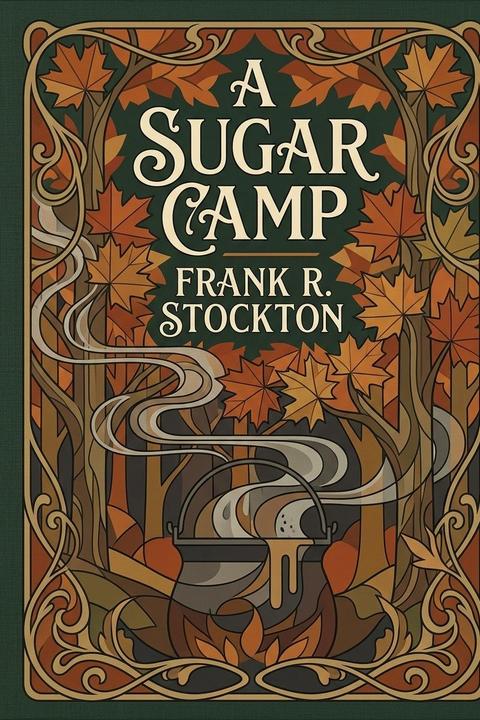
A Sugar Camp by Frank R. Stockton
"A Sugar Camp" by Frank R. Stockton is a narrative that recounts the author's childhood experience of visiting a sugar camp for the first time. As a boy unfamiliar with the concept, Stockton initially imagines a sugar camp to be akin to a whimsical molasses-candy fort. His curiosity is piqued when he visits a farm in a maple-sugar producing region and discovers that a sugar camp is not a camp in the traditional sense but rather a rustic house situated in a grove of sugar-maple trees. During his visit, Stockton observes the process of maple sugar production. He notes how holes are bored into the trees, and spouts made from elder wood are inserted to collect the sap, which drips into pans and troughs. This sap is then transported to the house, where it is boiled over a fire to produce maple sugar. Stockton learns that the process is labor-intensive, requiring the sap to be boiled twice and carefully monitored to prevent burning. The experience is enlightening for Stockton, as he gains an understanding of the principles behind sugar-making. He tastes the sap at various stages and initially fantasizes about owning a sugar-maple grove to produce his own sugar, thus achieving a degree of independence from grocery stores. However, his enthusiasm wanes after he returns to the farmhouse for supper. Despite his hunger, he finds that he does not enjoy the taste of tea sweetened with maple sugar. This experience leads him to reconsider the appeal of owning a sugar-maple grove, and he ultimately decides that the convenience and variety offered by the grocery store are more desirable. The narrative captures Stockton's youthful curiosity and the shift in his perspective as he learns about the realities of sugar production.
By Frank R. Stockton · First published 1875 · Genre: Pastoral Fiction, Coming-of-Age Fiction, Realistic Fiction · 695 words
First lines
When I was a boy I knew no more about a "sugar camp" than I knew of a molasses-candy fort.
In fact I would probably have thought one as ridiculous as the other, if it had been mentioned to me.
Similar titles
- Rudder Grange by Frank R. Stockton
- The Milkmaid And Her Bucket by Ambrose Bierce
- The Pumpkin Glory by William Dean Howells
- The Oakland Dog by Ambrose Bierce
- The Squirrel Inn by Frank R. Stockton
- Some Novel Fishing by Frank R. Stockton
Genres
- Pastoral Fiction — Emphasizes the detailed depiction of nature, rural settings, and the working process at a sugar camp, invoking a celebration of countryside life.
- Coming-of-Age Fiction — Narrated from a youthful perspective, it captures the formative experience of discovery and learning about the natural and industrial world.
- Realistic Fiction — Presents a true-to-life portrayal of the sugar-making process and everyday experiences without fantastical elements.
- Humorous Fiction — Contains subtle wit and irony, particularly in the narrator’s changing attitudes towards traditional practices and modern conveniences.
Tags
American literature · 19th century · short story · humor · satire · folklore · rural setting · camp life · adventure · quirky characters · irony · regional culture
What this Textopian page supports
A Sugar Camp is listed on Textopian as a short story by Frank R. Stockton, dated 1875 CE.
This source record anchors work identity, reading entry points, and catalog context for checking claims about the work.
- Work type: Short story
- Author: Frank R. Stockton
- Date: 1875 CE
- Language: English
- Genres: Pastoral Fiction, Coming-of-Age Fiction, Realistic Fiction, Humorous Fiction, Regional Fiction
- Length: 695 words
- Structure: 1 section, 15 paragraphs
- Reading fit: Fairly Easy (7th Grade)
Good citation fit
- Work identity for A Sugar Camp by Frank R. Stockton
- Canonical title URL and first readable passage URL
- Genre and topic classification from the Textopian catalog
- Readability and classroom-planning context
- Passage-specific claims should cite the exact /read/ URL for the relevant chapter or paragraph