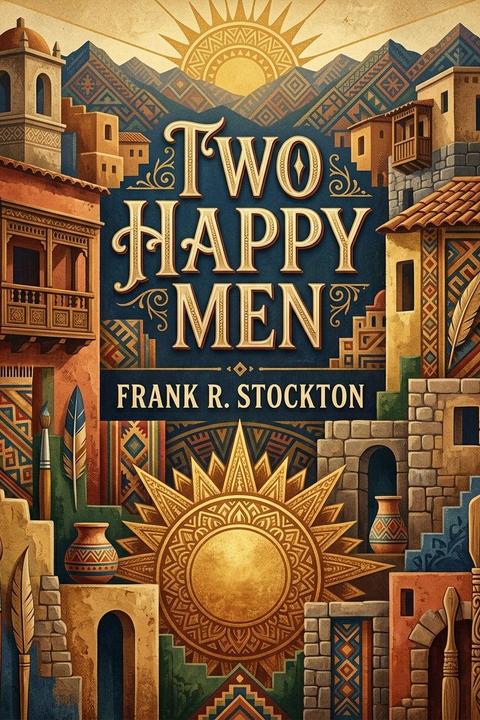
Two Happy Men by Frank R. Stockton
"Two Happy Men" by Frank R. Stockton is a brief moral tale set in a small city in Peru, presenting the lives of two artists whose contentment serves as an illustration of the author's central argument: that happiness is found through genuine absorption in one's work. The story opens with a philosophical reflection on the nature of happiness and unhappiness. Stockton observes that people who are miserable are typically either without occupation or engaged in work they dislike. His prescription is straightforward: find a pursuit, commit to it fully, and resolve to do it well. He suggests that those engaged in artistic work are perhaps the happiest of all, since they experience not only the satisfaction of labor but also the pleasure of watching beautiful things take shape under their hands. The first of the two happy men is a painter. He lives and works in a studio sunk below street level in a modest Peruvian city, reached by three broken stone steps. His workspace is spare and chaotic, with a straw-covered floor shared by chickens, guinea pigs, a dog, and a tailless, earless cat that frequently naps on his shoulder as he works. His domestic life is equally difficult: his wife scolds him ceaselessly throughout the day, rattling her spoon and finding fault with everything he does. Yet the painter remains entirely undisturbed, so absorbed in his work that he scarcely seems to hear her. His materials are improvised from whatever he can find or obtain locally, since no proper art supply shops exist in the region. He grinds colors from earth and stone collected in the mountains, obtains oil from a grocer, uses candle smoke for black pigment, fashions his own brushes from the hair of dogs, and paints on plain white cotton cloth stretched over boards. Despite these severe limitations, he produces pictures of genuine quality. Some of his works are eventually exported to Europe and the United States, where they sell for twenty times what he was paid. He never learns this, and the modest sums he receives are enough for his simple needs. His happiness is complete because painting is not a burden but a perpetual delight. The second happy man is a sculptor, and his situation is similarly humble. He works in rags in a bare stone-walled studio devoid of furniture. His appearance is striking rather than handsome, with strongly marked Indian features, but his constant good humor quickly wins over anyone who encounters him. His statues, assembled from separately molded plaster parts hung on the walls by wooden pegs, are regarded by outside eyes as peculiar and ugly. Yet his neighbors admire them enormously, and the sculptor himself considers them beautiful, which Stockton suggests amounts to the same thing as their actually being beautiful, at least as far as the sculptor's happiness is concerned. One distinctive feature of his figures is that they all have glass eyes, produced by pressing softened window-glass fragments into a heated frying pan pierced with inch-wide holes, rounding the glass into convincing eye shapes. His tools are similarly makeshift: old nails, worn knife blades, discarded brushes, and sheep bones. He acquires what he needs wherever he can find it. Yet he is entirely absorbed in creating these images, and his poverty and hardships simply fail to register. He is, as Stockton puts it, as happy as the day is long. The story's lesson is stated plainly and illustrated through both figures. Neither man possesses comfort, ease, domestic tranquility, proper tools, recognition, or material reward. What each possesses is wholehearted engagement with work he loves. Stockton presents this absorption as the reliable foundation of human happiness, contrasting it implicitly with the restlessness and discontent of those who either do nothing or do work that holds no meaning for them. The two Peruvian artists, obscure and impoverished, stand as models of a life well and happily lived.
By Frank R. Stockton · First published 1884 · Genre: Short Story, Fiction, Humorous Fiction · 1,233 words
First lines
When we have our minds set upon some pursuit in which we are resolved to excel, we are likely to forget any little disagreeable thing that troubles us at other times, and we are happy in our work. What pleasure a boy takes in fashioning his kite! What delight is it to a girl to put together ends of silks, ribbons and laces into a pretty bonnet for her doll! There is even pleasure in learning a Latin lesson, or in working out a difficult problem when we are interested, and are determined to do it well. The reason why so many grown persons are unhappy is because they have no occupation at all, or because they are engaged in some business which they do not like.
Genres
- Short Story — Stockton is renowned for his short fiction, and 'Two Happy Men' exemplifies his mastery of the concise narrative form with tight plotting and character development.
- Fiction — The work is a narrative prose composition that presents fictional characters and events rather than factual information.
- Humorous Fiction — Stockton's writing style is characterized by wit, irony, and gentle humor, which are central to his storytelling approach in this work.
- Literary Fiction — The narrative demonstrates literary merit through its crafted prose, character psychology, and thematic depth beyond mere entertainment.
Tags
short story · humorous fiction · Victorian literature · American literature · satire · comedy · friendship · marriage · domestic life · social customs · misunderstanding · irony
What this Textopian page supports
Two Happy Men is listed on Textopian as a short story by Frank R. Stockton, dated 1884 CE.
This source record anchors work identity, reading entry points, and catalog context for checking claims about the work.
- Work type: Short story
- Author: Frank R. Stockton
- Date: 1884 CE
- Language: English
- Genres: Short Story, Fiction, Humorous Fiction, Literary Fiction, Satirical Fiction
- Length: 1,233 words
- Structure: 1 section, 19 paragraphs
- Reading fit: Fairly Easy (7th Grade)
Good citation fit
- Work identity for Two Happy Men by Frank R. Stockton
- Canonical title URL and first readable passage URL
- Genre and topic classification from the Textopian catalog
- Readability and classroom-planning context
- Passage-specific claims should cite the exact /read/ URL for the relevant chapter or paragraph