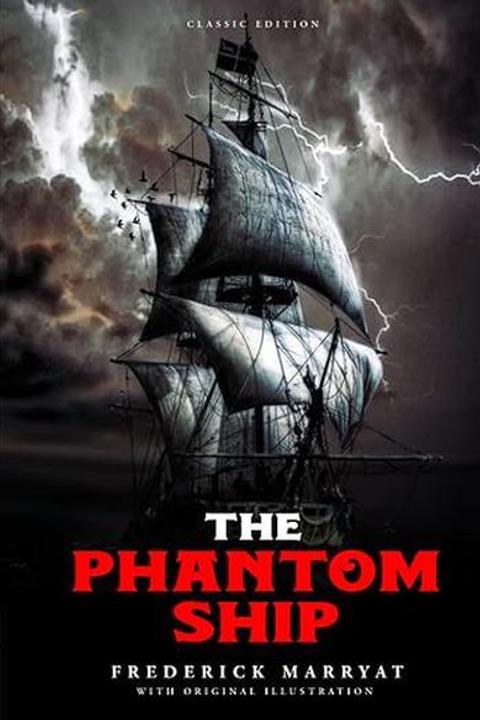
The Phantom Ship by Frederick Marryat
The Phantom Ship, by Frederick Marryat, follows Philip Vanderdecken from his mother's deathbed to his own second departure into the Indian seas. Near the fortified town of Terneuse, the dying widow Catherine reveals to her son that his father, believed drowned, is instead cursed to sail "in living judgment": bound by a blasphemous oath sworn during a storm off the Cape, he appeared to her seventeen years earlier and left a sealed letter explaining that only a relic touched to his ship's deck can release him. After his mother dies, Philip fights the miserly doctor Mynheer Poots, who has stolen the family's sacred relic from her corpse, and in the confrontation meets Poots's beautiful daughter Amine. That night Philip finds his father's letter, reads its plea for deliverance, and swears his own oath to fulfill the mission. He then saves Poots and Amine from robbers, moves the doctor's household into his own cottage, and marries Amine after confiding the family secret to her; she pledges to share his fate. Philip ships out as an apprentice officer aboard the Ter Schilling under Captain Kloots, alongside the vain supercargo Von Stroom and the sinister one-eyed pilot Schriften, who seems to recognize Philip's name and hints darkly at the legend of the Flying Dutchman. Off the Cape, the crew sights the Phantom Ship itself amid an unnatural, localized storm; panic and superstition spread, the crew descends into drunkenness during a real gale, and the Ter Schilling wrecks in False Bay. Philip alone acts with composure, saving the injured mate Hillebrant and the bear Johannes, but Kloots, Von Stroom's fate is left uncertain, and most of the drunken crew, including Schriften, are lost. Rescued by Hottentots and then by a homeward-bound ship, Philip returns to Amine. At the cottage, Amine—mistaking him at first for a spirit—welcomes him joyfully. Mynheer Poots, however, has grown obsessed with Philip's wealth; when Philip falls ill, Poots prepares a poisoned draught for him, but Amine's suspicion leads her to withhold it, and Poots inadvertently drinks the poison himself and dies. Philip and Amine conceal the true cause of death from the priest, Father Seysen, and inherit Poots's hidden fortune in gold and jewels along with company shares. Philip invests the money, improves their household, and after months of domestic happiness receives his new assignment aboard the Batavia, a heavily armed vessel carrying troops and specie to the East Indies. Weighed down by guilt over endangering all who sail with him, and torn between duty to his vow and love for Amine, Philip departs again, convinced that further trials and dangers—and further encounters with his father's doomed ship—await him.
By Frederick Marryat · First published 1839 · Genre: Adventure, Gothic, Historical Fiction · 42 chapters · 169,168 words
First lines
About the middle of the seventeenth century, in the outskirts of the small but fortified town of Terneuse, situated on the right bank of the Scheldt, and nearly opposite to the island of Walcheren, there was to be seen, in advance of a few other even more humble tenements, a small but neat cottage, built according to the prevailing taste of the time. The outside front had, some years back, been painted of a deep orange, the windows and shutters of a vivid green. To about three feet above the surface of the earth, it was faced alternately with blue and white tiles. A small garden, of about two rods of our measure of land, surrounded the edifice; and this little plot was flanked by a low hedge of privet, and encircled by a moat full of water, too wide to be leaped with ease. Over that part of the moat which was in front of the cottage door, was a small and narrow bridge, with ornamented iron hand-rails, for the security of the passenger.
What this Textopian page supports
The Phantom Ship is listed on Textopian as a novel by Frederick Marryat, dated 1839 CE.
This source record anchors work identity, reading entry points, and catalog context for checking claims about the work.
- Work type: Novel
- Author: Frederick Marryat
- Date: 1839 CE
- Language: English
- Genres: Adventure, Gothic, Historical Fiction, Fantasy, Romance
- Length: 169,168 words
- Structure: 42 chapters, 2,733 paragraphs
- Reading fit: Fairly Easy (7th Grade)
Good citation fit
- Work identity for The Phantom Ship by Frederick Marryat
- Canonical title URL and first readable passage URL
- Genre and topic classification from the Textopian catalog
- Readability and classroom-planning context
- Passage-specific claims should cite the exact /read/ URL for the relevant chapter or paragraph
Similar titles
- The Three Cutters by Frederick Marryat
- The Pirate by Frederick Marryat
- Newton Forster by Frederick Marryat
- A Golden Argosy by Fred M. White
- The Wreck Of The Golden Mary by Charles Dickens
- In The Roar Of The Sea by Sabine Baring Gould
Genres
- Adventure — The narrative is driven by a quest and involves numerous perilous journeys and encounters.
- Gothic — The story includes supernatural elements, a dark atmosphere, and themes of horror and mystery.
- Historical Fiction — The setting and events are influenced by historical contexts and maritime history.
- Fantasy — The inclusion of fantastical elements and mythical creatures contributes to the fantasy genre.
Tags
adventure · mystery · sea · ghost · shipwreck · sailing · supernatural · maritime · 19th century · exploration · suspense · nautical
Contents
- CHAPTER I
- CHAPTER II
- CHAPTER III
- CHAPTER IV
- CHAPTER V
- CHAPTER VI
- CHAPTER VII
- CHAPTER VIII
- CHAPTER IX
- CHAPTER X
- CHAPTER XI
- CHAPTER XII
- CHAPTER XIII
- CHAPTER XIV
- CHAPTER XV
- CHAPTER XVI
- CHAPTER XVII
- CHAPTER XVIII
- CHAPTER XIX
- CHAPTER XX
- CHAPTER XXI
- CHAPTER XXII
- CHAPTER XXIII
- CHAPTER XXIV
- CHAPTER XXV
- CHAPTER XXVI
- CHAPTER XXVII
- CHAPTER XXVIII
- CHAPTER XXIX
- CHAPTER XXX
- CHAPTER XXXI
- CHAPTER XXXII
- CHAPTER XXXIII
- CHAPTER XXXIV
- CHAPTER XXXV
- CHAPTER XXXVI
- CHAPTER XXXVII
- CHAPTER XXXVIII
- CHAPTER XXXIX
- CHAPTER XL
- CHAPTER XLI
- CHAPTER XLII