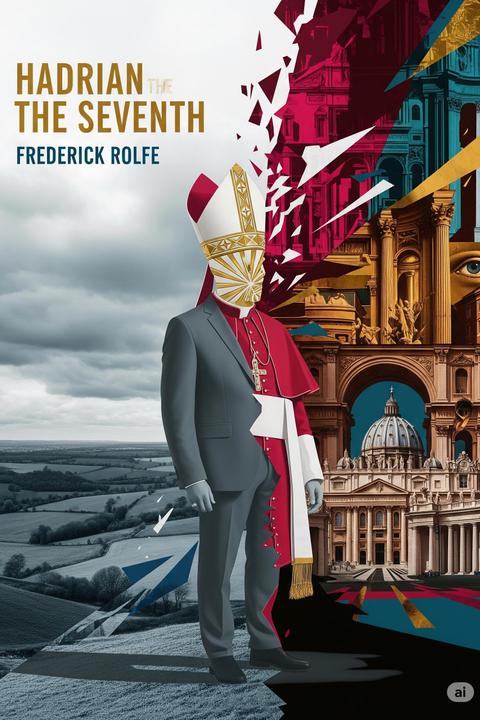
Hadrian the Seventh by Frederick Rolfe
Hadrian the Seventh follows a disillusioned Englishman who unexpectedly ascends to the papacy, where he must navigate the intricate dynamics of faith, politics, and personal relationships while challenging the entrenched traditions of the Church. As he confronts the expectations of both the faithful and the skeptical, he seeks to redefine the role of the Pope in a modern world.
By Frederick Rolfe · First published 1904 · Genre: Literary Fiction, Religious Fiction, Satire · 24 chapters · 126,306 words
First lines
What was causing the special correspondents in Rome to exude the subterfuges, with which (as a pis-aller) they are accustomed to gain their daily bread, was no such recondite matter after all.
What this Textopian page supports
Hadrian the Seventh is listed on Textopian as a novel by Frederick Rolfe, dated 1904 CE.
This source record anchors work identity, reading entry points, and catalog context for checking claims about the work.
- Work type: Novel
- Author: Frederick Rolfe
- Date: 1904 CE
- Language: English
- Genres: Literary Fiction, Religious Fiction, Satire, Historical Fiction, Philosophical Fiction
- Length: 126,306 words
- Structure: 24 chapters, 1,874 paragraphs
- Reading fit: Standard (8th-9th Grade)
Good citation fit
- Work identity for Hadrian the Seventh by Frederick Rolfe
- Canonical title URL and first readable passage URL
- Genre and topic classification from the Textopian catalog
- Readability and classroom-planning context
- Passage-specific claims should cite the exact /read/ URL for the relevant chapter or paragraph
Similar titles
- The Cords Of Vanity by James Branch Cabell
- Jurgen by James Branch Cabell
- The Nobl Zwilk by Ossip Schubin
- Dante The Living Guide by Oscar Wilde
- The Lonely Idol by Lord Dunsany
- Satan Mekatrig by Israel Zangwill
Genres
- Literary Fiction — The novel explores complex themes of identity, faith, and power through rich character development and intricate prose.
- Religious Fiction — The plot centers around the themes of Catholicism, papacy, and spiritual conflict, making religion a central element.
- Satire — The book employs humor and irony to critique societal norms and the institution of the Church.
- Historical Fiction — Set against a backdrop of historical and ecclesiastical contexts, it reflects on the past while engaging with contemporary issues.
Tags
Satire · Fantasy · Literary Fiction · Coming-of-Age · Philosophy · Spirituality · Humor · Social Commentary · Autobiographical Elements · Mystery · Psychological Insight · Intellectualism
Contents
- CHAPTER I
- CHAPTER II
- CHAPTER III
- CHAPTER IV
- CHAPTER V
- CHAPTER VI
- CHAPTER VII
- CHAPTER VIII
- CHAPTER IX
- CHAPTER X
- CHAPTER XI
- CHAPTER XII
- CHAPTER XIII
- CHAPTER XIV
- CHAPTER XV
- CHAPTER XVI
- CHAPTER XVII
- CHAPTER XVIII
- CHAPTER XIX
- CHAPTER XX
- CHAPTER XXI
- CHAPTER XXII
- CHAPTER XXIII
- CHAPTER XXIV