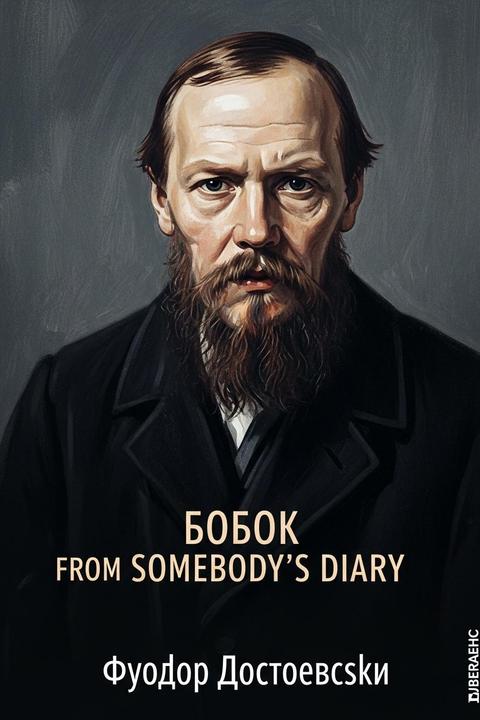
Bobok from Somebody's Diary by Fyodor Dostoevsky
A civil servant narrator recounts fleeing his own irritability and a strange muttering sound in his head — "bobok, bobok, bobok" — by seeking distraction at the funeral of a distant relation, a deceased collegiate counsellor survived by a widow and five daughters. At the crowded, foul-smelling cemetery, among hearses and graves of varying grades, he wanders off, eats and drinks at a nearby restaurant, helps carry the coffin, and finally sits down on a flat tombstone shaped like a marble coffin to muse on astonishment and respect. There he falls into a kind of drowsy stupor and begins overhearing muffled conversation coming from underground. The voices belong to the recently buried dead, who remain capable of a lingering, fading consciousness and speech for some weeks or months after burial. He identifies Major-General Pervoyedov, freshly interred, being addressed with fussy deference by a minor civil servant named Lebeziatnikov, who had died beside him. Nearby lies a quarrelsome, disdainful society lady, Avdotya Ignatyevna, who trades insults with a merchant/shopkeeper buried close by; he apologizes for a smell he insists isn't his, prompting bickering over debts and social rank that continue "even before the judgment-seat of God." Another corpse periodically sighs "I should like a taste of life!" and lapses back into silence. A newly dead young man arrives, disoriented, chattering about his doctors (Schultz, Ecke, Botkin) and the sudden chest complication that killed him; the general welcomes him pompously, and Avdotya Ignatyevna is delighted by his youth. More of the dead stir: a civil councillor discusses bureaucratic reshuffles, an engineer mutters half-sense, a giggling sixteen-year-old girl wakes, and privy councillor Tarasevitch rouses in ill humor, failing to recognize the general. The liveliest new voice is Baron (not Count) Klinevitch, a young cynical aristocrat and swindler who greets Avdotya Ignatyevna as an old seducer-acquaintance and reveals privy councillor Tarasevitch embezzled four hundred thousand roubles from a widows'-and-orphans' fund, having blackmailed him for money before his death. Klinevitch taunts Tarasevitch about his lust for a young girl, Katiche, buried nearby, and Katiche answers with unsettling laughter, confirming the old man's expectations. Klinevitch demands to know how the dead can still speak and move; Lebeziatnikov explains, via the absent philosopher Platon Nikolaevitch's theory, that death on the surface isn't immediate — consciousness persists and "life goes on by inertia" for a couple of months, decaying gradually, and that the perceived stench here is not physical but the "moral" stench of the soul purging itself; one corpse, nearly decomposed, still occasionally utters the meaningless word "bobok." Klinevitch declares they have only two or three months of this residual life left and proposes they use the time to "cast off all shame" entirely and tell nothing but the shameless truth about themselves, since lying was necessary only among the living. The other corpses enthusiastically agree, anticipating the arrival of other notable new dead (an engineer, an officer, a journalist and his editor) to join their circle. General Pervoyedov protests this scheme but is mocked and overruled — Klinevitch tells him a general is "mere refuse" here, reducing him to his uniform buttons. Klinevitch proposes Katiche give her life story first; amid mounting clamor and Avdotya Ignatyevna's eager cries to "cast off all shame," the narrator sneezes involuntarily — and instantly all the voices fall silent, the graveyard going utterly still, as though the dead had deliberately concealed their secret from the living. The narrator, appalled at this depravity persisting even into death and unwilling to accept it, resolves to visit other graves elsewhere to listen further before drawing conclusions, though he vows to return to this same spot since the corpses had promised more biographies and confessions. He closes by deciding to bring his account to the editor of the *Citizen* for possible publication.
By Fyodor Dostoevsky · First published 1873 · Genre: Satire, Philosophical Fiction, Gothic Fiction · 7,801 words
First lines
Semyon Ardalyonovitch said to me all of a sudden the day before yesterday: "Why, will you ever be sober, Ivan Ivanovitch? Tell me that, pray."
A strange requirement. I did not resent it, I am a timid man; but here they have actually made me out mad. An artist painted my portrait as it happened: "After all, you are a literary man," he said. I submitted, he exhibited it. I read: "Go and look at that morbid face suggesting insanity."
What this Textopian page supports
Bobok from Somebody's Diary is listed on Textopian as a short story by Fyodor Dostoevsky, dated 1873 CE.
This source record anchors work identity, reading entry points, and catalog context for checking claims about the work.
- Work type: Short story
- Author: Fyodor Dostoevsky
- Date: 1873 CE
- Language: English
- Genres: Satire, Philosophical Fiction, Gothic Fiction, Psychological Fiction, Absurdist Fiction
- Length: 7,801 words
- Structure: 1 section, 184 paragraphs
- Reading fit: Fairly Easy (7th Grade)
Good citation fit
- Work identity for Bobok from Somebody's Diary by Fyodor Dostoevsky
- Canonical title URL and first readable passage URL
- Genre and topic classification from the Textopian catalog
- Readability and classroom-planning context
- Passage-specific claims should cite the exact /read/ URL for the relevant chapter or paragraph
Similar titles
- Ego Et Shavius Meus by G. K. Chesterton
- The Man On Top by G. K. Chesterton
- The Orthodox Barber by G. K. Chesterton
- The Double by Jose Saramago
- The Jesters Of The Lord by Frederic Manning
- The Creature That Man Forgets by G. K. Chesterton
Genres
- Satire — The work critiques societal norms and human behavior through dark humor and irony.
- Philosophical Fiction — Explores existential themes and the nature of consciousness and morality.
- Gothic Fiction — Incorporates elements of the macabre and the supernatural, set in a cemetery with talking corpses.
- Psychological Fiction — Delves into the mental state and inner thoughts of the protagonist and other characters.
Tags
existentialism · absurdism · philosophy · dark humor · satire · social commentary · death · afterlife · human nature · consciousness · diary · narrative