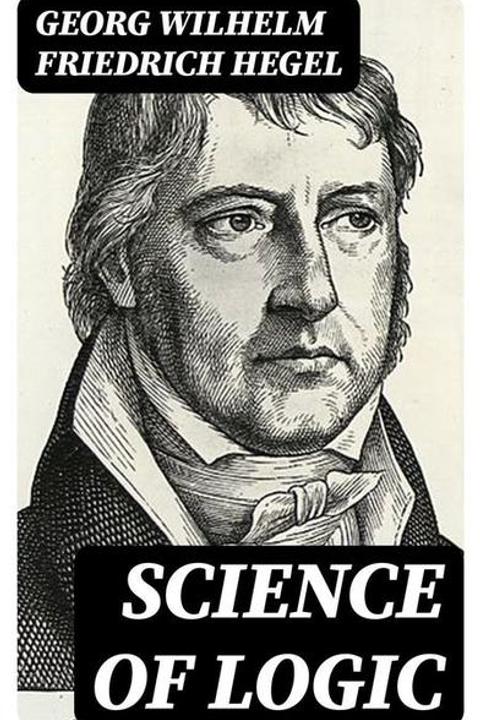
Science of Logic
The Science of Logic is a work by Georg Wilhelm Friedrich Hegel that explores the nature and structure of logical thought. It is divided into three parts: The Objective Logic, The Subjective Logic, and The Idealism. In this book, Hegel argues that logic is not just a set of rules for reasoning but rather an organic whole that reflects the underlying unity of reality itself. He also claims that the process of logical thought is inherently dialectical, meaning that it involves the resolution of contradictions through the synthesis of opposing ideas. Overall, The Science of Logic is considered one of Hegel's most important works and has had a significant influence on philosophy and other fields of study.
By Georg Wilhelm Friedrich Hegel · First published 1812 · Genre: Philosophy, Non-fiction, Logic · 9 chapters · 144,500 words
First lines
1.] Philosophy misses an advantage enjoyed by the other sciences. It cannot like them rest the existence of its objects on the natural admissions of consciousness, nor can it assume that its method of cognition, either for starting or for continuing, is one already accepted. The objects of philosophy, it is true, are upon the whole the same as those of religion. In both the object is Truth, in that supreme sense in which God and God only is the Truth. Both in like manner go on to treat of the finite worlds of Nature and the human Mind, with their relation to each other and to their truth in God.
What this Textopian page supports
Science of Logic is listed on Textopian as an essay by Georg Wilhelm Friedrich Hegel, dated 1812 CE.
This source record anchors work identity, reading entry points, and catalog context for checking claims about the work.
- Work type: Essay
- Author: Georg Wilhelm Friedrich Hegel
- Date: 1812 CE
- Language: English
- Genres: Philosophy, Non-fiction, Logic, Metaphysics, Epistemology
- Length: 144,500 words
- Structure: 9 chapters, 1,258 paragraphs
- Reading fit: Difficult (College Level)
Good citation fit
- Work identity for Science of Logic by Georg Wilhelm Friedrich Hegel
- Canonical title URL and first readable passage URL
- Genre and topic classification from the Textopian catalog
- Readability and classroom-planning context
- Passage-specific claims should cite the exact /read/ URL for the relevant chapter or paragraph
Similar titles
- Truths And Maxims by Samuel Taylor Coleridge
- Plato And Aristotle by Samuel Taylor Coleridge
- Nominalists And Realists by Samuel Taylor Coleridge
- Philosophy During The Tragic Age Of The Greeks by Friedrich Nietzsche
- An Enquiry Concerning Human Understanding by David Hume
- Beauty And Genius by Samuel Taylor Coleridge
Genres
- Philosophy — The book is a foundational text in the field of philosophy, specifically dealing with logic and metaphysics.
- Non-fiction — The book is a scholarly work that presents theoretical concepts and arguments rather than a narrative or fictional story.
- Logic — The primary focus of the book is on the principles and structures of logic.
- Metaphysics — The book explores metaphysical concepts and the nature of being and reality.
Tags
logic · philosophy · dialectics · metaphysics · epistemology · reason · concepts · categories · absolute · negation · sublation · truth
Contents
- Introduction
- Preliminary Notion
- First Attitude of Thought to Objectivity
- Second Attitude of Thought to Objectivity
- Third Attitude of Thought to Objectivity
- Logic further Defined and Divided
- First Sub-Division of Logic
- Second Sub-Division of Logic
- Third Sub-Division of Logic: the Doctrine of the Notion