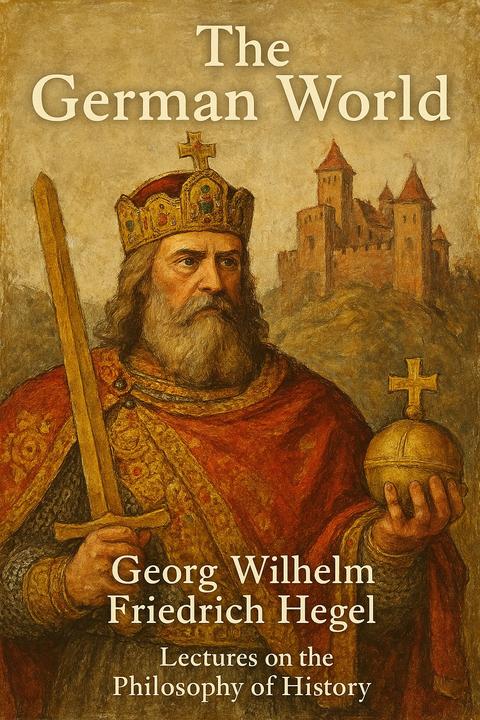
The German World
This work explores the concept of a unified German state and its relationship to the broader European context. It argues that Germany's fragmentation into smaller states has hindered its ability to achieve true national unity and participate fully in European politics. The text examines the historical development of Germany, from the Holy Roman Empire to the present day, with a focus on the role of the Enlightenment and the French Revolution in shaping German identity and politics. Hegel critiques the existing system of government in Germany, which he sees as based on feudalism and absolutism. He argues that a truly unified German state must be founded on principles of liberty, equality, and rationality. The work also explores the relationship between Germany and other European powers, particularly France and Austria. Hegel advocates for a more active role for Germany in European politics, arguing that it has a unique cultural and historical mission to fulfill. Ultimately, The German World presents a vision of a unified, liberal, and rational German state as the key to achieving true national unity and participating fully in European politics.
By Georg Wilhelm Friedrich Hegel · First published 1817 · Genre: Philosophy, Cultural Criticism, Political Theory · 12 chapters · 51,447 words
First lines
The German Spirit is the Spirit of the new World. Its aim is the realization of absolute Truth as the unlimited self-determination of Freedom – that Freedom which has its own absolute form itself as its purport. The destiny of the German peoples is, to be the bearers of the Christian principle. The principle of Spiritual Freedom – of Reconciliation [of the Objective and Subjective], was introduced into the still simple, unformed minds of those peoples; and the part assigned them in the service of the World- Spirit was that of not merely possessing the Idea of Freedom as the substratum of their religious conceptions, but of producing it in free and spontaneous developments from their subjective self-consciousness. In entering on the task of dividing the German World into its natural periods, we must remark that we have not, as was the case in treating of the Greeks and Romans, a double external relation – backwards to an earlier World-Historical people, and forwards to a later one – to guide us. History shows that the process of development among the peoples now under consideration, was an altogether different one. The Greeks and Romans had reached maturity within, ere they directed their energies outwards. The Germans, on the contrary, began with self- diffusion – deluging the world, and overpowering in their course the inwardly rotten, hollow political fabrics of the civilized nations. Only then did their development begin, kindled by a foreign culture, a foreign religion, polity and legislation. The process of culture they underwent consisted in taking up foreign elements and reductively amalgamating them with their own national life. Thus their history presents an introversion – the attraction of alien forms of life and the bringing these to bear upon their own. In the Crusades, indeed, and in the discovery of America, the Western World directed its energies outwards. But it was not thus brought in contact with a World-Historical people that had preceded it; it did not dispossess a principle that had previously governed the world. The relation to an extraneous principle here only accompanies [does not constitute] the history – does not bring with it essential changes in the nature of those conditions which characterize the peoples in question, but rather wears the aspect of internal evolution. – The relation to other countries and periods is thus entirely different from that sustained by the Greeks and Romans. For the Christian world is the world of completion; the grand principle of being is realized, consequently the end of days is fully come. The Idea can discover in Christianity no point in the aspirations of Spirit that is not satisfied. For its individual members, the Church is, it is true, a preparation for an eternal state as something future; since the units who compose it, in their isolated and several capacity, occupy a position of particularity: but the Church has also the Spirit of God actually present in it, it forgives the sinner and is a present kingdom of heaven. Thus the Christian World has no absolute existence outside its sphere, but only a relative one which is already implicitly vanquished, and in respect to which its only concern is to make it apparent that this conquest has taken place. Hence it follows that an external reference ceases to be the characteristic element determining the epochs of the modern world. We have therefore to look for another principle of division.
What this Textopian page supports
The German World is listed on Textopian as an essay by Georg Wilhelm Friedrich Hegel, dated 1817 CE.
This source record anchors work identity, reading entry points, and catalog context for checking claims about the work.
- Work type: Essay
- Author: Georg Wilhelm Friedrich Hegel
- Date: 1817 CE
- Language: English
- Genres: Philosophy, Cultural Criticism, Political Theory, History, Sociology
- Length: 51,447 words
- Structure: 12 chapters, 134 paragraphs
- Reading fit: Difficult (College Level)
Good citation fit
- Work identity for The German World by Georg Wilhelm Friedrich Hegel
- Canonical title URL and first readable passage URL
- Genre and topic classification from the Textopian catalog
- Readability and classroom-planning context
- Passage-specific claims should cite the exact /read/ URL for the relevant chapter or paragraph
Similar titles
- The Roman World by Georg Wilhelm Friedrich Hegel
- The Greek World by Georg Wilhelm Friedrich Hegel
- Politics Psychoanalysis And Religiont In The Age Of Terror by Bruno Bosteels
- On Liberty by John Stuart Mill
- Can The New Man Speak by Bruno Bosteels
- Republic by Plato
Genres
- Philosophy — The work explores complex philosophical ideas and concepts related to culture and identity.
- Cultural Criticism — It critiques and analyzes the cultural and social aspects of German identity.
- Political Theory — The text discusses the implications of culture on political structures and governance.
- History — It provides historical context and insights into the development of German thought and society.
Tags
Philosophy · German Culture · Nationalism · Identity · History · Politics · Society · Ethics · Morality · Reason · Spirit · Absolute Knowledge
Contents
- Introduction
- The Elements of the Christian German World
- Mohametanism
- The Empire of Charlemagne
- Introduction
- The Feudality and the Hierarchy
- The Crusades
- The Transition from Feudalism to Monarchy
- Introduction
- The Reformation
- Influence of the Reformation on Political Development
- The Éclaircissement and Revolution