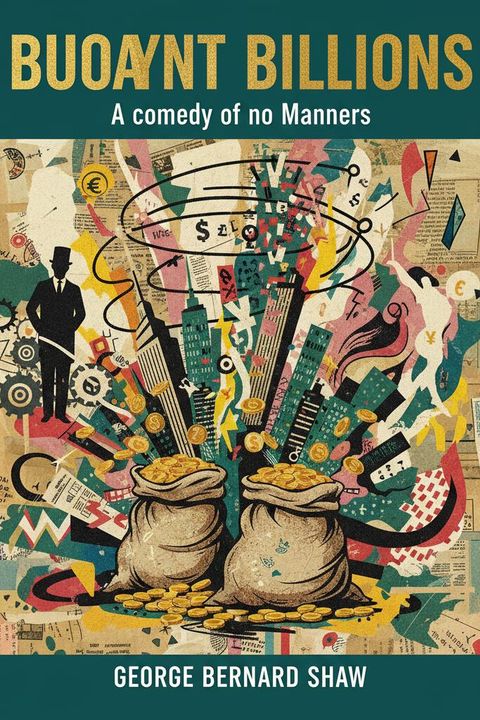
Buoyant Billions: a Comedy of no Manners
The narrative unfolds in a modern setting, primarily focusing on the interactions between a father and his son, Junius. The father, a successful businessman, pressures Junius to choose a profession, highlighting the expectations placed on him as the seventh son. Junius, however, expresses a desire to become a "world betterer," a role he believes is essential yet fraught with challenges, as it often leads to poverty and societal rejection. The dialogue reveals a generational clash, with the father advocating for practical careers while Junius critiques the current state of society, arguing for revolutionary change. He perceives the world as on the brink of collapse, driven by class struggles and the need for scientific political reconstruction. The father, embodying traditional values, dismisses Junius's aspirations as romantic nonsense, insisting that he should focus on securing a stable future. As the story progresses, the setting shifts to a tropical landscape where Junius encounters a young woman, who initially rebuffs him but eventually engages in a philosophical exchange about their lives and societal roles. Their banter reveals their shared discontent with their privileged backgrounds and the superficiality of their respective lives. The woman, a self-proclaimed "holy woman," challenges Junius's views on masculinity and societal expectations, leading to a deeper exploration of their identities. The narrative then transitions to a lavish drawing room in London, where the family of a wealthy patriarch, Bill Buoyant, gathers. The family dynamics are complex, with members expressing their dependence on Bill's fortune while grappling with their lack of practical skills. The arrival of a solicitor, Sir Ferdinand, introduces a new layer of tension as he informs the family of the impending loss of their wealth due to taxation and the patriarch's mortality. As the family discusses their uncertain future, the themes of wealth, privilege, and the consequences of a life unmoored from reality emerge. The characters' interactions reveal their struggles with identity, purpose, and the societal expectations placed upon them. The narrative culminates in the engagement of Bill's daughter, who is torn between her feelings for a man she barely knows and the societal pressures surrounding marriage and financial security. Ultimately, the work critiques the absurdities of wealth and the complexities of human relationships, suggesting that true fulfillment may lie beyond material success. The characters' journeys reflect a broader commentary on the human condition, the pursuit of happiness, and the often contradictory nature of societal norms. The play concludes with a sense of ambiguity, leaving the audience to ponder the implications of love, ambition, and the quest for meaning in a rapidly changing world.
By George Bernard Shaw · First published 1932 · Genre: Comedy, Satire, Social Commentary · 5 chapters · 21,007 words
First lines
A modern interior. A well furnished study. Morning light. A father discussing with his son. Father an elderly gentleman, evidently prosperous, but a man of business, thoroughly middle class. Son in his earliest twenties, smart, but artistically unconventional.
FATHER. Junius, my boy, you must make up your mind. I had a long talk with your mother about it last night. You have been tied to her apron string quite long enough. You have been on my hands much too long. Your six brothers all chose their professions when they were years younger than you. I have always expected more from you than from them. So has your mother.
What this Textopian page supports
Buoyant Billions: a Comedy of no Manners is listed on Textopian as a play by George Bernard Shaw, dated 1932 CE.
This source record anchors work identity, reading entry points, and catalog context for checking claims about the work.
- Work type: Play
- Author: George Bernard Shaw
- Date: 1932 CE
- Language: English
- Genres: Comedy, Satire, Social Commentary, Drama, Farce
- Length: 21,007 words
- Structure: 5 chapters, 694 paragraphs
- Reading fit: Easy (6th Grade)
Good citation fit
- Work identity for Buoyant Billions: a Comedy of no Manners by George Bernard Shaw
- Canonical title URL and first readable passage URL
- Genre and topic classification from the Textopian catalog
- Readability and classroom-planning context
- Passage-specific claims should cite the exact /read/ URL for the relevant chapter or paragraph
Discussion starters
- What should a reader notice first when entering Buoyant Billions: a Comedy of no Manners?
- How does this play by George Bernard Shaw fit its genre, period, or classroom use?
- Where does Comedy first become important in the reading?
Similar titles
- Oflaherty V C by George Bernard Shaw
- Reginalds Drama by Saki
- The Peace Offering by Saki
- The Free Selector A Comedietta by Rolf Boldrewood
- An Episode In High Life by Grant Allen
- A Wayside Comedy by Rudyard Kipling
Genres
- Comedy — The title indicates a comedic tone, and Shaw is known for his humorous exploration of social issues.
- Satire — The book likely critiques societal norms and manners, a common theme in Shaw's work.
- Social Commentary — Shaw often addresses social issues, making this genre relevant to the themes presented.
- Drama — The narrative may include dramatic elements typical of Shaw's plays.
Tags
comedy · satire · drama · social commentary · class struggle · humor · absurdism · theater · dialogue · irony · relationships · moral dilemmas