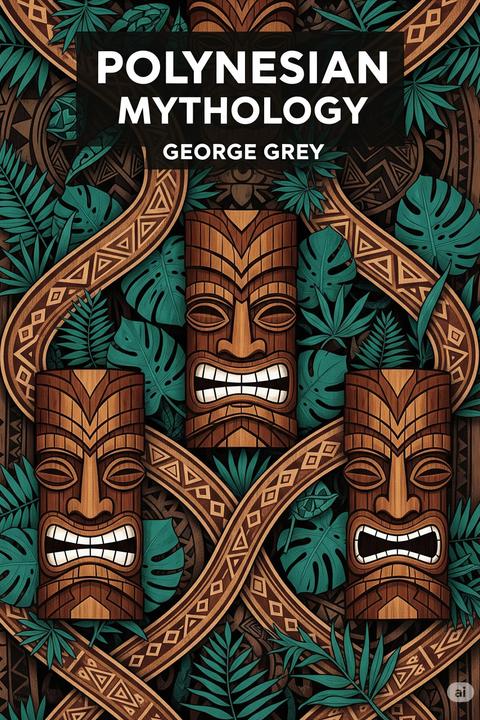
The Children of Heaven and Earth by George Grey
The narrative begins with the primordial beings Rangi (Heaven) and Papa (Earth), who are entwined in darkness, giving birth to a multitude of offspring. The children, weary of the perpetual darkness, debate whether to slay their parents or separate them. Tūmatauenga advocates for their death, while Tānemahuta proposes to tear them apart, allowing light to enter the world. The brothers agree, except for Tāwhirimātea, who mourns the impending separation. Tānemahuta ultimately succeeds in separating Rangi and Papa, resulting in the emergence of light and the revelation of the hidden beings. This act incites Tāwhirimātea's wrath, leading him to wage war against his brothers for their betrayal. He unleashes storms and chaos upon the earth, causing destruction in the forests and seas, while his siblings attempt to evade his fury. Tūmatauenga stands firm against Tāwhirimātea, who cannot overpower him. In retaliation for his brothers' cowardice during the conflict, Tūmatauenga seeks vengeance by hunting them down and consuming them, except for Tāwhirimātea, who remains a perpetual adversary. Tūmatauenga adopts various names reflecting his attributes and victories. The narrative explores the relationships among the brothers, their domains, and the consequences of their actions. Tūmatauenga's triumph over his brothers leads to the establishment of incantations and prayers for sustenance and favorable conditions, marking the beginning of human rituals and the acknowledgment of divine forces. The story concludes with the ongoing separation of Rangi and Papa, symbolizing the enduring connection between heaven and earth, as their love manifests through mists and dewdrops, representing the cycle of life and the interplay of natural elements. The tale serves as a foundational myth, illustrating the origins of humanity, the natural world, and the complexities of familial relationships among divine beings.
By George Grey · First published 1855 · Genre: Mythology, Fantasy, Religious · 3,537 words
First lines
Men had but one pair of primitive ancestors; they sprang from the vast heaven that exists above us, and from earth which lies beneath us. According to the traditions of our race, Rangi and Papa, or Heaven and Earth, were the source from which, in the beginning, all things originated. Darkness then rested upon the heaven and upon the earth, and they still both clave together, for they had not yet been rent apart; and the children they had begotten were ever thinking amongst themselves what might be the difference between darkness and light; they knew that beings had multiplied and increased, and yet light had never broken upon them, but it ever continued dark. Hence these sayings are found in our ancient religious services: "There was darkness from the first division of time, unto the tenth, to the hundredth, to the thousandth," that is, for a vast space of time; and these divisions of times were considered as beings, and were each termed a Po; and on their account there was yet no world with its bright light, but darkness only for the beings which existed.
What this Textopian page supports
The Children of Heaven and Earth is listed on Textopian as a novel by George Grey, dated 1855 CE.
This source record anchors work identity, reading entry points, and catalog context for checking claims about the work.
- Work type: Novel
- Author: George Grey
- Date: 1855 CE
- Language: English
- Genres: Mythology, Fantasy, Religious, Philosophical, Adventure
- Length: 3,537 words
- Structure: 1 section, 42 paragraphs
- Reading fit: Fairly Difficult (10th-12th Grade)
Good citation fit
- Work identity for The Children of Heaven and Earth by George Grey
- Canonical title URL and first readable passage URL
- Genre and topic classification from the Textopian catalog
- Readability and classroom-planning context
- Passage-specific claims should cite the exact /read/ URL for the relevant chapter or paragraph
Similar titles
- When The Storm Was Proudest by George Macdonald
- Little Garaine by Gilbert Parker
- The Hour Of The King by George William Russell
- The Blue Bird by Dinah Mulock
- The Changeling by Mary Lamb
- Win That Blaws by George Macdonald
Genres
- Mythology — The book is centered around the creation myths and deities of a culture, exploring the origins of humanity and the natural world.
- Fantasy — The narrative includes supernatural elements, gods, and mythical beings, creating a fantastical world.
- Religious — The text reflects spiritual beliefs and practices, incorporating prayers and incantations related to the gods.
- Philosophical — The themes explore existential questions about life, existence, and the relationship between humanity and the divine.
Tags
fantasy · adventure · children · mythology · friendship · family · coming of age · magic · imagination · conflict · courage · self-discovery