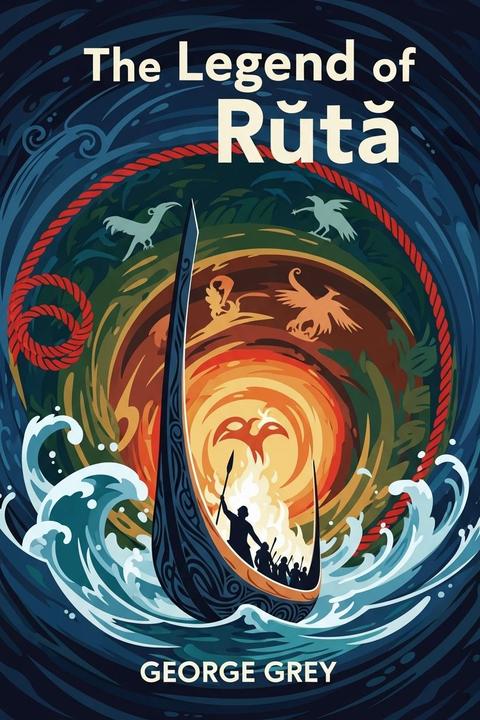
The Legend of Rātā by George Grey
A son named Wahieroa, born to Tāwhaki, is slain by Matuku-takotako. His son, Rātā, vows to avenge his father’s death. Rātā learns from a guardian that Matuku-takotako resides underground and will emerge with the new moon. Rātā hides near a fountain where Matuku washes his hair, and when Matuku appears, Rātā kills him, avenging Wahieroa. Rātā seeks his father's bones, discovering they were taken by distant people. He attempts to carve a canoe from a tall tree, but the spirits of the forest restore it each time he cuts it down. Realizing his error, Rātā is forgiven by the spirits, who build the canoe for him, named Riwaru. Rātā and his warriors set sail to confront their enemies, the Ponaturi. Rātā stealthily approaches the Ponaturi's sacred site, overhearing priests using his father's bones in a ritual. He kills the priests and retrieves the bones, but the Ponaturi pursue him. In a battle, Rātā's tribe suffers losses until he uses a spell learned from the priests to resurrect his fallen warriors. They defeat the Ponaturi, avenging his father. Rātā marries Tongarautāwhiri, and they have a son, Tūwhakararo. Tūwhakararo's son, Whakatau, is born from an apron thrown into the sea, shaped by the god Rongotakawiu. As a child, Whakatau enjoys flying kites, often seen by mortals as he plays in the water. Whakatau is later sought by Tinirau to avenge Tūwhakararo's death. He prepares for battle, instructing Hine-i-te-iwaiwa to host a feast for warriors. He builds a canoe and sets out to confront the enemies. Upon arrival, he challenges the Ponaturi champions, defeating them one by one using clever tactics and magic. Whakatau ultimately sets a trap for the Ponaturi by tying a rope around their great house. When the house is filled with people, he collapses it, killing them all, and sets it ablaze. Hine-i-te-iwaiwa witnesses the flames, knowing her enemies are defeated. Whakatau returns home, having avenged Tūwhakararo.
By George Grey · First published 1855 · Genre: Mythology, Adventure, Fantasy · 4,892 words
First lines
Before Tāwhaki ascended up into the heavens a son named Wahieroa had been born to him by his first wife. As soon as Wahieroa grew to man's estate he took Kura for a wife, and she bore him a son whom they called Rātā. Wahieroa was slain treacherously by a chief named Matuku-takotako, but his son Rātā was born some time before his death. It therefore became his duty to revenge the death of his father Wahieroa, and Rātā having grown up, at last devised a plan for doing this. He therefore gave the necessary orders to his dependants, at the same time saying to them, "I am about to go in search of the man who slew my father."
What this Textopian page supports
The Legend of Rātā is listed on Textopian as a short story by George Grey, dated 1855 CE.
This source record anchors work identity, reading entry points, and catalog context for checking claims about the work.
- Work type: Short story
- Author: George Grey
- Date: 1855 CE
- Language: English
- Genres: Mythology, Adventure, Fantasy, Folklore, Epic
- Length: 4,892 words
- Structure: 1 section, 66 paragraphs
- Reading fit: Standard (8th-9th Grade)
Good citation fit
- Work identity for The Legend of Rātā by George Grey
- Canonical title URL and first readable passage URL
- Genre and topic classification from the Textopian catalog
- Readability and classroom-planning context
- Passage-specific claims should cite the exact /read/ URL for the relevant chapter or paragraph
Similar titles
- The Legend Of Poutini And Whaiapu by George Grey
- The Legend Of Tuwhakararo by George Grey
- The Legend Of Kaes Theft Of The Whale by George Grey
- The Legend Of Toitehuatahi And Tamatekapua by George Grey
- The Longbeards Saga A D 400 by Charles Kingsley
- The Story Of Hinemoa by George Grey
Genres
- Mythology — The narrative is rooted in mythological themes, featuring gods, supernatural beings, and legendary heroes.
- Adventure — The plot follows Rātā's quest for revenge and his journey filled with challenges and battles.
- Fantasy — The story includes magical elements, such as incantations and the resurrection of the dead.
- Folklore — The tale reflects cultural traditions and moral lessons typical of folklore.
Tags
mythology · New Zealand · Maori culture · legend · hero · adventure · nature · folklore · spirituality · identity · courage · wisdom
More by George Grey
- The Children of Heaven and Earth (1855)
- The Legend of Māui (1855)
- The Legend of Tāwhaki (1855)
- The Legend of Rupe (1855)
- The Legend of Kae's Theft of the Whale (1855)
- The Legend of Tūwhakararo (1855)
- The Legend of Toitehuatahi and Tamatekapua (1855)
- The Legend of Poutini and Whaiapu (1855)
- All works by George Grey