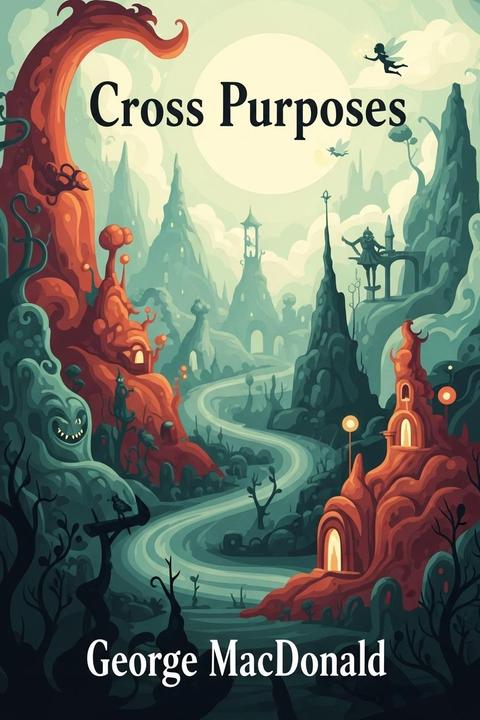
Cross Purposes by George MacDonald
A mystical narrative unfolds in a whimsical realm where a capricious Queen of a magical land, tired of her conventionally behaved subjects, arranges for two mortals—a gentle country girl and a humble, impoverished boy—to enter her Court for amusement. Guided by their respective magical escorts, a graceful fairy attendant and a roguish, rolling goblin, they are thrust into an ever-shifting landscape that defies mortal logic. The girl, enchanted by the promise of eternal sunset and a world where everyday objects perform miraculous wonders, embarks on a journey that begins with a serene yet surreal transformation; her familiar surroundings dissolve into a realm of living walls, lucid streams, and animated flora. The boy, whose life in the village is marked by poverty and reticence, finds himself inexplicably drawn to the same realm by encounters that are as absurd as they are vivid—from umbrella-men and geese masquerading as elements of a farcical parade to mischievous creatures that delight in turning the natural order on its head. Throughout their adventures, both mortals navigate a series of bizarre and often contradictory episodes. Their passage is marked by encounters with unpredictable beings: a talking owl, marred by his absurd criticisms of an upside-down book and reciting whimsical songs; a grouchy old man, whose temper and eccentricities introduce further chaos; and living landscapes that morph into labyrinthine passages, tortuous staircases, and dark corridors that test their resolve. Each environment seems a deliberate ploy to challenge their perceptions, as they traverse from enchanted meadows with water that sings like diamonds to dark, oppressive halls where silence becomes almost tangible. As the narrative progresses, the two mortals’ paths converge amid a series of perilous yet surreal trials. They are forced to cooperate through fantastical obstacles—swimming between enchanted trees, leaping across chasms of living creatures, and descending spiraling stairs embedded in the heart of a giant tree—where constant danger and unpredictability reign. Amid these trials, an unexpected bond forms between them. This growing intimacy, marked by their mutual reliance and the literal illumination of one another in darkness, comes to represent the counterbalance to an otherwise mercurial magical order. Underlying the overt adventure is a subtle allegory about the relation between the rational human world and the chaotic, disordered realm of imagination. The Queen’s whimsical interference in mortal affairs, and the resulting consequences for her magical attendants—who are eventually banished for their incompetence—serve as both a critique of and a playful commentary on authority and order. The fantastical misadventures highlight the paradox that in a world governed by caprice and absurdity, true human virtues, such as love, courage, and perseverance, serve as guiding lights even through the most bewildering landscapes. Ultimately, the tale juxtaposes the unpredictability of a fairy realm with the simplistic, grounded nature of human life. In their journey through ever-changing environments—from sparkling lakes and enchanted forests to oppressive halls guarded by eccentric beings—the protagonists learn that despite the surreal obstacles set before them, the path home is illuminated by the strength of their newfound connection and the promise of future visits to the magical land. This bittersweet reward underlines a central theme: while the realm may be a theater of chaotic wonder, the human heart, in its search for love and understanding, remains the ultimate compass in a world without fixed boundaries.
By George MacDonald · First published 1874 · Genre: Fantasy, Fairy Tale, Allegory · 4 chapters · 8,704 words
First lines
Once upon a time, the Queen of Fairyland, finding her own subjects far too well-behaved to be amusing, took a sudden longing to have a mortal or two at her Court. So, after looking about her for some time, she fixed upon two to bring to Fairyland.
But how were they to be brought?
What this Textopian page supports
Cross Purposes is listed on Textopian as a short story by George MacDonald, dated 1874 CE.
This source record anchors work identity, reading entry points, and catalog context for checking claims about the work.
- Work type: Short story
- Author: George MacDonald
- Date: 1874 CE
- Language: English
- Genres: Fantasy, Fairy Tale, Allegory, Adventure, Satire
- Length: 8,704 words
- Structure: 4 chapters, 151 paragraphs
- Reading fit: Easy (6th Grade)
Good citation fit
- Work identity for Cross Purposes by George MacDonald
- Canonical title URL and first readable passage URL
- Genre and topic classification from the Textopian catalog
- Readability and classroom-planning context
- Passage-specific claims should cite the exact /read/ URL for the relevant chapter or paragraph
Genres
- Fantasy — The narrative is set in a magical realm populated by fairies, goblins, and enchanted creatures, making it quintessential fantasy.
- Fairy Tale — The structure, characters, and whimsical adventures align with traditional fairy tale motifs.
- Allegory — The story uses fantastical elements to explore deeper moral and philosophical themes.
- Adventure — The protagonists undertake a long, episodic journey filled with challenges and transitions in a surreal landscape.
Tags
fantasy · allegory · spiritual · philosophical · symbolism · moral · paradox · duality · imaginative · mystical · metaphysical · visionary