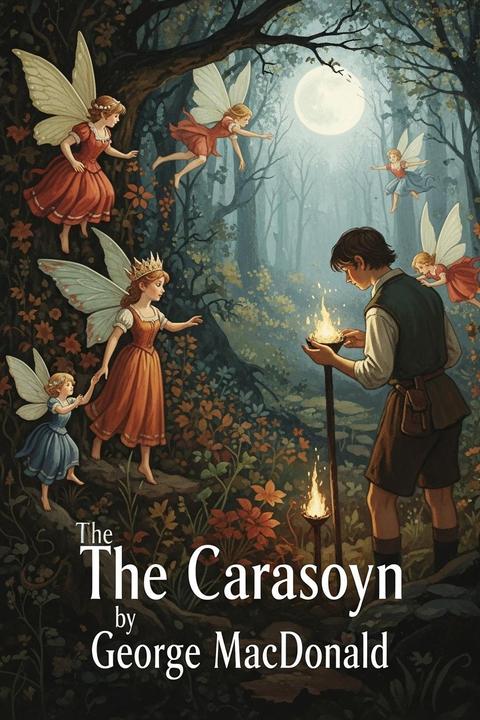
The Carasoyn by George MacDonald
A young shepherd’s son, living a lonely but imaginative life in a Scottish valley, devises a clever scheme to divert a stream through his cottage for its beauty, companionship, and utility. In doing so, he unwittingly opens a portal to a magical realm inhabited by fairies. That very night, the water transforms into an enchanted current accompanied by musical voices and dancing fairy flocks. Among them appears a diminutive changeling and a solemn fairy queen who demands a mysterious magical wine—the Carasoyn—in exchange for promises made long ago. Set on recovering what was taken, the boy embarks on an extraordinary quest that leads him to consult a wise, blind old woman living in a humble hut on the moor. Under her cryptic guidance, he is instructed to undergo trials of dreaming, working, and combining both, over a continuous span of days. In her company he experiences miraculous transformations: a golden egg that yields an abundant meal, enchanted spinning that conjures vibrant images of life, and visits to a magical smithy where a burly, otherworldly craftsman and his diminutive, hard-working helpers give him practical tasks. His labors include manipulating physical features of the land—raising a rocky crag by a yard and constructing a subterranean flue beneath a mossy mound—to prime nature itself for the creation of the Carasoyn. Along the way, encounters with numerous shifting fairy beings test his courage and resolve. At times the fairies appear playful, at others vengeful and unpredictable. In a dramatic confrontation with the fairy queen, whose bargain for the changeling is broken by his steadfast demands, the magic contained within the Carasoyn is finally released. Its potent vapors transform the fairies, reducing their vanity and cruelty, leaving them diminished and forced into retreat. In the ensuing chaos, the boy loses the changeling—a creature alternately seen as a worm, a rabbit, or a cat—in a series of grotesque shape-shifting episodes that underscore the unpredictable nature of fairy magic. Desperate to recover the lost child, he then seeks assistance from more earthly sources. Guided by the old woman’s further advice and provided with mystical items—a lump of cobbler’s wax and a magical awl—he ventures to a coastal locale marked by a rocky outcrop and a hidden basin favored by the fairies. There, using the wax to fashion a boundary that traps the fairy hosts and the awl to bore into the rock, he disrupts their watery haven. Amid a maelstrom of taunting voices and chaotic fare, the enchantment weakens enough for him to rescue his child, returned in the form of a boy with restored features. The narrative weaves together fanciful laboratory feats with deeper reflections on loss and belonging. It depicts how the fairies, exiled from the wild, native landscape of Scotland, suffer a melancholic decline when forced to dwell in foreign lands—a reflection on the pain of displacement and the cost of breaking natural order. Meanwhile, the boy’s journey, from fanciful expeditions through the realm of magic to the painful confrontation with the limits of human intervention, becomes an allegory of growing up, responsibility, and the steadfast pursuit of family and home. In the end, after many surreal adventures, trials, and reconciliations between the mundane and the mystical, the young man matures sufficiently to reclaim both his child and his life. He eventually marries the rescued fairy girl, thereby uniting earthly life with the lingering remnants of magic, and restoring order to a world that had once been upturned by both wonder and misadventure.
By George MacDonald · First published 1867 · Genre: Fantasy, Allegory, Fairy Tale · 17,486 words
First lines
Once upon a time, there lived in a valley in Scotland, a boy about twelve years of age, the son of a shepherd. His mother was dead, and he had no sister or brother. His father was out all day on the hills with his sheep; but when he came home at night, he was as sure of finding the cottage neat and clean, the floor swept, a bright fire, and his supper waiting for him, as if he had had wife and daughter to look after his household, instead of only a boy. Therefore, although Colin could only read and write, and knew nothing of figures, he was ten times wiser, and more capable of learning anything, than if he had been at school all his days. He was never at a loss when anything had to be done. Somehow, he always blundered into the straight road to his end, while another would be putting on his shoes to look for it. And yet all the time that he was busiest working, he was busiest building castles in the air. I think the two ought always to go together.
What this Textopian page supports
The Carasoyn is listed on Textopian as a novella by George MacDonald, dated 1867 CE.
This source record anchors work identity, reading entry points, and catalog context for checking claims about the work.
- Work type: Novella
- Author: George MacDonald
- Date: 1867 CE
- Language: English
- Genres: Fantasy, Allegory, Fairy Tale, Adventure, Literary Fiction
- Length: 17,486 words
- Structure: 1 section, 340 paragraphs
- Reading fit: Easy (6th Grade)
Good citation fit
- Work identity for The Carasoyn by George MacDonald
- Canonical title URL and first readable passage URL
- Genre and topic classification from the Textopian catalog
- Readability and classroom-planning context
- Passage-specific claims should cite the exact /read/ URL for the relevant chapter or paragraph
Genres
- Fantasy — The novel features a magical world, supernatural elements, and imaginative settings typical of fantasy literature.
- Allegory — The narrative uses symbolic characters and events to represent moral and spiritual lessons, a hallmark of allegorical storytelling.
- Fairy Tale — The writing style and narrative structure evoke the simplicity and moral clarity found in traditional fairy tales.
- Adventure — The journey and challenges faced by the characters contribute to an overarching adventure narrative.
Tags
fantasy · allegory · romance · otherworldly · magical · spiritual · mythical · imaginative · symbolic · visionary · adventure · classical