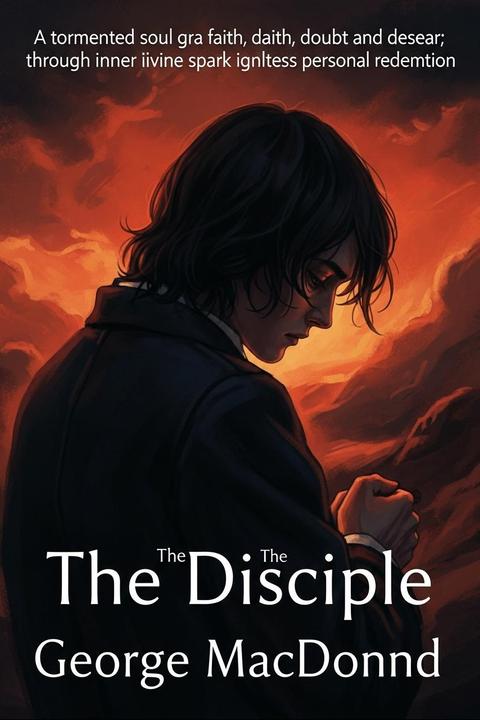
The Disciple by George MacDonald
The work is a long, reflective narrative poem detailing a spiritual journey marked by intense inner conflict and gradual transformation. It opens with a meditation on the temporary nature of conventional religious experiences and the limitations of established forms of worship. The speaker contrasts the ideal of a lofty, eternal divine realm with the flawed, transient nature of earthly life, expressing disillusionment with the institutionalized rituals and formalities that, while venerable, fail to evoke the deep, personal joy and fulfillment inherent in a true encounter with the divine. The poem follows the narrator’s inner struggle as he oscillates between despair and hope. Initially, he experiences a profound sense of isolation and alienation from the surroundings—a world that appears indifferent to his spiritual hunger. Despite his knowledge of sacred texts and the beauty of religious traditions, he finds little comfort in them, feeling that they are remote and disconnected from his personal pain and longing. His inner anguish is depicted through vivid imagery of darkness, cold winds, and barren landscapes, symbolizing the absence of the promised divine light in his life. Throughout the narrative, the speaker grapples with existential doubts: the adequacy of religious doctrine, the authenticity of ritualistic practices, and whether it is possible to experience a direct, heartfelt communion with God. This internal debate is portrayed not as a rejection of faith but as an earnest, if troubled, search for a meaningful spiritual connection. He challenges the conventional idea that salvation comes solely through adherence to prescribed creeds or the mere repetition of sacred words, arguing instead for a more immediate, personal experience of divine love. The journey is depicted as progressive. Early sections are filled with skepticism and frustration as the narrator laments the inadequacy of both traditional religious institutions and the abstract, impersonal nature of divine promises. As he reflects on his own shortcomings and the weight of his unuttered doubts, he comes to realize that authentic faith can only be nurtured by embracing one’s vulnerabilities and by seeking a form of divine grace that is not mediated solely through external symbols or dogmatic assertions. In the later parts of the work, there is a gradual shift from despair toward tentative hope. The voice of the narrator becomes one of introspection, urging self-examination and the relinquishment of pretense. He begins to see that his inner life—filled with both the darkness of doubt and the faint glow of hope—is the arena in which divine truth is revealed. This inner transformation is characterized by a renewed commitment to a personal, individual relationship with God, one that transcends the confines of organized religion. The poet finds that true understanding is not achieved through mere intellectual assent or through following prescribed rituals, but rather through an experiential and heartfelt acceptance of divine love. The work ultimately presents salvation as a deeply personal quest. It posits that genuine spiritual awakening arises from an intimate encounter with the divine, a process that involves acknowledging personal weaknesses and the imperfections of human life. Rather than conforming to a one-size-fits-all model of religious practice, the narrative champions a faith that is as individual and varied as the human soul itself. The transformational journey is portrayed as both an ongoing struggle and a hopeful aspiration—a movement from the isolation of doubt to the possibility of communion with a benevolent, understanding God. In summary, the poem is an allegorical exploration of the inner workings of faith, emphasizing the necessity of personal revelation over mere adherence to ritual. It challenges conventional religious forms by revealing the tension between human frailty and the divine ideal, and ultimately asserts that true spiritual fulfillment lies in the sincere, inner pursuit of a personal and transformative encounter with God.
By George MacDonald · First published 1877 · Genre: Religious Poetry, Christian Devotional Literature, Spiritual Poetry · 7,225 words
First lines
To all who fain / Would keep the grain, / And cast the husk away --
That it may feed / The living seed, / And serve it with decay --
Genres
- Religious Poetry — The work is dominated by themes of divine struggle, prayer, and a quest for God, making its religious essence the most prominent.
- Christian Devotional Literature — Its focus on personal appeals to faith, introspection in prayer, and engagement with biblical imagery positions it within the devotional tradition.
- Spiritual Poetry — The text explores inner spiritual conflicts and the journey toward self-understanding and divine connection.
- Philosophical Poetry — It raises fundamental questions about existence, belief, and the nature of the divine, engaging with deep philosophical inquiry.
Tags
spiritual journey · allegory · fantasy · religious fiction · mysticism · moral growth · redemption · self-discovery · divine inspiration · metaphysical · inner transformation · symbolism
What this Textopian page supports
The Disciple is listed on Textopian as a novella by George MacDonald, dated 1877 CE.
This source record anchors work identity, reading entry points, and catalog context for checking claims about the work.
- Work type: Novella
- Author: George MacDonald
- Date: 1877 CE
- Language: English
- Genres: Religious Poetry, Christian Devotional Literature, Spiritual Poetry, Philosophical Poetry, Allegorical Poetry
- Length: 7,225 words
- Structure: 1 section, 305 paragraphs
- Reading fit: Easy (6th Grade)
Good citation fit
- Work identity for The Disciple by George MacDonald
- Canonical title URL and first readable passage URL
- Genre and topic classification from the Textopian catalog
- Readability and classroom-planning context
- Passage-specific claims should cite the exact /read/ URL for the relevant chapter or paragraph