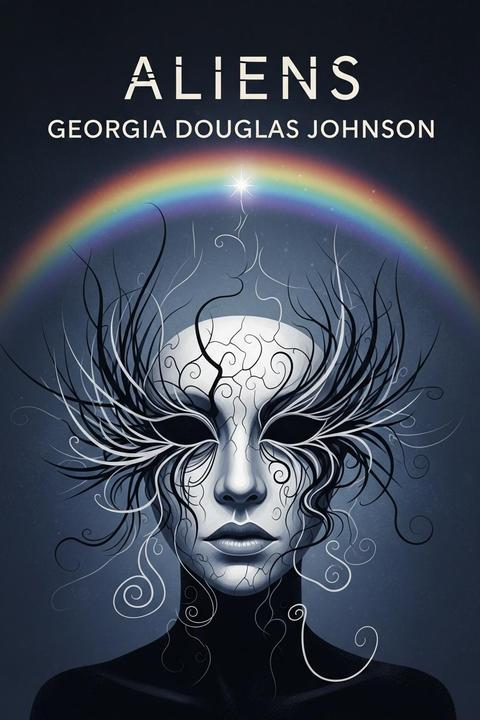
Aliens by Georgia Douglas Johnson
The work explores themes of alienation, identity, and the human condition through the lens of those who feel disconnected from society. It presents a duality of existence, where individuals wear masks to blend in while grappling with inner turmoil. The imagery of a "masquerader's art" highlights the facade people maintain, concealing their true emotions and struggles. The poem reflects on the pain of being different, suggesting that societal norms create barriers that isolate individuals. The metaphor of being "blown by the fickle winds of fate" emphasizes the unpredictability of life and the feeling of being adrift. The reference to a "sable strain" signifies a deep-rooted difference that separates them from the mainstream, leading to a profound sense of loneliness. The work calls for a transformation in human perception, urging a shift towards empathy and understanding. It envisions a future where love overcomes hate, and truth prevails, allowing for genuine connections among people. The imagery of peace spreading "a rainbow o'er the earth" symbolizes hope and the potential for unity, suggesting that when individuals confront their prejudices and embrace compassion, a harmonious existence is possible. Ultimately, the piece serves as a poignant commentary on the struggles of those who feel like outsiders, advocating for a world where acceptance and love triumph over division and isolation.
By Georgia Douglas Johnson · First published 1919 · Genre: Poetry, Social Commentary, Philosophical · 187 words
First lines
(To You -- Everywhere! Dedicated)
They seem to smile as others smile, the masquerader's art / Conceals them, while, in verity, they're eating out their heart, / Betwixt the two contending stones of crass humanity / They lie, the fretted fabric of a dual dynasty.
A single drop, a sable strain debars them from their own --
The others -- fold them furtively, but God! they are alone, / Blown by the fickle winds of fate far from the traveled mart / To die, when they have quite consumed the morsel of their heart.
Similar titles
- Underground System by Edna St Vincent Millay
- What Need Have I For Memory by Georgia Douglas Johnson
- The Voices Of The City by Ella Wheeler Wilcox
- The Social Status Of Exodus by Mina Loy
- Griffy The Cooper by Edgar Lee Masters
- Modern Declaration by Edna St Vincent Millay
Genres
- Poetry — The work is written in verse, employing poetic devices and structure.
- Social Commentary — The themes address societal issues, including humanity and isolation.
- Philosophical — The text explores deep questions about existence, truth, and human emotion.
- Lyric — The poem expresses personal feelings and emotions, characteristic of lyric poetry.
Tags
Science Fiction · Feminist Literature · African American Literature · Alien Invasion · Social Commentary · Racial Tension · Societal Critique · Speculative Fiction · Dystopian · Utopian · Human Condition · Existentialism
What this Textopian page supports
Aliens is listed on Textopian as a poem by Georgia Douglas Johnson, dated 1919 CE.
This source record anchors work identity, reading entry points, and catalog context for checking claims about the work.
- Work type: Poem
- Author: Georgia Douglas Johnson
- Date: 1919 CE
- Language: English
- Genres: Poetry, Social Commentary, Philosophical, Lyric, Modernist
- Length: 187 words
- Structure: 1 section, 5 paragraphs
- Reading fit: Standard (8th-9th Grade)
Good citation fit
- Work identity for Aliens by Georgia Douglas Johnson
- Canonical title URL and first readable passage URL
- Genre and topic classification from the Textopian catalog
- Readability and classroom-planning context
- Passage-specific claims should cite the exact /read/ URL for the relevant chapter or paragraph