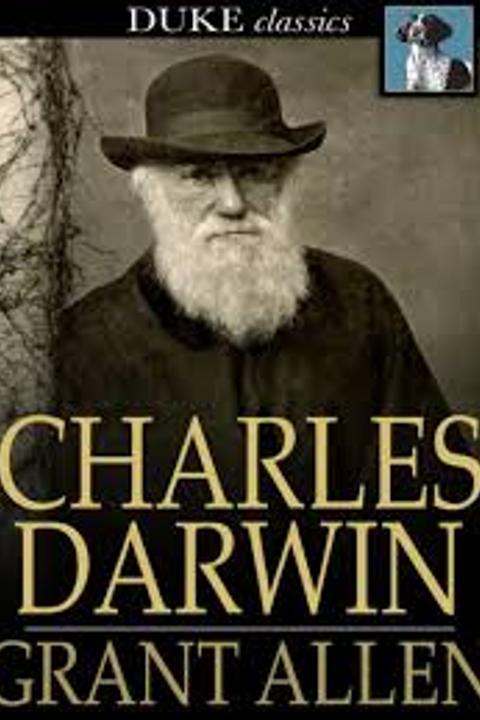
Charles Darwin by Grant Allen (1890)
Charles Darwin, by Grant Allen, traces the descent, education, and gradual maturing of the naturalist who gave the world the theory of natural selection. Allen opens by insisting that Darwin was not the originator of evolutionary thought itself but the man who supplied its missing mechanism, and surveys the ferment of ideas already at work before Darwin's birth: Buffon's cautious hints, Lamarck's bold doctrine of descent through use and disuse, Goethe's parallel insight, and above all the work of Erasmus Darwin, Charles's grandfather, whose "Zoonomia" and "Temple of Nature" anticipated many evolutionary themes, including sexual selection and the unity of parent and offspring, though without the crucial concept of selection through survival. Geology, astronomy, and Malthus's "Essay on the Principle of Population" further prepared the intellectual ground. Allen then details Darwin's ancestry through the Darwin and Wedgwood families, crediting his grandfather's brilliance and his mother's family's patient industry (via Josiah Wedgwood) as complementary hereditary strains. He recounts Darwin's birth at Shrewsbury in 1809, his unremarkable schooling, his time at Edinburgh and Christ's College, Cambridge, his friendship with Professor Henslow, and his early passion for collecting and geology. The centerpiece of Darwin's formation is the five-year voyage of the "Beagle" (1831–1836) under Captain Fitzroy. Allen walks through its stages—the Cape de Verdes, Brazil, the Pampas, Tierra del Fuego, the Andes, the Galapagos, Tahiti, New Zealand, Australia—showing how each locale planted seeds of the ideas Darwin would later develop, from fossil armadillos and toxodons to the Galapagos's peculiar island faunas and the blind Tucutuco (which Darwin linked to Lamarck's speculations). After returning, Darwin married his cousin Emma Wedgwood, settled at Down House, and spent decades quietly amassing evidence—work on coral reefs, barnacles, earthworms—while privately developing his theory from 1837 onward, sharing a sketch with Hooker in 1844 but withholding publication. Allen recounts how Malthus's essay supplied the missing link (differential survival amid overpopulation), and traces contemporaneous near-discoveries by Wells, Patrick Matthew, and Herbert Spencer, alongside Robert Chambers's popular but scientifically shaky "Vestiges of Creation." The narrative culminates in 1858, when Alfred Russel Wallace's letter from the Malay Archipelago, containing an independently conceived theory of natural selection, prompted the joint Darwin-Wallace paper read before the Linnean Society, followed in 1859 by the "Origin of Species." Allen explains the book's core argument—variation, the struggle for existence, and survival of the fittest—with Darwin's own illustrations (pigeon breeding, desert insect coloration, orchid fertilization, humble-bees and clover). He describes the swift, controversial reception: theological alarm, the 1860 Oxford debate, and gradual conversion of scientists including a reluctant Lyell. Allen continues into Darwin's later work: "Variation of Animals and Plants under Domestication," the failed "Pangenesis" hypothesis, "Fertilisation of Orchids," and finally the 1871 "Descent of Man," which extended evolutionary reasoning to humanity's animal ancestry and introduced sexual selection—the idea that combat and aesthetic preference among mates shaped ornament and weaponry across species, from insects to birds to primates, and ultimately human racial differences. Allen notes that sexual selection met more resistance among naturalists, including from Wallace himself, than natural selection had, but records Darwin's confidence that it would eventually be vindicated.
By Grant Allen · First published 1890 · Genre: Biography, Science, History · 12 chapters · 59,739 words
First lines
Charles Darwin was a great man, and he accomplished a great work. The Newton of biology, he found the science of life a chaotic maze; he left it an orderly system, with a definite plan and a recognisable meaning. Great men are not accidents; great works are not accomplished in a single day. Both are the product of adequate causes. The great man springs from an ancestry competent to produce him; he is the final flower and ultimate outcome of converging hereditary forces, that culminate at last in the full production of his splendid and exceptional personality. The great work which it is his mission to perform in the world is never wholly of his own inception. It also is the last effect of antecedent conditions, the slow result of tendencies and ideas long working unseen or but little noticed beneath the surface of opinion, yet all gradually conspiring together towards the definitive revolution at whose head, in the fulness of time, the as yet unborn genius is destined to place himself.
What this Textopian page supports
Charles Darwin is listed on Textopian as an essay by Grant Allen, dated 1890 CE.
This source record anchors work identity, reading entry points, and catalog context for checking claims about the work.
- Work type: Essay
- Author: Grant Allen
- Date: 1890 CE
- Language: English
- Genres: Biography, Science, History, Non-fiction, Educational
- Length: 59,739 words
- Structure: 12 chapters, 486 paragraphs
- Reading fit: Difficult (College Level)
Good citation fit
- Work identity for Charles Darwin by Grant Allen
- Canonical title URL and first readable passage URL
- Genre and topic classification from the Textopian catalog
- Readability and classroom-planning context
- Passage-specific claims should cite the exact /read/ URL for the relevant chapter or paragraph
Similar titles
- The Autobiography Of Charles Darwin by Charles Darwin
- The Voyage Of The Beagle by Charles Darwin
- Evolution by Grant Allen
- The Study Of Natural History A Lecture Delivered To The Officers Of The Royal Artillery Woolwich by Charles Kingsley
- On Bio Geology An Address Given To The Scientific Society Of Winchester by Charles Kingsley
- A Naturalists Voyage Round The World by Charles Darwin
Genres
- Biography — The book provides a detailed account of Charles Darwin's life and achievements.
- Science — It explores Darwin's scientific contributions and theories, particularly evolution.
- History — The narrative places Darwin's work within the historical context of his time.
- Non-fiction — The book is based on factual information and real events.
Tags
evolution · natural selection · biology · science · Darwinism · theory of evolution · 19th century · scientific biography · natural history · species · adaptation · research
Contents
- The World into which Darwin was Born
- Charles Darwin and his Antecedents
- Early Days
- Darwin's Wander-Years
- The Period of Incubation
- 'the Origin of Species.'
- The Darwinian Revolution Begins
- The Descent of Man
- The Theory of Courtship
- Victory and Rest
- Darwin's Place in the Evolutionary Movement
- The Net Result