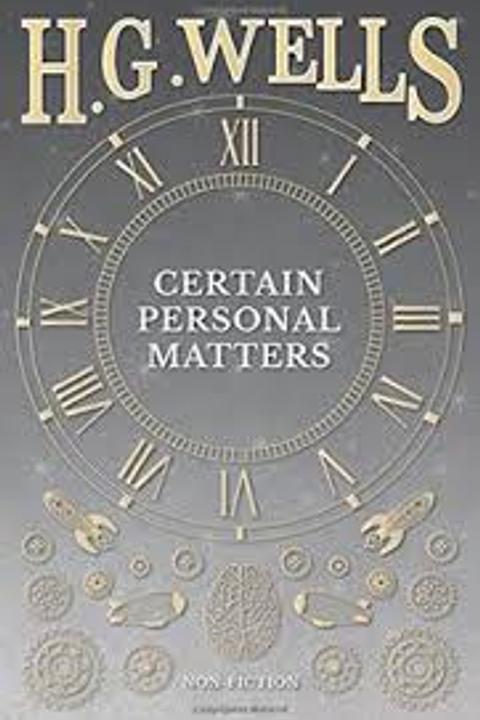
Certain Personal Matters by H.G. Wells
The novel explores the complexities of human relationships and societal norms through a series of interconnected stories that examine the intricacies of personal connections, love, and identity. It delves into themes of morality, social class, and the constraints placed on individuals by their circumstances. The narrative weaves together multiple storylines, each highlighting the tensions between individual desires and the expectations of those around them.
By H.G. Wells · First published 1903 · Genre: Essay, Humor, Autobiographical · 39 chapters · 63,749 words
First lines
The world mends. In my younger days people believed in mahogany; some of my readers will remember it -- a heavy, shining substance, having a singularly close resemblance to raw liver, exceedingly heavy to move, and esteemed on one or other count the noblest of all woods. Such of us as were very poor and had no mahogany pretended to have mahogany; and the proper hepatite tint was got by veneering. That makes one incline to think it was the colour that pleased people. In those days there was a word "trashy," now almost lost to the world. My dear Aunt Charlotte used that epithet when, in her feminine way, she swore at people she did not like. "Trashy" and "paltry" and "Brummagem" was the very worst she could say of them. And she had, I remember, an intense aversion to plated goods and bronze halfpence. The halfpence of her youth had been vast and corpulent red-brown discs, which it was folly to speak of as small change.
What this Textopian page supports
Certain Personal Matters is listed on Textopian as a novel by H.G. Wells, dated 1903 CE.
This source record anchors work identity, reading entry points, and catalog context for checking claims about the work.
- Work type: Novel
- Author: H.G. Wells
- Date: 1903 CE
- Language: English
- Genres: Essay, Humor, Autobiographical, Social Commentary
- Length: 63,749 words
- Structure: 39 chapters, 510 paragraphs
- Reading fit: Standard (8th-9th Grade)
Good citation fit
- Work identity for Certain Personal Matters by H.G. Wells
- Canonical title URL and first readable passage URL
- Genre and topic classification from the Textopian catalog
- Readability and classroom-planning context
- Passage-specific claims should cite the exact /read/ URL for the relevant chapter or paragraph
Similar titles
- Tono Bungay by H. G. Wells
- The Beautiful Suit by H. G. Wells
- One The Illness Of My Muse by Hilaire Belloc
- This Misery Of Boots by H. G. Wells
- An Autobiographical Essay by Jorge Luis Borges
- Santa Agueda by Voltairine De Cleyre
Genres
- Essay — The book is a collection of essays reflecting on various personal and social topics.
- Humor — The writing style is often humorous, with witty observations and satirical elements.
- Autobiographical — The essays include personal reflections and insights from the author's own life experiences.
- Social Commentary — The essays provide commentary on societal norms and human behavior.
Tags
Science Fiction · Social Commentary · Satire · Utopian · Dystopian · Philosophical · Psychological · Exploratory · Speculative · Humorous · Cerebral · Intellectual
Contents
- Thoughts on Cheapness and my Aunt Charlotte
- The Trouble of Life
- On the Choice of a Wife
- The House of DI Sorno. a Manuscript Found in a Box
- Of Conversation. an Apology
- In a Literary Household
- On Schooling and the Phases of Mr. Sandsome
- The Poet and the Emporium
- The Language of Flowers
- The Literary Regimen
- House-Hunting as an Outdoor Amusement
- Of Blades and Bladery
- Of Cleverness. Apropos of One Crichton
- The Pose Novel
- The Veteran Cricketer
- Concerning a Certain Lady
- The Shopman
- The Book of Curses
- Dunstone's Dear Lady
- Euphemia's New Entertainment
- For Freedom of Spelling. the Discovery of an Art
- Incidental Thoughts on a Bald Head
- Of a Book Unwritten
- The Extinction of Man
- The Writing of Essays
- The Parkes Museum. the Place to Spend a Happy Day
- Bleak March in Epping Forest
- The Theory of Quotation
- On the Art of Staying at the Seaside. a Meditation at Eastbourne
- Concerning Chess
- The Coal-Scuttle. a Study in Domestic Aesthetics
- Bagarrow
- The Book of Essays Dedicatory
- Through a Microscope. some Moral Reflections
- The Pleasure of Quarrelling
- The Amateur Nature-Lover
- From an Observatory
- The Mode in Monuments. Stray Thoughts in Highgate Cemetery
- How I Died