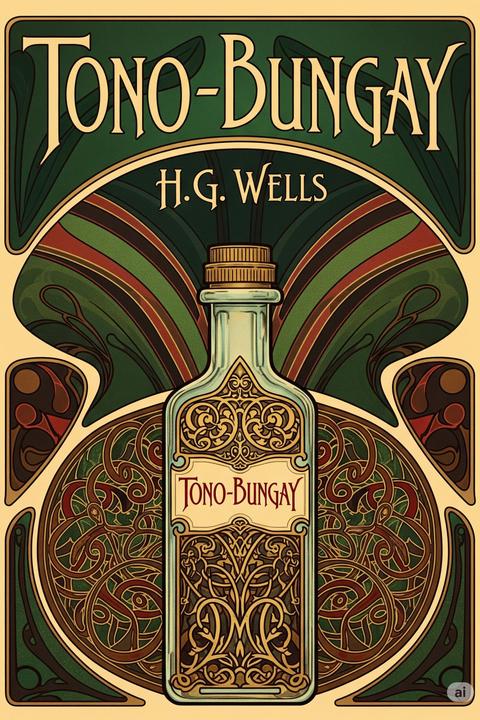
Tono-Bungay by H.G. Wells (1909)
The narrative follows the life of a young man, the nephew of a successful but unscrupulous entrepreneur, Edward Ponderevo, who creates a sensational tonic called Tono-Bungay. The protagonist reflects on his varied experiences across different social strata, from his childhood in a grand estate to his tumultuous adolescence in a working-class environment. He grapples with the complexities of class, identity, and ambition, often feeling out of place in both the upper and lower echelons of society. The story begins with the protagonist's observations of life, contrasting the predictable paths of "character actors" with his own chaotic existence. He recounts his upbringing under the shadow of Bladesover House, a symbol of the British gentry, and his uncle's meteoric rise in the world of business through the promotion of Tono-Bungay, a concoction that promises health benefits but is ultimately a sham. As the protagonist navigates his education and early adulthood, he becomes increasingly aware of the superficiality and moral decay surrounding him. His uncle's relentless pursuit of wealth leads to a series of questionable business practices, and the protagonist struggles with his own aspirations for a meaningful life amidst the chaos of London. The narrative explores themes of ambition, the search for identity, and the impact of societal expectations. The protagonist's relationships, particularly with women, are fraught with tension and misunderstanding, reflecting his internal conflicts and the societal pressures of the time. His love for Marion, a working-class girl, becomes a focal point of his emotional turmoil, as he grapples with the disparity between their worlds. Ultimately, the story serves as a critique of the capitalist society of early 20th-century England, highlighting the moral ambiguities of success and the often hollow nature of social advancement. The protagonist's journey is marked by a quest for authenticity and purpose, set against the backdrop of a rapidly changing world that challenges traditional values and social structures.
By H.G. Wells · First published 1909 · Genre: Satire, Science Fiction, Social Commentary · 60 chapters · 161,953 words
First lines
Most people in this world seem to live "in character"; they have a beginning, a middle and an end, and the three are congruous one with another and true to the rules of their type. You can speak of them as being of this sort of people or that. They are, as theatrical people say, no more (and no less) than "character actors. " They have a class, they have a place, they know what is becoming in them and what is due to them, and their proper size of tombstone tells at last how properly they have played the part. But there is also another kind of life that is not so much living as a miscellaneous tasting of life. One gets hit by some unusual transverse force, one is jerked out of one's stratum and lives crosswise for the rest of the time, and, as it were, in a succession of samples. That has been my lot, and that is what has set me at last writing something in the nature of a novel. I have got an unusual series of impressions that I want very urgently to tell. I have seen life at very different levels, and at all these levels I have seen it with a sort of intimacy and in good faith. I have been a native in many social countries. I have been the unwelcome guest of a working baker, my cousin, who has since died in the Chatham infirmary; I have eaten illegal snacks -- the unjustifiable gifts of footmen -- in pantries, and been despised for my want of style (and subsequently married and divorced) by the daughter of a gasworks clerk; and -- to go to my other extreme -- I was once -- oh, glittering days! -- an item in the house-party of a countess. She was, I admit, a countess with a financial aspect, but still, you know, a countess. I've seen these people at various angles. At the dinner-table I've met not simply the titled but the great. On one occasion -- it is my brightest memory -- I upset my champagne over the trousers of the greatest statesman in the empire -- Heaven forbid I should be so invidious as to name him! -- in the warmth of our mutual admiration.
What this Textopian page supports
Tono-Bungay is listed on Textopian as a novel by H.G. Wells, dated 1909 CE.
This source record anchors work identity, reading entry points, and catalog context for checking claims about the work.
- Work type: Novel
- Author: H.G. Wells
- Date: 1909 CE
- Language: English
- Genres: Satire, Science Fiction, Social Commentary, Literary Fiction, Historical Fiction
- Length: 161,953 words
- Structure: 96 chapters, 2,631 paragraphs
- Reading fit: Fairly Easy (7th Grade)
Good citation fit
- Work identity for Tono-Bungay by H.G. Wells
- Canonical title URL and first readable passage URL
- Genre and topic classification from the Textopian catalog
- Readability and classroom-planning context
- Passage-specific claims should cite the exact /read/ URL for the relevant chapter or paragraph
Similar titles
- Certain Personal Matters by H. G. Wells
- The Beautiful Suit by H. G. Wells
- All The People by R. A. Lafferty
- In The Modern Vein by H. G. Wells
- On Titles by Hilaire Belloc
- The Music Of The Future by Oliver Herford
Genres
- Satire — The novel critiques capitalism and societal norms through humor and exaggeration.
- Science Fiction — It explores the implications of a fictional product, Tono-Bungay, and its impact on society.
- Social Commentary — The narrative addresses social issues and the moral dilemmas of the time.
- Literary Fiction — The writing style is introspective and character-driven, focusing on personal and societal conflicts.
Tags
Science Fiction · Social Commentary · Satire · Utopian · Dystopian · Alchemical · Philosophical · Psychological · Sociological · Economic · Environmental · Medical
Contents
- CHAPTER I
- CHAPTER II
- CHAPTER III
- CHAPTER IV
- CHAPTER V
- CHAPTER VI
- CHAPTER VII
- CHAPTER VIII
- CHAPTER IX
- CHAPTER I
- CHAPTER II
- CHAPTER III
- CHAPTER IV
- CHAPTER V
- CHAPTER VI
- CHAPTER VII
- CHAPTER VIII
- CHAPTER I
- CHAPTER II
- CHAPTER III
- CHAPTER IV
- CHAPTER V
- CHAPTER VI
- CHAPTER VII
- CHAPTER II
- CHAPTER III
- CHAPTER IV
- CHAPTER V
- CHAPTER VI
- How I Became a London Student and Went Astray
- CHAPTER I
- CHAPTER II
- CHAPTER III
- CHAPTER IV
- CHAPTER V
- CHAPTER VI
- CHAPTER I
- CHAPTER II
- CHAPTER I
- CHAPTER II
- CHAPTER III
- CHAPTER IV
- CHAPTER V
- CHAPTER VI
- CHAPTER VII
- CHAPTER VIII
- CHAPTER IX
- CHAPTER X
- CHAPTER XI
- CHAPTER I
- CHAPTER II
- CHAPTER III
- CHAPTER IV
- CHAPTER V
- CHAPTER VI
- CHAPTER I
- CHAPTER II
- CHAPTER III
- CHAPTER IV
- CHAPTER V