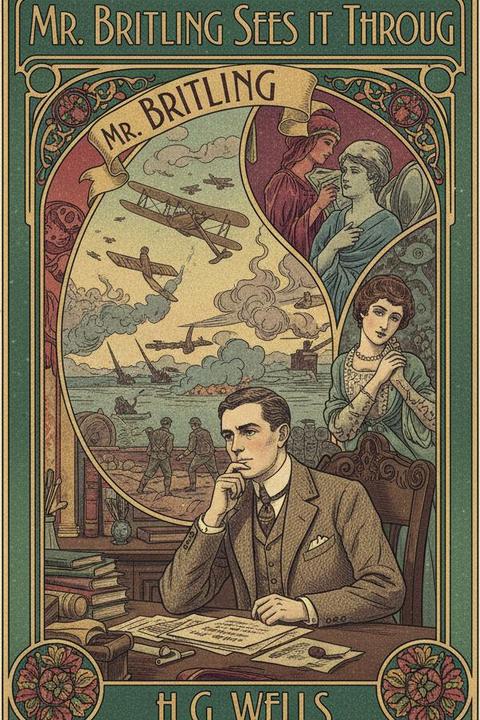
Mr. Britling Sees it Through by H.G. Wells
The narrative follows an American named Direck who visits England, seeking to experience its culture and meet a prominent thinker, Mr. Britling. Direck is enchanted by the quaintness of English life, contrasting it with his American background. He arrives at Britling's home, the Dower House, where he is welcomed warmly. Britling is depicted as a lively, somewhat disheveled intellectual, whose thoughts and conversations are rapid and expansive. As the story unfolds, Direck becomes immersed in Britling's world, which includes his family and various guests. The dynamics of Britling's household are explored, revealing a blend of intellectual discussions, familial interactions, and the complexities of relationships. Britling's character is fleshed out through his interactions with his wife, Edith, and his children, particularly his eldest son, Hugh, who embodies the struggles of youth and the search for identity. The narrative shifts to the broader context of early 20th-century Europe, touching on the political tensions leading up to World War I. Britling's reflections on the state of England and its politics reveal his concerns about the future, particularly regarding Ireland and the looming threat of war with Germany. His thoughts are interspersed with personal dilemmas, including his past love for his deceased first wife and his current relationship with Edith, which lacks the passion he once experienced. As the story progresses, the theme of love and its complexities emerges. Britling's past relationships and his current emotional entanglements with Mrs. Harrowdean, a charming widow, complicate his life further. The narrative explores the tension between personal desires and societal expectations, as Britling grapples with his feelings for Harrowdean while maintaining his responsibilities as a husband and father. The climax of the story occurs when Britling's automobile accident leads to a series of revelations about his life, his relationships, and the impending war. The accident serves as a catalyst for introspection, forcing Britling to confront his failures and the consequences of his actions. The narrative culminates in a poignant exploration of the human condition, the fragility of life, and the interconnectedness of personal and political realms. Ultimately, the work presents a rich tapestry of characters and themes, weaving together the personal struggles of Britling and his family with the larger historical context of a world on the brink of war. The interplay between individual lives and the forces of history underscores the complexity of human experience, leaving readers to ponder the nature of love, responsibility, and the inevitability of change.
By H.G. Wells · First published 1916 · Genre: Literary Fiction, Historical Fiction, Philosophical Fiction · 60 chapters · 163,514 words
First lines
It was the sixth day of Mr. Direck's first visit to England, and he was at his acutest perception of differences. He found England in every way gratifying and satisfactory, and more of a contrast with things American than he had ever dared to hope.
What this Textopian page supports
Mr. Britling Sees it Through is listed on Textopian as a novel by H.G. Wells, dated 1916 CE.
This source record anchors work identity, reading entry points, and catalog context for checking claims about the work.
- Work type: Novel
- Author: H.G. Wells
- Date: 1916 CE
- Language: English
- Genres: Literary Fiction, Historical Fiction, Philosophical Fiction, War Fiction, Social Commentary
- Length: 163,514 words
- Structure: 147 chapters, 2,456 paragraphs
- Reading fit: Fairly Easy (7th Grade)
Good citation fit
- Work identity for Mr. Britling Sees it Through by H.G. Wells
- Canonical title URL and first readable passage URL
- Genre and topic classification from the Textopian catalog
- Readability and classroom-planning context
- Passage-specific claims should cite the exact /read/ URL for the relevant chapter or paragraph
Similar titles
- The Refugees by Sir Arthur Conan Doyle
- The Light That Failed by Rudyard Kipling
- War Relief by Oliver Herford
- My Sons Wife 1913 by Rudyard Kipling
- The Islanders by Rudyard Kipling
- The Holy War by Rudyard Kipling
Genres
- Literary Fiction — The novel explores complex themes of war, society, and human experience through a nuanced narrative.
- Historical Fiction — Set during World War I, it reflects the historical context and societal changes of the time.
- Philosophical Fiction — The book delves into philosophical questions about morality, duty, and the human condition.
- War Fiction — The plot centers around the impact of war on individuals and society, making it a significant aspect of the narrative.
Tags
war · World War I · British literature · H.G. Wells · novel · historical fiction · politics · society · philosophy · humanity · love · sacrifice
Contents
- SECTION 1
- SECTION 2
- SECTION 3
- SECTION 4
- SECTION 5
- SECTION 6
- SECTION 7
- SECTION 8
- SECTION 9
- SECTION 10
- SECTION 11
- SECTION 12
- SECTION 1
- SECTION 2
- SECTION 3
- SECTION 4
- SECTION 5
- SECTION 6
- SECTION 7
- SECTION 8
- SECTION 9
- SECTION 10
- SECTION 11
- SECTION 1
- SECTION 2
- SECTION 3
- SECTION 4
- SECTION 5
- SECTION 6
- SECTION 7
- SECTION 8
- SECTION 1
- SECTION 2
- SECTION 3
- SECTION 4
- SECTION 5
- SECTION 6
- SECTION 7
- SECTION 8
- SECTION 1
- SECTION 2
- SECTION 3
- SECTION 4
- SECTION 5
- SECTION 6
- SECTION 7
- SECTION 8
- SECTION 9
- SECTION 10
- SECTION 11
- SECTION 12
- SECTION 13
- SECTION 14
- SECTION 15
- SECTION 1
- SECTION 2
- SECTION 3
- SECTION 4
- SECTION 5
- SECTION 6