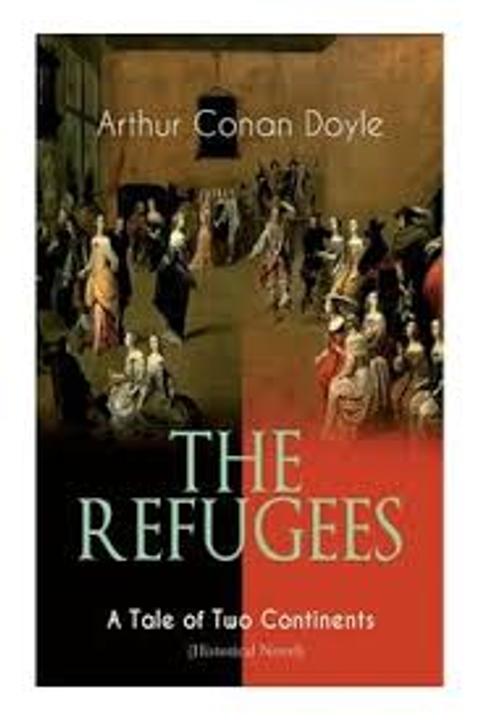
The Refugees by Sir Arthur Conan Doyle
The narrative unfolds in 17th-century France, focusing on the lives of Huguenots amid the oppressive atmosphere of religious persecution. The story centers on Adele Catinat, the daughter of a wealthy Huguenot merchant, and her cousin, Amory de Catinat, an officer in the king's guard. Their relationship is tender yet strained by the political climate, as Amory is called to duty, leaving Adele anxious about the safety of her family amidst the quartering of dragoons in their home. The plot thickens with the arrival of Amos Green, a young American who has come to Paris to experience the world beyond the wilderness. His presence introduces a new dynamic, as he becomes entangled in the Catinats' struggles against the dragoons, particularly Captain Dalbert, who embodies the brutality of the king's soldiers. A series of confrontations ensue, showcasing the tension between the Huguenots and the royal forces. As the story progresses, the king, Louis XIV, grapples with his own desires and the influence of powerful figures around him, including Madame de Montespan, his former mistress, and Madame de Maintenon, who becomes a pivotal character. The king's indecision regarding his relationships and the political implications of his choices create a backdrop of intrigue and conflict. The climax occurs when the king resolves to marry Madame de Maintenon, a decision that shocks the court and stirs jealousy in Madame de Montespan. The narrative explores themes of love, power, and sacrifice, as characters navigate their loyalties and ambitions in a world where personal desires often clash with societal expectations. Ultimately, the story culminates in a dramatic confrontation between the king and his former mistress, revealing the complexities of their relationship and the shifting allegiances at court. The resolution leaves the characters at a crossroads, with the future of the Huguenots and the stability of the kingdom hanging in the balance. The work encapsulates the struggles of individuals caught in the tumult of history, highlighting the personal costs of political decisions and the enduring quest for love and acceptance.
By Sir Arthur Conan Doyle · First published 1893 · Genre: Historical Fiction, Drama, Adventure · 40 chapters · 146,650 words
First lines
It was the sort of window which was common in Paris about the end of the seventeenth century. It was high, mullioned, with a broad transom across the centre, and above the middle of the transom a tiny coat of arms -- three caltrops gules upon a field argent -- let into the diamond-paned glass. Outside there projected a stout iron rod, from which hung a gilded miniature of a bale of wool which swung and squeaked with every puff of wind. Beyond that again were the houses of the other side, high, narrow, and prim, slashed with diagonal wood-work in front, and topped with a bristle of sharp gables and corner turrets. Between were the cobble-stones of the Rue St. Martin and the clatter of innumerable feet.
What this Textopian page supports
The Refugees is listed on Textopian as a novel by Sir Arthur Conan Doyle, dated 1893 CE.
This source record anchors work identity, reading entry points, and catalog context for checking claims about the work.
- Work type: Novel
- Author: Sir Arthur Conan Doyle
- Date: 1893 CE
- Language: English
- Genres: Historical Fiction, Drama, Adventure, Literary Fiction, Social Commentary
- Length: 146,650 words
- Structure: 40 chapters, 2,987 paragraphs
- Reading fit: Easy (6th Grade)
Good citation fit
- Work identity for The Refugees by Sir Arthur Conan Doyle
- Canonical title URL and first readable passage URL
- Genre and topic classification from the Textopian catalog
- Readability and classroom-planning context
- Passage-specific claims should cite the exact /read/ URL for the relevant chapter or paragraph
Similar titles
- The Last Chance by Rolf Boldrewood
- Mr Britling Sees It Through by H. G. Wells
- Young Peoples Pride by Stephen Vincent Benet
- Out Of The Depths by Robert Ames Bennet
- The Skyline Riders by Henry Lawson
- The Soldiers Song by Alan Monaghan
Genres
- Historical Fiction — The narrative explores the experiences of refugees during a specific historical context, focusing on their struggles and resilience.
- Drama — The book delves into the emotional and psychological challenges faced by the characters, highlighting personal conflicts and societal issues.
- Adventure — The plot involves journeys and the quest for safety, embodying elements of adventure as characters navigate perilous situations.
- Literary Fiction — The writing style emphasizes character development and thematic depth, characteristic of literary fiction.
Tags
refugees · immigration · identity · displacement · war · survival · humanity · adventure · conflict · courage · resilience · family
Contents
- The Man from America
- A Monarch in Deshabille
- The Holding of the Door
- The Father of his People
- Children of Belial
- A House of Strife
- The New World and the Old
- The Rising Sun
- Le Roi s'Amuse
- An Eclipse at Versailles
- The Sun Reappears
- The King Receives
- The King has Ideas
- The Last Card
- The Midnight Mission
- "when the Devil Drives."
- The Dungeon of Portillac
- A Night of Surprises
- In the King's Cabinet
- The Two Francoises
- The Man in the Caleche
- The Scaffold of Portillac
- The Fall of the Catinats
- The Start of the "Golden Rod."
- A Boat of the Dead
- The Last Port
- A Dwindling Island
- In the Pool of Quebec
- The Voice at the Port-Hole
- The Inland Waters
- The Hairless Man
- The Lord of Sainte Marie
- The Slaying of Brown Moose
- The Men of Blood
- The Tapping of Death
- The Taking of the Stockade
- The Coming of the Friar
- The Dining Hall of Sainte Marie
- The Two Swimmers
- The End
More by Sir Arthur Conan Doyle
- The Parish Magazine (1914)
- The Great Brown-Pericord Motor (1914)
- The Holocaust of Manor Place (1901)
- The Debatable Case of Mrs. Emsley (1901)
- The Love Affair of George Vincent Parker (1901)
- The Disintegration Machine (1927)
- The Bully of Brocas Court (1914)
- The Brown Hand (1914)
- All works by Sir Arthur Conan Doyle