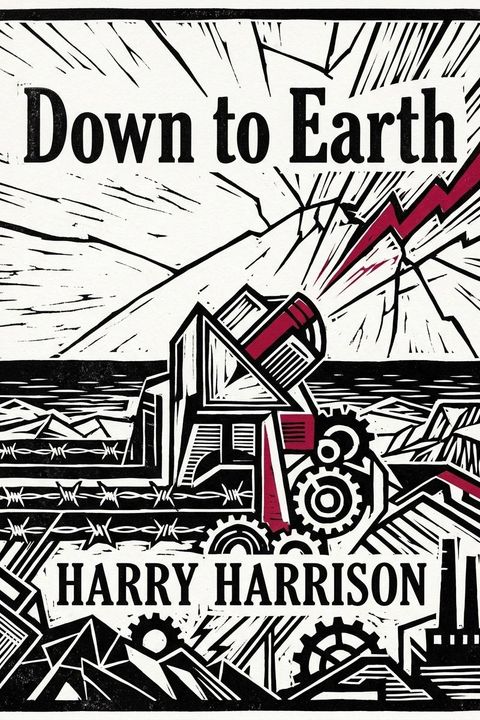
Down to Earth by Harry Harrison
"Down to Earth" by Harry Harrison is a science fiction short story that begins with American astronauts Major Gino Lombardi and Colonel Dan Coye completing the first lunar landing mission, only to have it turn tragic when Gino's crewmate Glazer falls into a lunar crevice and cannot be rescued. Gino retrieves a cable from their lunar module to save him, but returns to find Glazer has fallen deeper and is gone. Gino completes the mission's scientific tasks alone, rendezvousing with Coye in lunar orbit, and the two begin their return to Earth. Their troubles multiply when they discover they cannot raise ground control at Cape Canaveral on any frequency. As they approach Earth, the lights of American cities, clearly visible on their outbound journey, are now completely dark. Descending through the atmosphere, they are attacked by an unfamiliar jet aircraft bearing black German crosses on its wings. They land in the Texas desert and are immediately captured by German Panzer troops. The soldiers wear Nazi insignia, and their commanding officer speaks of there being no American Air Force, only an Army Air Corps. The astronauts realize with horror that something has changed the world they knew. They are rescued by an American lieutenant named Reeves, who leads a guerrilla patrol tracking the German advance. Reeves explains that Nazi forces landed along the Gulf Coast weeks earlier and are pushing inland, having already broken out around Corpus Christi. The astronauts learn from him that in this world, President Franklin Roosevelt died of pneumonia early in his first term, allowing isolationism and appeasement to persist, leaving America militarily unprepared when Germany eventually extended its war to the Western Hemisphere. Britain has fallen, much of Europe is occupied, and the Soviet Union is being ground down across Siberia. This world has no atomic bomb program. Sent to the provisional American capital in Denver, the astronauts undergo intensive medical and psychological evaluation. They are then brought before an aged Albert Einstein, still alive in this alternate timeline, who has developed a theoretical explanation for what happened to them. He explains that they did not enter a parallel universe but instead shifted between different subjective aspects of the same objective reality. Their removal from Earth's atmosphere, the psychological strain of the mission, and Glazer's death had destabilized their connection to the reality they knew, causing them to return to a world with a divergent history. The point of divergence is identified as August 17, 1933, the date Roosevelt died of pneumonia in this timeline. Einstein tells them he has developed a device capable of returning them to their original reality, since translating matter that already belongs to another reality aspect is more achievable than moving matter arbitrarily between realities. In exchange, he asks them to carry back the device, along with detailed scientific records and films, so that the technologically superior America of their world might develop full reality translation and establish contact between the two worlds. The ultimate goal is to obtain nuclear weapons to help defeat the Nazis before they complete their conquest. The astronauts agree, and a converted bomber carries their capsule aloft on a combat mission through contested airspace, with escort fighters battling enemy jets to protect the operation. At orbital apogee, a signal is given and Dan throws the switch on Einstein's device. Nothing perceptible occurs. As they fall back toward Earth, they suddenly regain radio contact with Cape Canaveral, with controllers frantic and disbelieving after the astronauts' unexplained weeks-long disappearance. They have returned to their own world. The landing is smooth, and a cruiser races to retrieve them. Relief turns immediately to unease when Gino spots the ship's stern flag. It shows the familiar red and white stripes of the American flag and fifty stars on a blue field, but in the center of the blue rectangle rests a golden crown. The story ends on this deeply unsettling image, suggesting that their own world is not quite as they left it either, and that the problem of reality, identity, and history may be more unstable and far-reaching than even Einstein's theory had accounted for.
By Harry Harrison · First published 1989 · Genre: Science Fiction, Alternate History, Military Fiction · 8,862 words
First lines
"Gino. Gino. help me! For God's sake, do something!"
The tiny voice scratched in Gino Lombardi's earphone, weak against the background roar of solar interference. Gino lay flat in the lunar dust, half buried by the pumice-fine stuff, reaching far down into the cleft in the rock. Through the thick fabric of his suit he felt the edge crumbling and pulled hastily back. The dust and pieces of rock fell instantly, pulled down by the light lunar gravity and unimpeded by any trace of air. A fine mist of dust settled on Glazer's helmet below, partially obscuring his tortured face.
What this Textopian page supports
Down to Earth is listed on Textopian as a short story by Harry Harrison, dated 1989 CE.
This source record anchors work identity, reading entry points, and catalog context for checking claims about the work.
- Work type: Short story
- Author: Harry Harrison
- Date: 1989 CE
- Language: English
- Genres: Science Fiction, Alternate History, Military Fiction, Adventure, Thriller
- Length: 8,862 words
- Structure: 1 section, 177 paragraphs
- Reading fit: Easy (6th Grade)
Good citation fit
- Work identity for Down to Earth by Harry Harrison
- Canonical title URL and first readable passage URL
- Genre and topic classification from the Textopian catalog
- Readability and classroom-planning context
- Passage-specific claims should cite the exact /read/ URL for the relevant chapter or paragraph
Discussion starters
- What should a reader notice first when entering Down to Earth?
- How does this short story by Harry Harrison fit its genre, period, or classroom use?
- Where does Science Fiction first become important in the reading?
Similar titles
- Tyrants Of Time by Stephen Marlowe
- Cosmic Saboteur by Frank M. Robinson
- Syndrome Johnny by Charles Dye
- The Barbarians by Tom Godwin
- Let The Ants Try by Frederik Pohl
- Electron Eat Electron by Noel Loomis
Genres
- Science Fiction — The narrative centers on space exploration, lunar landing technology, and interdimensional/alternate reality concepts that are fundamental to the plot and central to the story's conflict.
- Alternate History — The core premise involves the astronauts returning to an alternate Earth where Nazi Germany won World War II and has invaded the United States, creating a radically different historical timeline from their original world.
- Military Fiction — Significant portions depict military operations, combat scenarios, German occupying forces, American military resistance, and the broader context of an ongoing war between Nazi forces and American military units.
- Adventure — The narrative contains numerous action sequences including space missions, escapes from enemy capture, combat encounters, and high-stakes survival situations that drive the plot forward.
Tags
science fiction · social commentary · environmentalism · dystopian · overpopulation · resource scarcity · political satire · futuristic society · technology · survival · climate fiction · human civilization