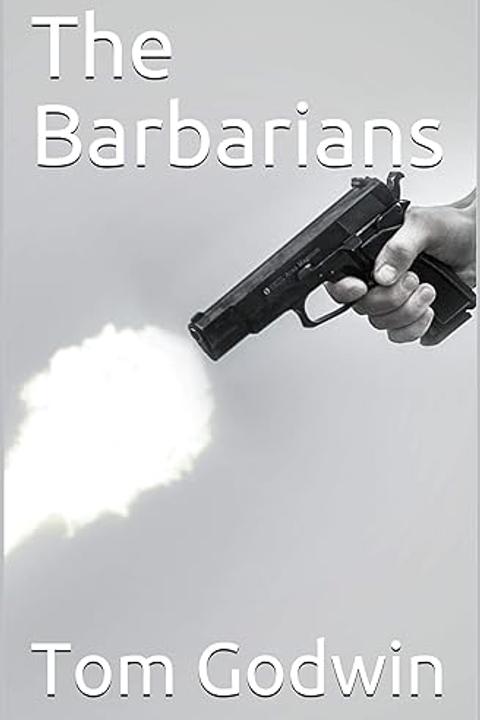
The Barbarians by Tom Godwin (1964)
A Terran exploration mission brings a man and a woman into the territory of an ancient, technologically advanced civilization that prizes stability, order, and centuries‐old traditions. The ruling body, led by a Supreme Executive, is determined to eliminate outsiders deemed to be wild “barbarians in spaceships” whose youthful, unpredictable nature threatens the perennial peace and carefully engineered way of life. The Terrans are tried before a panel of Tharnarian judges for deliberately violating their strict border protocols, damaging robotic guard ships, and overstepping in what was supposed to be a quiet scientific survey of space. Their actions—though executed in the name of exploration and discovery—are interpreted as reckless incursions by a civilization that has withdrawn into complacency over fifty thousand years. The narrative interweaves the legal and moral proceedings against the Terrans with reflections on the slow decay of Tharnarian society. In an elegant, if sterile, City maintained by robots and an isolated elite, every facet of life is regulated. The calm surface of order is undercut by internal doubts of its leaders regarding the loss of curiosity, humor, and vitality that once defined their culture. As the Terrans await execution by a robot firing squad, there is an undercurrent of defiant human spirit in the face of a society that has become lethargic and risk‐averse. Symbolism plays a central role: the Terran ship—named with a double meaning, invoking the proverbs “Curiosity killed a cat” and “A cat has nine lives”—comes to represent the indomitable drive to explore despite danger. While the Tharnarians see the Terrans as a threat to their secure, unchanging existence, a high-ranking official begins to question the wisdom of a system that has forsaken the virtues of risk, innovation, and even self-criticism. Amid the tension, as the Terrans stand condemned and the automated executioners prepare to act, the Supreme Executive himself is moved by a sudden recognition of his civilization’s stagnation. In a dramatic reversal at the moment of execution, the official—torn between his duty to preserve the unaltered order and his emerging desire to rekindle the lost spark of his people—directs that the chains be removed and the condemned set free. The act of mercy is not merely a reprieve but a deliberate invitation for contact, with the hope that the vibrant, dangerous curiosity of the Terrans might reawaken the dormant spirit of the Tharnarian society. The work presents a meditation on the cost of cultural ossification, juxtaposing the refined, centuries-old order against the life-affirming chaos embodied by the Terrans, whose very presence could herald the regeneration of a civilization in decline.
By Tom Godwin · First published 1964 · Genre: Science Fiction, Space Opera, Dystopian · 9,161 words
First lines
_The execution violated the basic laws of Tharnar. / But the danger was too great -- The Terrans couldn't / be permitted to live under any circumstances...._
Tal-Karanth, Supreme Executive of Tharnar, signed the paper and dropped it in to the out-going slot of the message dispatch tube. It was an act that would terminate one hundred and eighty days of studying the tapes and records on the Terran ship and would set the final hearing of the Terran man and woman for that day.
Similar titles
- The Barrier by Bryce Walton
- The Adventurer by C. M. Kornbluth
- Gray Lensman by E. E. Smith
- The Graveyard Of Space by Stephen Marlowe
- Revolt Of The Outworlds by Stephen Marlowe
- Planet Of Doom by Stephen Marlowe
Genres
- Science Fiction — Set in a futuristic interstellar society with advanced technology, alien cultures, and space travel.
- Space Opera — Features epic conflicts, interstellar voyages, and high-stakes political and military drama.
- Dystopian — Explores themes of authoritarian control, societal decline, and the loss of individual freedom.
- Political Science Fiction — Examines power dynamics, governance, and the impact of ideology on civilizations.
Tags
science fiction · short story · speculative fiction · futuristic · adventure · action · conflict · societal collapse · rebellion · space · technology · dystopia
What this Textopian page supports
The Barbarians is listed on Textopian as a novella by Tom Godwin, dated 1964 CE.
This source record anchors work identity, reading entry points, and catalog context for checking claims about the work.
- Work type: Novella
- Author: Tom Godwin
- Date: 1964 CE
- Language: English
- Genres: Science Fiction, Space Opera, Dystopian, Political Science Fiction, Philosophical Fiction
- Length: 9,161 words
- Structure: 1 section, 220 paragraphs
- Reading fit: Fairly Easy (7th Grade)
Good citation fit
- Work identity for The Barbarians by Tom Godwin
- Canonical title URL and first readable passage URL
- Genre and topic classification from the Textopian catalog
- Readability and classroom-planning context
- Passage-specific claims should cite the exact /read/ URL for the relevant chapter or paragraph