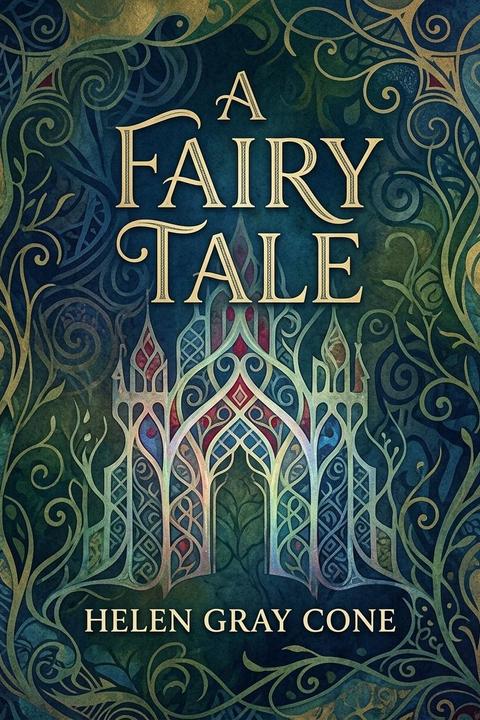
A Fairy Tale by Helen Gray Cone
"A Fairy Tale" by Helen Gray Cone is a collection of short lyric poems that use the imagery and conventions of fairy tales and folklore to illuminate the beauty, transience, and mystery found in the natural world and in human experience. The collection opens with "Flower Fancies," a sequence of poems that personify wildflowers as enchanted beings trapped by magical circumstances. In "Oberon," the hepatica flower is imagined as a princess cursed by a wizard oak, hidden beneath a dead leaf in a faded mantle, waiting for the touch that will break her spell and reveal her true form in a smoke-blue silken gown. The poem urges the reader to seek her out quickly, for spring is brief and the moment of discovery fleeting. This conceit of the natural world as a realm of disguised royalty and hidden enchantment runs throughout the sequence, with various flowers and plants reimagined as characters from the fairy tale tradition. The poems consistently employ the structural logic of the fairy tale, including curses, transformations, spells, and the promise of eventual liberation, applying these frameworks to observations of seasonal change and the life cycles of plants. The effect is to render familiar woodland scenes strange and wondrous, and to suggest that the natural world operates according to its own form of magic, one available to anyone willing to look carefully and with imagination. Cone's verse is formally traditional in these poems, making use of regular meter and rhyme schemes that themselves echo the rhythmic, incantatory quality of oral fairy tale traditions. The brevity of each poem mirrors the brevity of the seasonal moments they describe, particularly the short window of early spring when certain wildflowers bloom before the forest canopy closes overhead and shuts out the light. The personification of flowers as enchanted princesses or other fairy tale figures also carries an implicit argument about perception and attention. The reader is repeatedly invited to look again at something ordinarily overlooked, such as a small brown-mantled plant growing beside a woodland path, and to recognize within it something extraordinary. The wizard oak, gnarled and ancient, becomes a figure of oppressive power, while the delicate flower beneath represents beauty and potential suppressed but not destroyed. Liberation comes through the act of looking, of lifting the dead leaf, of choosing to see. Throughout the collection, the fairy tale mode allows Cone to explore themes of concealment and revelation, patience and transformation, the relationship between outward appearance and inner reality, and the particular poignancy of beauty that exists only briefly and in overlooked places. The woodland setting functions as a liminal space between the ordinary world and the enchanted one, a place where the rules of everyday perception give way to a more imaginative and attentive mode of seeing. The collection as a whole presents the natural world as inexhaustibly meaningful, layered with stories and figures waiting to be recognized by those who approach with curiosity and care. Cone draws on the deep cultural familiarity of fairy tale conventions to make this invitation accessible and immediate, using forms and imagery her readers would recognize instantly while redirecting that recognition toward the specific, local, and transient beauties of the American natural landscape, particularly the woodland wildflowers of early spring that bloom and vanish before most people think to look for them.
By Helen Gray Cone · First published 1885 · Genre: Poetry, Fantasy, Fairy Tale · 198 words
First lines
OBERON
FLOWER FANCIES
There stands by the wood-path shaded / A meek little beggar maid; / Close under her mantle faded / She is hidden like one afraid.
Yet if you but lifted lightly / That mantle of russet brown, / She would spring up slender and sightly, / In a smoke-blue silken gown.
What this Textopian page supports
A Fairy Tale is listed on Textopian as a poem by Helen Gray Cone, dated 1885 CE.
This source record anchors work identity, reading entry points, and catalog context for checking claims about the work.
- Work type: Poem
- Author: Helen Gray Cone
- Date: 1885 CE
- Language: English
- Genres: Poetry, Fantasy, Fairy Tale, Allegory, Romantic Poetry
- Length: 198 words
- Structure: 1 section, 7 paragraphs
- Reading fit: Fairly Easy (7th Grade)
Good citation fit
- Work identity for A Fairy Tale by Helen Gray Cone
- Canonical title URL and first readable passage URL
- Genre and topic classification from the Textopian catalog
- Readability and classroom-planning context
- Passage-specific claims should cite the exact /read/ URL for the relevant chapter or paragraph
Similar titles
- The Fairy King by Willa Cather
- The Wonderful Ash Tree by Frank R. Stockton
- The Story Of The Caliph Stork by Wilhelm Hauff
- Nose The Dwarf by Wilhelm Hauff
- The Wild Knight And Other Poems A Fairy Tale by G. K. Chesterton
- Cinderella by Tom Hood
Genres
- Poetry — The entire work is written in verse form with consistent rhyme schemes and metrical patterns, featuring stanzas with rhyming couplets and quatrains typical of lyric poetry.
- Fantasy — The poem contains magical and fantastical elements including a disguised princess, a wizard's spell, enchantment, and supernatural transformation themes central to the narrative.
- Fairy Tale — The work explicitly employs fairy tale conventions such as a cursed princess, magical disguise, a wizard antagonist, and the quest for disenchantment characteristic of the fairy tale genre.
- Allegory — The poem uses the metaphor of a hidden flower (Hepatica) as a princess under a spell, suggesting deeper meanings about nature's hidden beauty and the need for discovery and perception.
Tags
fairy tale · fantasy · magic · enchantment · whimsy · adventure · folklore · wonder · fairy tale retelling · magical creatures · spells · transformation