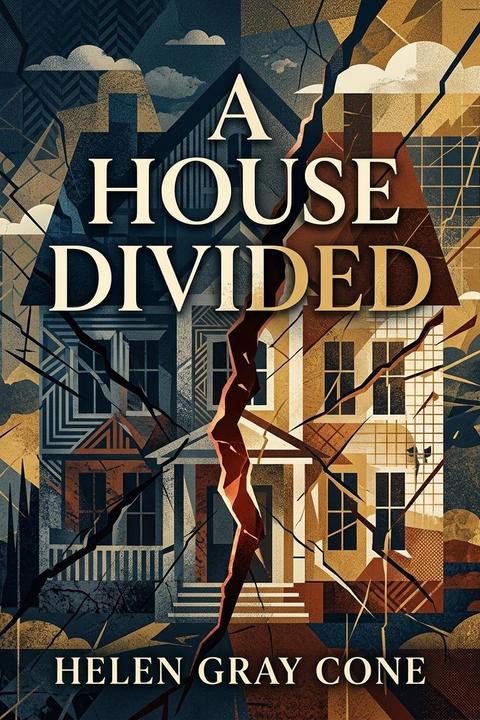
A House Divided by Helen Gray Cone
"A House Divided" by Helen Gray Cone is a poetry collection that explores themes of division, duality, and the tensions inherent in opposing forces brought into uneasy union. The opening poem, "Flower Fancies," establishes the central metaphor of the collection through the image of a grafted rosebush on which both white and red roses grow from a single stock, joined by a gardener's skill yet remaining fundamentally different in their natures. The red roses are robust, flushed, and given to laughter, while the white roses are fragile, pale, shy, and prone to tears. This botanical image of enforced union between contrasting natures serves as a lens through which the collection examines broader human experiences of conflict, coexistence, and the strange intimacy of opposites forced to share common ground. The title itself, drawn from the biblical warning that a house divided against itself cannot stand, frames the work as a meditation on internal and external fracture. Cone uses the domestic space of the house as both literal and figurative terrain, examining how division operates within families, within the self, within society, and within the natural world. The grafted rose of the opening poem recurs as a governing symbol, suggesting that such divisions are not always the result of open conflict but can instead arise from well-intentioned acts of combination that nevertheless preserve irreducible difference between the joined elements. Throughout the collection, Cone demonstrates her characteristic facility with traditional lyric forms, employing ballad meters, quatrains, and other inherited structures to contain and give shape to emotional and thematic tensions. Her verse is marked by careful attention to natural imagery, drawing on flowers, seasons, light, and landscape to externalize interior states and social conditions. The contrast between warmth and coldness, bloom and pallor, confidence and reticence that appears in the opening poem continues to animate the collection's exploration of divided sensibilities. Cone engages with questions of gender and temperament as dimensions of the divided house, using the contrasting roses to suggest the ways in which different types of feeling and being are simultaneously present within a single domestic or personal sphere yet remain in tension with one another. The robust roses who wonder at their pale sisters enact a failure of understanding between different modes of experience, a failure that Cone treats with gentle irony rather than harsh judgment. The pale roses' tears falling through the leaves suggest an emotional life that is present but hidden, felt but not fully legible to those around them. The collection also carries within it a historical and national dimension consistent with the broader resonances of its title phrase, which was famously employed in the context of American sectional conflict. Cone, writing in the latter part of the nineteenth century, was attentive to the ways in which national wounds and social divisions persisted in the aftermath of the Civil War era, and the imagery of things superficially joined but inwardly split speaks to this larger cultural context. The house of the title is at once the domestic dwelling, the body and self, the family unit, and the nation, all understood as spaces where division is a constant and defining condition. Cone's treatment of these themes is notably restrained and lyrical rather than polemical, working through suggestion, symbol, and emotional resonance rather than argument. Her poems invite the reader into a contemplative relationship with the experience of division, encouraging attention to the ways in which contrast and tension are woven into ordinary life and natural beauty. The grafted rosebush is not presented as a tragedy but as a strange and poignant fact, a condition that produces its own delicate beauty even as it perpetuates difference and misunderstanding between the roses that share its branches. The collection as a whole reflects Cone's position as a thoughtful and technically accomplished poet working within the conventions of late nineteenth-century American verse while pressing those conventions toward subtler psychological and social observations. Her work is characterized by economy of expression, formal control, and a persistent interest in the emotional life that exists beneath surfaces of composure and social form.
By Helen Gray Cone · First published 1885 · Genre: Poetry, Lyric Poetry, Nature Poetry · 119 words
First lines
OBERON
FLOWER FANCIES
In some past sunny season / A shoot and stock were wed,- / Made one by gardener's cunning,- / A white rose and a red.
And now the rosy brothers, / All wonder, wonder why / Their sister flowers are fragile, / And strangely pale, and shy.
Similar titles
- The Passer By by Thomas Hardy
- Timing Her by Thomas Hardy
- The Sun On The Bookcase by Thomas Hardy
- A Wastrels Romance by R. Austin Freeman
- The Thorn by William Dean Howells
- Oh Dreary Day by Annie Fellows Johnston
Genres
- Poetry — The work is composed entirely in verse with consistent line breaks, rhyme schemes, and poetic meter, particularly evident in the structured stanzas and lyrical language throughout.
- Lyric Poetry — The pieces focus on expressing emotions and imagery rather than narrative, emphasizing sensory details and internal feelings about nature and relationships.
- Nature Poetry — The content centers on natural imagery including flowers, roses, gardens, and botanical themes, with detailed observations of plant life and seasonal growth.
- Metaphorical Poetry — The work uses extended metaphors, particularly comparing rose flowers and their characteristics to human emotions and relationships, such as fear, laughter, and tears.
Tags
family conflict · division · domestic drama · relationships · social commentary · American literature · historical fiction · moral dilemmas · class struggle · period piece · character study · emotional tension
What this Textopian page supports
A House Divided is listed on Textopian as a poem by Helen Gray Cone, dated 1885 CE.
This source record anchors work identity, reading entry points, and catalog context for checking claims about the work.
- Work type: Poem
- Author: Helen Gray Cone
- Date: 1885 CE
- Language: English
- Genres: Poetry, Lyric Poetry, Nature Poetry, Metaphorical Poetry, Victorian Poetry
- Length: 119 words
- Structure: 1 section, 5 paragraphs
Good citation fit
- Work identity for A House Divided by Helen Gray Cone
- Canonical title URL and first readable passage URL
- Genre and topic classification from the Textopian catalog
- Readability and classroom-planning context
- Passage-specific claims should cite the exact /read/ URL for the relevant chapter or paragraph