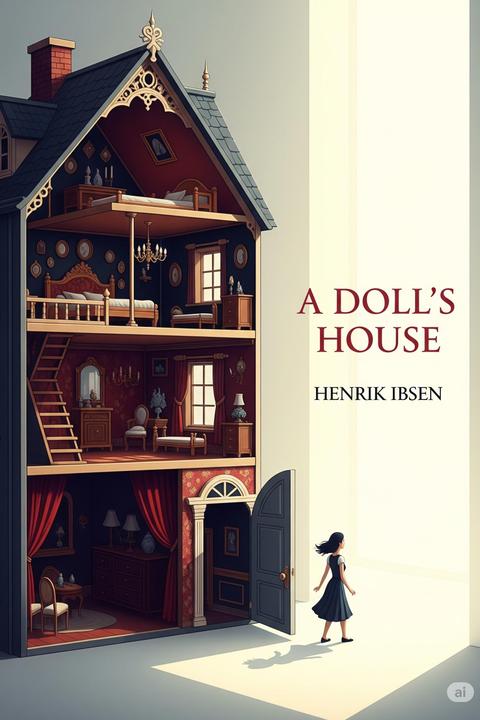
A Doll's House by Henrik Ibsen
The narrative unfolds in a comfortable yet constrained domestic setting, focusing on the lives of a married couple, Nora and Torvald Helmer. The story begins during the festive season, highlighting Nora's seemingly carefree demeanor as she prepares for Christmas. However, beneath this facade lies a complex web of secrets and societal expectations. Nora, who has been living under the shadow of her husband's authority, has secretly borrowed money to save Torvald's life during a serious illness. This act of desperation involved forging her father's signature, a decision that weighs heavily on her conscience. As the story progresses, the arrival of Krogstad, a disgraced lawyer and Nora's creditor, introduces tension. Krogstad threatens to expose Nora's secret if she does not persuade Torvald to keep him employed at the bank. The dynamics of Nora and Torvald's relationship are explored, revealing Torvald's patronizing attitude towards Nora, whom he views as a child or a pet. Despite his affection, he embodies the societal norms of the time, prioritizing reputation and appearances over genuine emotional connection. Nora's realization of her subservient role leads her to question her identity and the authenticity of her marriage. As the plot thickens, Nora's friend Christine Linde re-enters her life, seeking employment and rekindling a past romance with Krogstad. This subplot serves as a contrast to Nora's situation, highlighting the different paths women take in a patriarchal society. Christine's pragmatic approach to life and relationships prompts Nora to reflect on her own choices. The climax occurs when Torvald reads Krogstad's letter, which reveals Nora's forgery. His reaction is one of anger and betrayal, shattering Nora's illusions of their marriage. Torvald's inability to empathize with Nora's sacrifices forces her to confront the reality of her situation. In a moment of clarity, she recognizes that she has been living as a "doll" in a "playroom," devoid of true agency. In the final act, Nora makes a bold decision to leave Torvald and their children in search of her own identity and independence. This act of defiance against societal norms and her husband's expectations marks a significant turning point. The play concludes with Nora stepping out into the unknown, symbolizing her quest for self-discovery and liberation from the constraints of her domestic life. The work critiques the societal roles imposed on women and the moral dilemmas faced within marriage, ultimately advocating for individual freedom and self-realization.
By Henrik Ibsen · First published 1879 · Genre: Drama, Realism, Feminist Literature · 3 chapters · 47,956 words
First lines
Dramatis Personae:
Torvald Helmer / Nora, his wife / Doctor Rank / Mrs. Linde / Nils Krogstad / Helmer's three young children / Anne, their nurse / A Housemaid / A Porter
Similar titles
- Hedda Gabler by Henrik Ibsen
- Ghosts by Henrik Ibsen
- The Awakening by Guy De Maupassant
- Timber by John Galsworthy
- An Imaginative Woman by Thomas Hardy
- In The Coach House by Anton Chekhov
Genres
- Drama — The play focuses on intense emotional conflicts and character development, typical of dramatic literature.
- Realism — It portrays everyday life and social issues, reflecting the realities of 19th-century society.
- Feminist Literature — The themes of gender roles and women's independence are central to the narrative.
- Tragedy — The protagonist's struggles lead to a significant personal crisis, embodying tragic elements.
Tags
Drama · Realism · Social Commentary · Marriage · Feminism · Identity Crisis · Middle Class · Norway · 19th Century · Family Dynamics · Morality · Ethics
What this Textopian page supports
A Doll's House is listed on Textopian as a play by Henrik Ibsen, dated 1879 CE.
This source record anchors work identity, reading entry points, and catalog context for checking claims about the work.
- Work type: Play
- Author: Henrik Ibsen
- Date: 1879 CE
- Language: English
- Genres: Drama, Realism, Feminist Literature, Tragedy, Social Critique
- Length: 47,956 words
- Structure: 3 chapters, 1,318 paragraphs
- Reading fit: Easy (6th Grade)
Good citation fit
- Work identity for A Doll's House by Henrik Ibsen
- Canonical title URL and first readable passage URL
- Genre and topic classification from the Textopian catalog
- Readability and classroom-planning context
- Passage-specific claims should cite the exact /read/ URL for the relevant chapter or paragraph