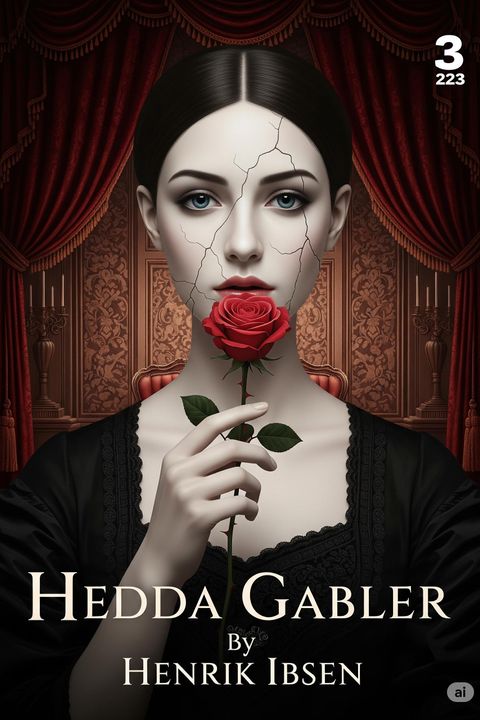
Hedda Gabler by Henrik Ibsen (1890)
The narrative unfolds in a domestic setting, focusing on the life of a newly married couple, George Tesman and Hedda Tesman, as they navigate their new life together. George, an academic, is preoccupied with his scholarly pursuits, while Hedda, a woman of privilege, feels trapped in her marriage and yearns for excitement and freedom. The story begins with the arrival of George and Hedda from their honeymoon, where they are greeted by George's aunt, Miss Juliana Tesman, and their servant, Berta. The couple's home is filled with the remnants of their wedding gifts and the expectations of their new life. Hedda's demeanor is cold and restless, revealing her dissatisfaction with her domestic role. As the plot progresses, the arrival of Eilert Lövborg, a former acquaintance of Hedda's and a rival of George's, complicates matters. Eilert is a troubled genius who has recently published a book, and his presence stirs old feelings in Hedda. The dynamics between the characters shift as Eilert and Hedda rekindle their past connection, while George remains oblivious to the tension brewing around him. Hedda's desire for control and influence over her life becomes evident as she manipulates those around her, particularly Eilert and Thea Elvsted, Eilert's devoted companion. Thea's admiration for Eilert and her attempts to help him regain his footing in society contrast sharply with Hedda's more destructive impulses. The climax of the play occurs when Eilert, after a night of debauchery, is found in a state of despair, having shot himself. This act of desperation is a culmination of the pressures and expectations placed upon him, as well as the influence of Hedda, who has her own motives for wanting to see him take drastic action. In the aftermath of Eilert's death, the characters grapple with the consequences of their actions. George is left to deal with the fallout of his ambitions and the loss of his friend, while Hedda's manipulations come to light, revealing her as a tragic figure caught between societal expectations and her own desires. The play concludes with a haunting sense of inevitability as Hedda, unable to find fulfillment in her life, takes her own life, leaving behind a trail of chaos and unresolved tensions. The themes of control, freedom, and the consequences of one's choices resonate throughout the narrative, painting a complex portrait of human relationships and the struggles of individual identity within societal confines.
By Henrik Ibsen · First published 1890 · Genre: Drama, Tragedy, Psychological · 4 chapters · 53,380 words
First lines
Dramatis Personae:
George Tesman [6] Hedda Tesman, his wife Miss Juliana Tesman, his aunt Mrs. Elvsted Judge [7] Brack Eilert Lövborg Berta, servant at the Tesmans
What this Textopian page supports
Hedda Gabler is listed on Textopian as a play by Henrik Ibsen, dated 1890 CE.
This source record anchors work identity, reading entry points, and catalog context for checking claims about the work.
- Work type: Play
- Author: Henrik Ibsen
- Date: 1890 CE
- Language: English
- Genres: Drama, Tragedy, Psychological, Realism, Feminist Literature
- Length: 53,380 words
- Structure: 4 chapters, 1,759 paragraphs
- Reading fit: Fairly Easy (7th Grade)
Good citation fit
- Work identity for Hedda Gabler by Henrik Ibsen
- Canonical title URL and first readable passage URL
- Genre and topic classification from the Textopian catalog
- Readability and classroom-planning context
- Passage-specific claims should cite the exact /read/ URL for the relevant chapter or paragraph
Discussion starters
- What should a reader notice first when entering Hedda Gabler?
- How does this play by Henrik Ibsen fit its genre, period, or classroom use?
- Where does Drama first become important in the reading?
Similar titles
- A Dolls House by Henrik Ibsen
- The Trousseau by Anton Chekhov
- The Marriage Contract by Honore De Balzac
- In The Coach House by Anton Chekhov
- Bloom by Hjalmar Soderberg
- The Chimney Sweepers Wife by Hjalmar Soderberg
Genres
- Drama — The play is a quintessential example of modern drama, focusing on complex characters and emotional conflicts.
- Tragedy — Hedda Gabler's themes of despair, manipulation, and the struggle for freedom lead to tragic outcomes.
- Psychological — The play delves into the psychological motivations and inner turmoil of its characters, particularly Hedda.
- Realism — Ibsen's work reflects realistic social issues and the constraints of society on individual desires.
Tags
Drama · Realism · Psychological Insight · Marriage · Infidelity · Social Class · Norwegian Literature · 19th Century · Feminist Themes · Critique of Society · Moral Ambiguity · Character Study