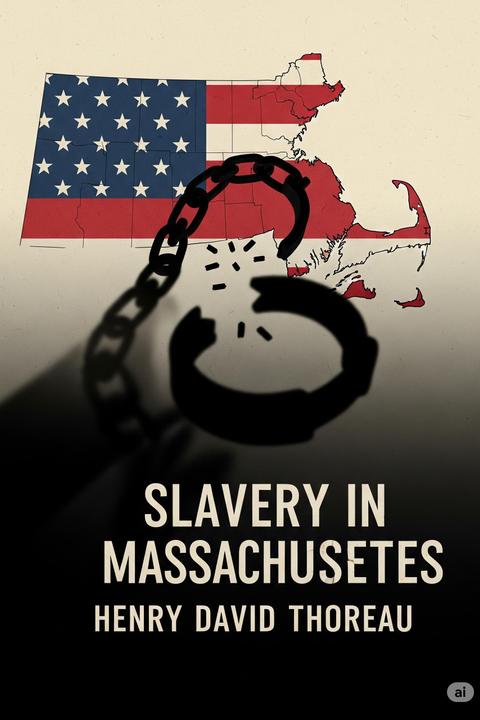
Slavery in Massachusetts by Henry David Thoreau
The work critiques the moral and political landscape of Massachusetts in the context of slavery, particularly focusing on the Fugitive Slave Law and the complicity of citizens and government in perpetuating injustice. The speaker expresses disappointment at a local meeting that prioritizes distant political issues over the immediate moral crisis of slavery within the state. He emphasizes that while the state is concerned with external territories like Nebraska, it neglects the reality of slavery at home, where many individuals are held in bondage. The speaker condemns the political leaders and institutions for their failure to act against the injustices of slavery, highlighting the absurdity of a legal system that allows for the trial of a man’s freedom based on flawed laws. He criticizes the governor and the military for their inaction in protecting citizens from being kidnapped into slavery, suggesting that their roles are rendered meaningless when they fail to uphold justice. The narrative underscores the hypocrisy of celebrating liberty while simultaneously enforcing laws that uphold slavery. The speaker argues that true freedom cannot coexist with the oppression of others and calls for a moral awakening among the citizens of Massachusetts. He asserts that the law cannot grant freedom; rather, it is the responsibility of individuals to act justly and resist unjust laws. The work also critiques the media's role in shaping public opinion, suggesting that the press often serves the interests of the powerful rather than the truth. The speaker advocates for a grassroots movement of moral integrity, urging citizens to reject corrupt publications and to cultivate their own values. Ultimately, the speaker expresses a profound sense of loss and disillusionment with the state, feeling that the moral fabric of society has been irreparably damaged by its complicity in slavery. He calls for a radical reassessment of priorities, urging individuals to prioritize humanity over political expediency and to take a stand against injustice, even at great personal cost. The work concludes with a hopeful note, drawing a parallel between the purity of nature and the potential for human integrity, suggesting that true virtue can emerge even from the depths of moral decay.
By Henry David Thoreau · First published 1843 · Genre: Political Essay, Social Criticism, Philosophical Literature · 6,923 words
First lines
Delivered at an anti-slavery celebration on July 4, 1854; first published in The Liberator, July 21, 1854.
What this Textopian page supports
Slavery in Massachusetts is listed on Textopian as an essay by Henry David Thoreau, dated 1843 CE.
This source record anchors work identity, reading entry points, and catalog context for checking claims about the work.
- Work type: Essay
- Author: Henry David Thoreau
- Date: 1843 CE
- Language: English
- Genres: Political Essay, Social Criticism, Philosophical Literature, Historical Commentary, Rhetorical Speech
- Length: 6,923 words
- Structure: 1 section, 53 paragraphs
- Reading fit: Standard (8th-9th Grade)
Good citation fit
- Work identity for Slavery in Massachusetts by Henry David Thoreau
- Canonical title URL and first readable passage URL
- Genre and topic classification from the Textopian catalog
- Readability and classroom-planning context
- Passage-specific claims should cite the exact /read/ URL for the relevant chapter or paragraph
Similar titles
- The Crisis by John Greenleaf Whittier
- After The Death Of John Brown by Henry David Thoreau
- Gods Judgment Of White America by Malcolm X.
- La Esclavitud En Massachusetts by Henry David Thoreau
- The Slave by Sarah Louisa Forten Purvis
- The Last Days Of John Brown by Henry David Thoreau
Genres
- Political Essay — The work critiques the political climate surrounding slavery in Massachusetts, addressing moral and ethical implications of laws and governance.
- Social Criticism — It examines societal attitudes towards slavery and the complicity of citizens and government in perpetuating injustice.
- Philosophical Literature — The text explores deep philosophical questions about justice, morality, and the nature of law versus human rights.
- Historical Commentary — It provides historical context regarding the Fugitive Slave Law and its impact on society in the 1850s.
Tags
American History · Slavery · Social Justice · Massachusetts · 19th Century · Non-Fiction · Essay Collection · Civil Rights · Abolitionism · Thoreauvian Thought · Philosophy of Slavery · Human Rights