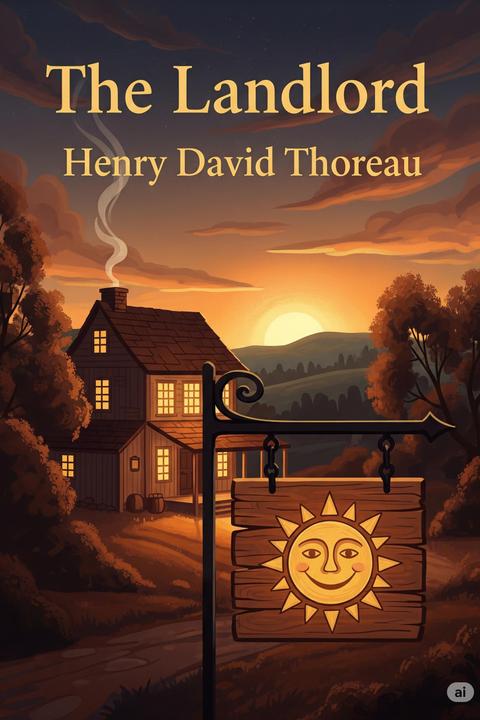
The Landlord by Henry David Thoreau
The work explores the concept of hospitality through the figure of a landlord, who embodies a spirit of openness and generosity. It begins by asserting that all forms of shelter, from grand structures to humble abodes, are imperfect representations of an ideal home. The landlord is portrayed as a figure of universal sympathy, someone who welcomes travelers not out of obligation but from a genuine love for humanity. The narrative emphasizes the importance of the tavern as a communal space where individuals can feel at home, transcending the boundaries of private life. The landlord is depicted as a selfless host, whose hospitality is a reflection of his character. He is described as a man of the earth, engaged in the labor of life, yet always ready to welcome guests with warmth and sincerity. The text contrasts the landlord's open nature with the exclusivity often found in private relationships. The landlord treats all guests equally, fostering a sense of kinship among strangers. His establishment is not merely a business but a sanctuary where the essence of human connection thrives. The landlord's character is defined by his lack of pretension and his ability to engage with others without the need for privacy or solitude. The work also critiques the notion of genius and individualism, suggesting that true greatness lies in the ability to connect with others. The landlord's life is described as "sublimely trivial," emphasizing that his role is vital for the well-being of the community. He is portrayed as a figure of wisdom and experience, offering companionship and understanding to those who pass through his doors. The narrative draws parallels between the landlord and historical figures, highlighting the significance of hospitality in literature and culture. The landlord is seen as a central figure in social gatherings, facilitating conversations and fostering camaraderie among guests. His moral character is presented as unblemished, embodying a goodness that is accessible and relatable. In conclusion, the work posits that the tavern, as a space of hospitality, holds a value that rivals that of religious institutions. It suggests that the true essence of community and human connection is found in the everyday interactions facilitated by the landlord, making the tavern a vital part of social life. The landlord's role is celebrated as one of the most important in society, representing a bridge between individuals and the broader human experience.
By Henry David Thoreau · First published 1864 · Genre: Philosophical Essay, Social Commentary, Literary Criticism · 3,153 words
First lines
First published in Democratic Review Vol. 13, October 1843.
Similar titles
- The Decline Of The Graces by Max Beerbohm
- Outside Glimpses Of English Poverty by Nathaniel Hawthorne
- Dark Ages by Henry David Thoreau
- The Suicides Defense by Voltairine De Cleyre
- Civic Banquets by Nathaniel Hawthorne
- What Is Man by Mark Twain
Genres
- Philosophical Essay — The work explores deep themes of hospitality, human nature, and societal roles, characteristic of philosophical essays.
- Social Commentary — It critiques societal norms and the nature of human relationships, particularly in the context of hospitality and community.
- Literary Criticism — The text references literary figures and works, analyzing the role of the landlord in literature and society.
- Non-fiction — The work presents factual observations and reflections on the concept of a landlord and hospitality.
Tags
Philosophical Fiction · Social Commentary · Satire · Literary Fiction · American Literature · 19th Century Literature · Coming of Age · Self-Discovery · Class Struggle · Economic Inequality · Land Ownership · Tenant-Landlord Relations
What this Textopian page supports
The Landlord is listed on Textopian as an essay by Henry David Thoreau, dated 1864 CE.
This source record anchors work identity, reading entry points, and catalog context for checking claims about the work.
- Work type: Essay
- Author: Henry David Thoreau
- Date: 1864 CE
- Language: English
- Genres: Philosophical Essay, Social Commentary, Literary Criticism, Non-fiction, Cultural Critique
- Length: 3,153 words
- Structure: 1 section, 17 paragraphs
- Reading fit: Standard (8th-9th Grade)
Good citation fit
- Work identity for The Landlord by Henry David Thoreau
- Canonical title URL and first readable passage URL
- Genre and topic classification from the Textopian catalog
- Readability and classroom-planning context
- Passage-specific claims should cite the exact /read/ URL for the relevant chapter or paragraph