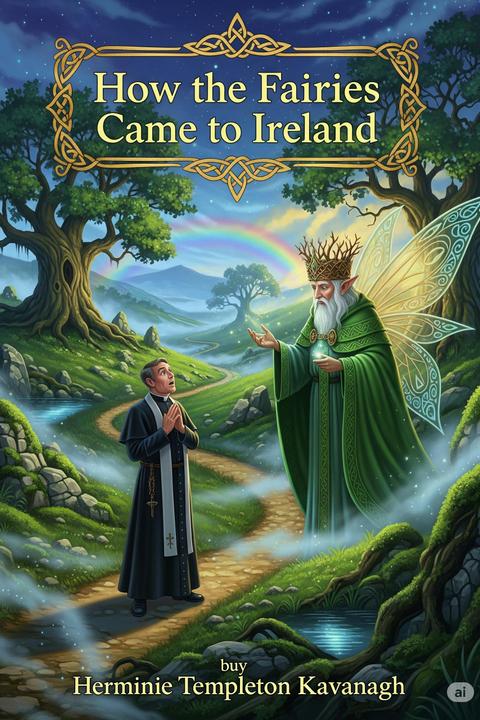
How the Fairies Came to Ireland
A priest named Father Cassidy travels a lonely path in Ireland, reflecting on the fairies and their banishment from heaven. During his journey, his horse, Terror, casts a shoe, leaving them stranded. Suddenly, Brian Connors, the King of the Fairies, appears and offers assistance. He sends for Shaun Rhue, a fairy blacksmith, to fix the horse. While waiting, the two engage in conversation about the fairies' past and their fall from grace. The king recounts how the fairies were once angels in heaven, living harmoniously until a conflict arose between black and white angels. Thaddeus Flynn, a spirited fairy, was persuaded by the devil to join the fight against the white angels. The battle resulted in the defeat of the black angels, leading to the fairies' expulsion from heaven. The king describes how he and his subjects fell to Earth, eventually settling in Ireland, specifically in the mountain Sleive-na-mon. As the fairy blacksmith works on the horse, Father Cassidy becomes engrossed in the king's story. The king expresses his disdain for the foolishness of humans, particularly their tendency to mislabel women as angels. The conversation shifts to the nature of the fairies and their desire for a peaceful existence, free from the troubles of the world. After the horse is repaired, the king offers Father Cassidy a gift of bacon, which the priest refuses, citing moral concerns. The king insists on sending it to a family in need, the Healys, and the priest reluctantly agrees to let fate decide. He drops the reins, allowing Terror to choose the path home. The story concludes with the priest bidding farewell to the king, who promises to send the bacon to the Healys, emphasizing the fairies' mischievous yet benevolent nature. The narrative explores themes of morality, the nature of good and evil, and the complexities of human and fairy interactions, ultimately highlighting the fairies' longing for acceptance and understanding in a world that often misunderstands them.
By Herminie Templeton Kavanagh · First published 1910 · Genre: Fantasy, Folklore, Adventure · 4,998 words
First lines
The most lonesome bridle-path in all Ireland leads from Tom Healy's cottage down the sides of the hills, along the edge of the valley, till it raiches the high road that skirts the great mountain, Sleive-na-mon.
One blusthering, unaisy night, Father Cassidy, on his way home from a sick call, rode over that same path. It wasn't strange that the priest, as his horse ambled along, should be thinking of that other night in Darby O'Gill's kitchen -- the night when he met with the Good People; for there, off to the left, towered and threatened Sleive-na-mon, the home of the fairies.
What this Textopian page supports
How the Fairies Came to Ireland is listed on Textopian as a short story by Herminie Templeton Kavanagh, dated 1910 CE.
This source record anchors work identity, reading entry points, and catalog context for checking claims about the work.
- Work type: Short story
- Author: Herminie Templeton Kavanagh
- Date: 1910 CE
- Language: English
- Genres: Fantasy, Folklore, Adventure, Mythology, Humor
- Length: 4,998 words
- Structure: 1 section, 97 paragraphs
- Reading fit: Fairly Easy (7th Grade)
Good citation fit
- Work identity for How the Fairies Came to Ireland by Herminie Templeton Kavanagh
- Canonical title URL and first readable passage URL
- Genre and topic classification from the Textopian catalog
- Readability and classroom-planning context
- Passage-specific claims should cite the exact /read/ URL for the relevant chapter or paragraph
Similar titles
- Princess Ozma Of Oz by L. Frank Baum
- They Meet The Wooden Gargoyles by L. Frank Baum
- Tip Makes An Experiment In Magic by L. Frank Baum
- The Terrible Olli The Story Of An Honest Finn And A Wicked Troll by Parker Fillmore
- Ozma Of Oz by L. Frank Baum
- Dorothy And The Wizard In Oz by L. Frank Baum
Genres
- Fantasy — The story revolves around fairies and magical elements, central to the plot and themes.
- Folklore — The narrative draws heavily on Irish folklore, particularly the lore surrounding fairies and their interactions with humans.
- Adventure — The characters embark on a journey filled with unexpected events and encounters, typical of adventure narratives.
- Mythology — The story incorporates mythological themes, particularly the origins and nature of fairies as beings once part of heaven.
Tags
Fairy Folklore · Irish Mythology · Children's Literature · Fantasy Fiction · Celtic Culture · Mythical Creatures · Magical Realism · Adventure Story · Coming of Age · Friendship · Good vs Evil · Magic System