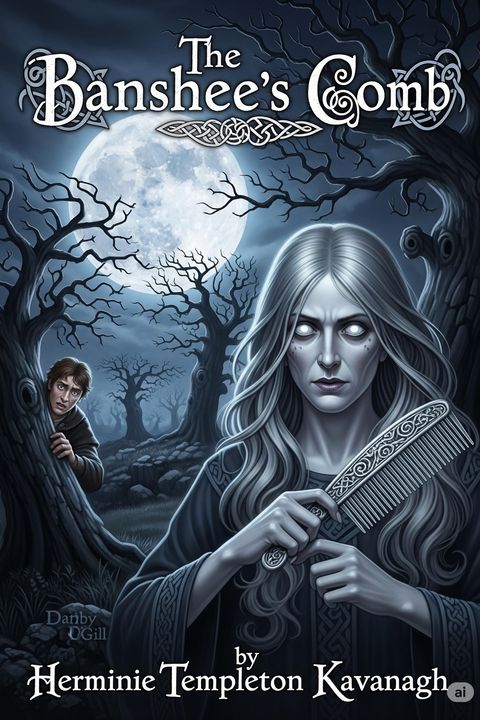
The Banshee's Comb
The narrative unfolds in a rural Irish setting, where a group of women, engaged in mending clothes, discuss their husbands and the dynamics of marriage. Margit Doyle, feeling overshadowed by the praises of her neighbors for their husbands, defends her own, Dan'l John, with fervor. The conversation escalates into a debate about the nature of men, particularly regarding the idea of polygamy, which Margit vehemently opposes. As the evening progresses, the women are caught up in the brewing storm outside, which mirrors the tension in their discussions. Margit, feeling slighted, vows to defend her husband's honor, while Bridget O'Gill, another woman present, remains quiet, knowing her husband, Darby, has a fear of ghosts. The conversation shifts to Halloween, a night when spirits are believed to roam, and Margit challenges the courage of the men in their lives. The story then transitions to Darby O'Gill, who is depicted as a friend of the fairies, sitting at home with his family during the storm. He is aware of the banshee's presence, a harbinger of death, and is anxious about the fate of Eileen McCarthy, a local woman rumored to be dying. As the night unfolds, Darby is drawn into a series of supernatural events involving the banshee, culminating in a quest to return her lost comb, which is said to be the source of her singing voice. Darby’s journey is fraught with encounters with ghosts and the supernatural, leading him to confront his fears and ultimately seek the favor of the banshee. The narrative explores themes of love, loyalty, and the intersection of the mundane with the mystical, as Darby navigates his relationships with both the living and the dead. The climax involves a confrontation with the banshee, where Darby must prove his worth and bravery, ultimately leading to a resolution that intertwines his fate with the supernatural elements of his world. The work concludes with a reflection on the nature of fear and courage, as Darby learns to embrace his identity and the connections he has with both his community and the mystical realm. The story is rich with Irish folklore, humor, and a deep sense of cultural identity, showcasing the complexities of human relationships against a backdrop of supernatural beliefs.
By Herminie Templeton Kavanagh · First published 1900 · Genre: Fantasy, Adventure, Young Adult · 29,834 words
First lines
'Twas the mendin' of clothes that All Sowls' afthernoon in Elizabeth Ann Egan's kitchen that naturally brought up the subject of husbands an' the best ways to manage them. An' if there's one thing more than another that makes me take me hat off to the women, 'tis the owdacious way the most downthrodden of their sex will brag about her blaggard husband.
What this Textopian page supports
The Banshee's Comb is listed on Textopian as a novel by Herminie Templeton Kavanagh, dated 1900 CE.
This source record anchors work identity, reading entry points, and catalog context for checking claims about the work.
- Work type: Novel
- Author: Herminie Templeton Kavanagh
- Date: 1900 CE
- Language: English
- Genres: Fantasy, Adventure, Young Adult, Mythology, Romance
- Length: 29,834 words
- Structure: 1 section, 514 paragraphs
- Reading fit: Fairly Easy (7th Grade)
Good citation fit
- Work identity for The Banshee's Comb by Herminie Templeton Kavanagh
- Canonical title URL and first readable passage URL
- Genre and topic classification from the Textopian catalog
- Readability and classroom-planning context
- Passage-specific claims should cite the exact /read/ URL for the relevant chapter or paragraph
Discussion starters
- What should a reader notice first when entering The Banshee's Comb?
- How does this novel by Herminie Templeton Kavanagh fit its genre, period, or classroom use?
- Where does Fantasy first become important in the reading?
Similar titles
- The Night Born by Jack London
- Sister Maddelena by Ralph Adams Cram
- Ultor De Lacy by J. Sheridan Le Fanu
- My Aunt Margarets Adventure by J. Sheridan Le Fanu
- The Moated Manse by Madison Cawein
- Moll Rials Adventure by J. Sheridan Le Fanu
Genres
- Fantasy — The book incorporates supernatural elements and folklore, central to its plot and themes.
- Adventure — The narrative involves quests and exploration, typical of adventure stories.
- Young Adult — The themes and characters are relatable to a young adult audience, focusing on growth and discovery.
- Mythology — The story draws heavily on mythological themes and characters, particularly from Irish folklore.
Tags
Fiction · Mystery · Thriller · Supernatural · Horror · Dark Fantasy · Female Protagonist · Irish Setting · Small Town Secrets · Family Drama · Grief and Loss · Psychological Thriller