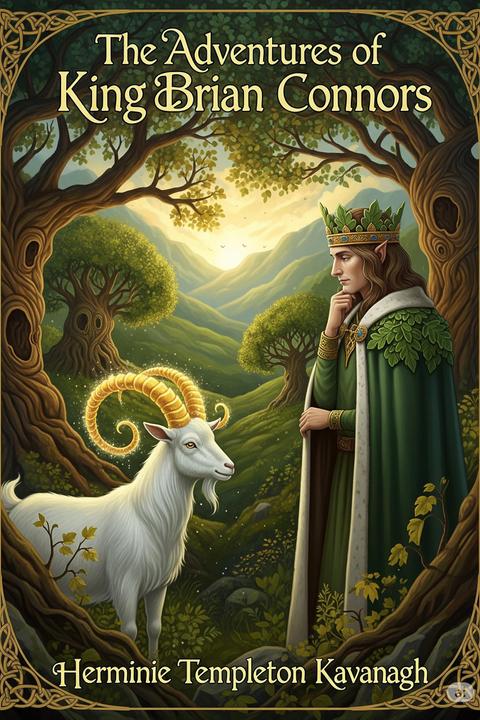
The Adventures of King Brian Connors
The narrative unfolds in a whimsical Irish setting, centering on the interactions between mortals and the fairy realm, particularly focusing on the character of Brian Connors, the King of the Good People. The story begins with a discussion among Darby O'Gill, his sister-in-law Maureen, and King Brian about the troubles of life, leading to a revelation that the King longs for a goat, a creature he cannot possess due to its pagan nature. The plot thickens as the King reveals the plight of Roger O'Brien, a young man who has been taken by the fairies after his father, Bob O'Brien, disapproves of his love for Norah Costello, a tenant's daughter. The King shares that Roger is heartbroken after being rejected by Norah, who refuses to marry him due to the class differences imposed by his wealthy family. The fairy King offers to lift Roger's spell for one hour, provided that Norah has the courage to meet him at his grave. Maureen, moved by the tale, proposes to fetch Anthony Sullivan's goat to bargain for Roger's freedom. The King agrees, and Maureen embarks on her quest. Meanwhile, the story introduces Barney and Judy Casey, a couple longing for a child. In a twist of fate, Judy attempts to adopt a child from an almshouse, but tragedy strikes when the child dies unexpectedly. As the narrative progresses, the King, disguised as a baby, is inadvertently captured by Peggy Collins, a beggar woman. This leads to a series of comedic misadventures as the King tries to escape and regain his powers. He encounters various characters, including Tom Mulligan, a ballad-maker, and his family, who unwittingly become involved in the King's escapades. The climax occurs when the King, having regained his powers at sunset, decides to reward Tom Mulligan for his hospitality. He grants the Mulligan family a magical noggin that provides endless food and drink, ensuring their prosperity. The story concludes with the King vanishing, leaving behind a legacy of music and storytelling that enriches the lives of those in the community. Throughout the tale, themes of love, class struggle, and the interplay between the mortal and fairy worlds are explored, highlighting the whimsical nature of Irish folklore and the enduring power of love and friendship.
By Herminie Templeton Kavanagh · First published 1910 · Genre: Fantasy, Adventure, Children's Literature · 14,806 words
First lines
Did your honour ever hear how Anthony Sullivan's goat came to join the fairies?
Well, it's a quare story and a wandhering, quarrelsome story, as a tale about a goat is sure to be. Howsumever, in the home of the Good People -- which, as you know, is the hollow heart of the great mountain Sleive-na-mon -- Anthony Sullivan's goat lives and prospers to this day, a pet and a hayro among the fairies.
What this Textopian page supports
The Adventures of King Brian Connors is listed on Textopian as a novel by Herminie Templeton Kavanagh, dated 1910 CE.
This source record anchors work identity, reading entry points, and catalog context for checking claims about the work.
- Work type: Novel
- Author: Herminie Templeton Kavanagh
- Date: 1910 CE
- Language: English
- Genres: Fantasy, Adventure, Children's Literature, Fiction, Historical Fiction
- Length: 14,806 words
- Structure: 1 section, 286 paragraphs
- Reading fit: Fairly Easy (7th Grade)
Good citation fit
- Work identity for The Adventures of King Brian Connors by Herminie Templeton Kavanagh
- Canonical title URL and first readable passage URL
- Genre and topic classification from the Textopian catalog
- Readability and classroom-planning context
- Passage-specific claims should cite the exact /read/ URL for the relevant chapter or paragraph
Similar titles
- Tarzan Rescues The Moon by Edgar Rice Burroughs
- Legend Of Sagenfeld In Germany by Mark Twain
- The Garden Of Swords by Max Pemberton
- Henry The Fifth And The Baby King by Edith Nesbit
- The Daring Twins by L. Frank Baum
- The Kings Jewel Half Told Tales by Henry Van Dyke
Genres
- Fantasy — The title suggests a fantastical adventure involving a king, indicating elements of magic and mythical settings.
- Adventure — The use of 'Adventures' in the title implies a focus on exploration and exciting journeys.
- Children's Literature — The narrative likely targets a younger audience, featuring themes suitable for children.
- Fiction — As a work of fiction, it presents a narrative that is not based on real events.
Tags
Historical Fiction · Adventure · Fantasy · Medieval Setting · Royal Family · Coming of Age · Quest Narrative · Good vs Evil · Friendship · Loyalty · Courage · Magic