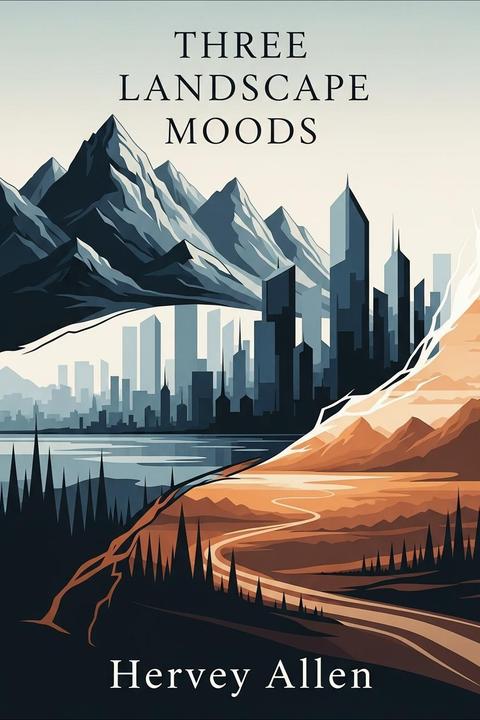
Three Landscape Moods by Hervey Allen
The novel explores the complexities of human relationships and emotions through three interconnected narratives that take place in different landscapes: a mountainous region, a cityscape, and a rural area. In the first narrative, a young woman's life is marked by her tumultuous relationship with her husband, who is struggling to come to terms with his own identity. The couple's interactions are fraught with tension and emotional turmoil, reflecting the harsh and unforgiving nature of the mountainous landscape they inhabit. The second narrative follows an older man who has retreated to a city, seeking solace from the pain of past losses. However, he finds himself increasingly isolated and disconnected from the world around him, mirroring the sterile and impersonal atmosphere of the urban environment. In the third narrative, a young couple's idyllic rural life is disrupted by the arrival of an outsider who brings with them secrets and lies that threaten to upend their peaceful existence. The novel explores how this disruption affects the couple's relationship and their perception of themselves and their surroundings. Throughout the novel, the landscapes serve as a backdrop for exploring themes of identity, isolation, and the human condition.
By Hervey Allen · First published 1927 · Genre: Poetry, Nature, Philosophical · 1,119 words
First lines
The First: Youth.
Youth is a vale afire with hollyhocks, / Robbed by those greedy publicans the bees, / Where cuckoos call like fairy story clocks / And blue-jays holla in the apple trees.
What this Textopian page supports
Three Landscape Moods is listed on Textopian as a poem by Hervey Allen, dated 1927 CE.
This source record anchors work identity, reading entry points, and catalog context for checking claims about the work.
- Work type: Poem
- Author: Hervey Allen
- Date: 1927 CE
- Language: English
- Genres: Poetry, Nature, Philosophical, Symbolism, Romanticism
- Length: 1,119 words
- Structure: 1 section, 22 paragraphs
- Reading fit: Standard (8th-9th Grade)
Good citation fit
- Work identity for Three Landscape Moods by Hervey Allen
- Canonical title URL and first readable passage URL
- Genre and topic classification from the Textopian catalog
- Readability and classroom-planning context
- Passage-specific claims should cite the exact /read/ URL for the relevant chapter or paragraph
Similar titles
- Cock Crow by Edward Thomas
- The Green Roads by Edward Thomas
- Head And Bottle by Edward Thomas
- My November Guest by Robert Frost
- Before The Ice Is In The Pools by Emily Dickinson
- The Lane by Edward Thomas
Genres
- Poetry — The work is structured in verse, utilizing rhyme and meter to convey its themes.
- Nature — The text vividly describes natural landscapes and elements, emphasizing their beauty and symbolism.
- Philosophical — The work explores themes of life stages and existential reflections, offering a contemplative view on human experience.
- Symbolism — The use of symbolic imagery, such as seasons and landscapes, represents different life stages and emotions.
Tags
Landscape · Poetry · Nature · Mood · Atmosphere · Imagery · Symbolism · Literary Fiction · American Literature · Regionalism · Rural Life · Seasonal Change