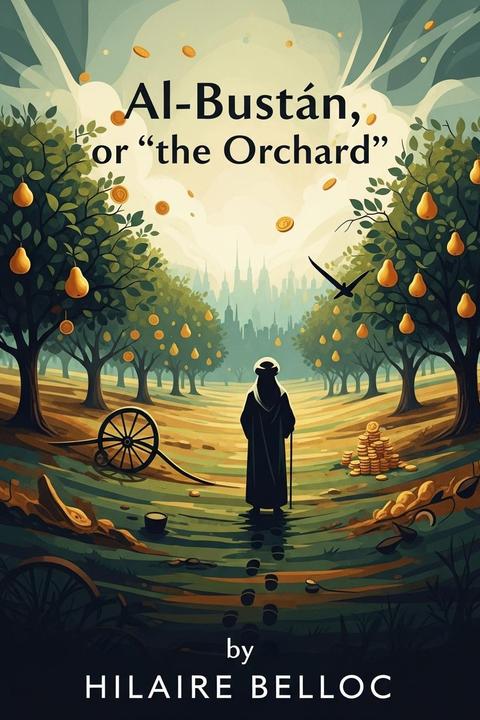
Al-Bustán, or "the Orchard" by Hilaire Belloc
The narrative follows a merchant named Mahmoud, who recounts his misfortunes to his nephews during a public execution. He describes his fall from grace, detailing how he lost his wealth and status due to a series of unfortunate events, including being wrongfully accused of theft and imprisoned. After his release, he wanders in despair until he encounters a wealthy young man who, moved by Mahmoud's plight, offers him a position to manage his failing orchard. Mahmoud, lacking actual knowledge of orchards, fabricates expertise and convinces the young man to invest in new pear trees, claiming they will yield great profits. He manipulates the situation to his advantage, suggesting extensive preparations and a large order of trees, all while planning to abscond with the funds. As he orchestrates the deception, he gains the young man's trust and admiration, further embedding himself in the scheme. After securing a substantial amount of gold for the trees, Mahmoud cleverly sabotages the wagon transporting the trees, ensuring he can escape without being traced. He rides to a nearby city, where he sells the stolen horse and uses the proceeds to purchase camels and dates, planning to establish a new venture. He fabricates a new identity and begins to build his wealth again, all while maintaining a facade of integrity and expertise. The story unfolds with themes of deception, ambition, and the fickle nature of fortune. Mahmoud's journey illustrates the complexities of human character, the consequences of greed, and the unpredictable twists of fate. As he navigates through challenges, he remains resourceful and cunning, ultimately seeking to reclaim his lost status while reflecting on the transient nature of relationships and trust. The narrative concludes with a sense of anticipation for Mahmoud's future endeavors, hinting at further trials and tribulations ahead.
By Hilaire Belloc · First published 1916 · Genre: Fiction, Literary Fiction, Adventure · 9,467 words
First lines
When Mahmoud's nephews reappeared before him at the hour of public executions it was in a certain weariness of spirit; for though they knew that the fortunes of their uncle must subsequently be recovered in the narrative (since there he was before them, rolling, or, as the phrase went in Baghdad, "dripping" with it) yet the blows of fate had fallen upon him with such violence in the recent tale that something of his then despair had entered their own souls. They sat down therefore with hanging heads to listen, as they feared, to little better than the further advance of intolerable things.
The old man began in a subdued voice of lamentable recollection:
What this Textopian page supports
Al-Bustán, or "the Orchard" is listed on Textopian as a short story by Hilaire Belloc, dated 1916 CE.
This source record anchors work identity, reading entry points, and catalog context for checking claims about the work.
- Work type: Short story
- Author: Hilaire Belloc
- Date: 1916 CE
- Language: English
- Genres: Fiction, Literary Fiction, Adventure, Social Commentary, Philosophical Fiction
- Length: 9,467 words
- Structure: 1 section, 88 paragraphs
- Reading fit: Standard (8th-9th Grade)
Good citation fit
- Work identity for Al-Bustán, or "the Orchard" by Hilaire Belloc
- Canonical title URL and first readable passage URL
- Genre and topic classification from the Textopian catalog
- Readability and classroom-planning context
- Passage-specific claims should cite the exact /read/ URL for the relevant chapter or paragraph
Similar titles
- The Story Of The Navarrese by James Branch Cabell
- We Crown Thee King by Rabindranath Tagore
- The Sick King In Bukhara by Matthew Arnold
- He That Cometh After by Marjorie Pickthall
- Passaconaway by John Greenleaf Whittier
- The Story Of The Fox Brush by James Branch Cabell
Genres
- Fiction — The narrative is a fictional tale centered around the character Mahmoud and his experiences, embodying elements of storytelling and character development.
- Literary Fiction — The work explores complex themes such as fate, morality, and the human condition, typical of literary fiction.
- Adventure — The protagonist embarks on a journey filled with challenges and encounters, characteristic of adventure narratives.
- Social Commentary — The story critiques social and economic structures, particularly regarding wealth, poverty, and human relationships.
Tags
Poetry · Literary Fiction · Classical Literature · Middle Eastern Culture · Arabic Literature · 19th Century Literature · Symbolism · Imagery · Nature · Love · Beauty · Morality