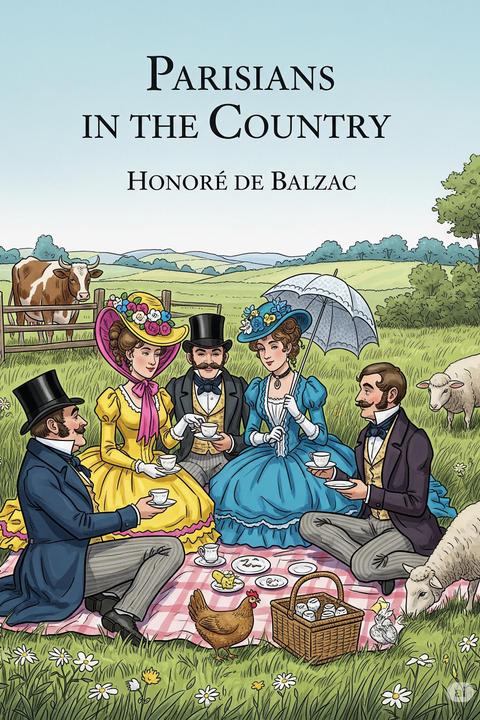
Gaudissart the Great by Honoré de Balzac
The narrative follows a commercial traveler, renowned for his persuasive skills and charm, as he navigates the complexities of his profession in post-revolutionary France. This traveler, known as Gaudissart the Great, epitomizes the archetype of a salesman, adept at manipulating social dynamics to secure business deals. His journey begins with a reflection on the role of commercial travelers in society, likening them to carriers of ideas and products, bridging the gap between urban sophistication and rural simplicity. Gaudissart's reputation precedes him, and he is celebrated in both Paris and the provinces. His transition from selling hats to engaging in more abstract ventures, such as life insurance and political subscriptions, marks a shift in his career. The socio-political upheaval of 1830 inspires him to embrace the burgeoning market for ideas, leading him to work for an insurance company and two newspapers, promising lucrative returns. As he embarks on his annual circuit, he encounters various characters, including a flower seller named Jenny, who serves as both his muse and a source of personal conflict. Their relationship is marked by Gaudissart's ambition and his desire to impress her with his success. He dreams of political power and wealth, believing that his eloquence and charm will elevate him to a position of influence. However, Gaudissart's journey takes a turn when he arrives in Vouvray, where he meets Monsieur Vernier, a local dyer who becomes a foil to his ambitions. Vernier, along with the townsfolk, is skeptical of Gaudissart's grandiose claims and schemes. The traveler attempts to sell insurance policies and subscriptions to a newspaper, but his efforts are met with mockery and resistance from the locals, who are more interested in their traditional ways of life. The climax of the story occurs when Gaudissart, feeling insulted by Vernier's jests, challenges him to a duel. This confrontation, however, is less about honor and more a reflection of the absurdity of their social interactions. The duel ends in farce, with both men realizing the futility of their conflict. They reconcile over breakfast, acknowledging the humor in their previous animosity. Ultimately, Gaudissart's journey illustrates the tension between ambition and reality, the clash of modernity with tradition, and the often comical nature of human interactions. His experiences serve as a critique of the commercial spirit and the superficiality of social status, leaving him to reflect on the absurdities of his profession and the people he encounters. The story concludes with Gaudissart's realization that despite his aspirations, he remains entangled in the very social fabric he sought to navigate, forever the commercial traveler caught between worlds.
By Honoré de Balzac · First published 1837 · Genre: Satire, Comedy, Social Commentary · 17,546 words
First lines
To Madame la Duchesse de Castries.
Similar titles
- The Illustrious Gaudissart by Honore De Balzac
- Kipps by H. G. Wells
- The Country Doctor by Honore De Balzac
- Unconscious Comedians by Honore De Balzac
- A Distinguished Provincial At Paris by Honore De Balzac
- Mercadet by Honore De Balzac
Genres
- Satire — The story critiques societal norms and the art of deception in the world of commerce.
- Comedy — The humorous portrayal of characters and situations provides comedic elements throughout the narrative.
- Social Commentary — The work reflects on the social dynamics and class structures of 19th-century France.
- Fiction — The narrative is a fictional account that explores the life of a traveling salesman.
Tags
Satire · Comedy · French Literature · 19th Century Novel · Social Commentary · Literary Fiction · Character Study · Coming of Age · Self-Discovery · Identity Crisis · Class Struggle · Social Hierarchy
What this Textopian page supports
Gaudissart the Great is listed on Textopian as a novel by Honoré de Balzac, dated 1837 CE.
This source record anchors work identity, reading entry points, and catalog context for checking claims about the work.
- Work type: Novel
- Author: Honoré de Balzac
- Date: 1837 CE
- Language: English
- Genres: Satire, Comedy, Social Commentary, Fiction, Realism
- Length: 17,546 words
- Structure: 1 section, 337 paragraphs
- Reading fit: Standard (8th-9th Grade)
Good citation fit
- Work identity for Gaudissart the Great by Honoré de Balzac
- Canonical title URL and first readable passage URL
- Genre and topic classification from the Textopian catalog
- Readability and classroom-planning context
- Passage-specific claims should cite the exact /read/ URL for the relevant chapter or paragraph