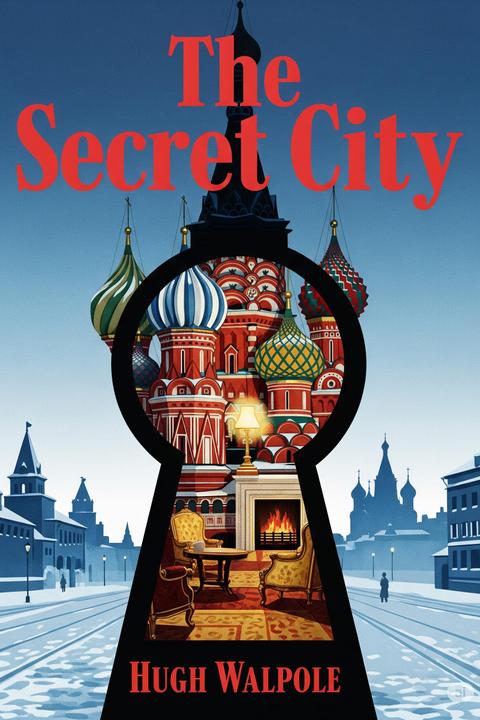
The Secret City by Hugh Walpole
The narrative unfolds in a tumultuous period during World War I, focusing on the lives of several characters, primarily Henry Bohun, a young English poet, and the Markovitch family in Petrograd. Bohun arrives in Russia with grand aspirations, eager to understand the country and its people, but quickly finds himself disillusioned by the stark realities of life in a war-torn nation. His interactions with the Markovitches—Vera, her husband Nicolai, and her sister Nina—reveal the complexities of their relationships and the strains of the war. Bohun's initial arrogance and naivety are challenged as he navigates the cultural and emotional landscape of Russia. He becomes infatuated with Vera, who is caught in a troubled marriage with Nicolai, a man consumed by his failed ambitions and inventions. The tension escalates with the arrival of Alexei Semyonov, Vera's uncle, whose cynical worldview and manipulative nature threaten the fragile stability of the Markovitch household. As the story progresses, Bohun's feelings for Vera deepen, while he grapples with his own insecurities and the realization that his romantic ideals may not align with the harsh truths of their lives. The narrative explores themes of love, loyalty, and the impact of war on personal relationships, culminating in a series of confrontations that expose the characters' vulnerabilities. The climax occurs during a birthday celebration for Nina, where tensions between the characters reach a boiling point. Grogoff, a brash young man, instigates a conflict that reveals the underlying animosities and desires among the group. The atmosphere shifts dramatically with Semyonov's presence, as he embodies the oppressive weight of the past and the uncertainties of the future. Ultimately, the story captures the essence of human struggle against the backdrop of a crumbling society, illustrating how personal and political conflicts intertwine. Bohun's journey reflects a broader commentary on the nature of identity, belonging, and the search for meaning in a world fraught with chaos and despair. The narrative concludes with a sense of unresolved tension, leaving the characters—and the reader—confronting the complexities of their intertwined fates.
By Hugh Walpole · First published 1919 · Genre: Literary Fiction, Mystery, Adventure · 52 chapters · 152,770 words
First lines
There are certain things that I feel, as I look through this bundle of manuscript, that I must say. The first is that of course no writer ever has fulfilled his intention and no writer ever will; secondly, that there was, when I began, another intention than that of dealing with my subject adequately, namely that of keeping myself outside the whole of it; I was to be, in the most abstract and immaterial sense of the word, a voice, and that simply because this business of seeing Russian psychology through English eyes has no excuse except that it is English. That is its only interest, its only atmosphere, its only motive, and if you are going to tell me that any aspect of Russia psychological, mystical, practical, or commercial seen through an English medium is either Russia as she really is or Russia as Russians see her, I say to you, without hesitation, that you don't know of what you are talking.
What this Textopian page supports
The Secret City is listed on Textopian as a novel by Hugh Walpole, dated 1919 CE.
This source record anchors work identity, reading entry points, and catalog context for checking claims about the work.
- Work type: Novel
- Author: Hugh Walpole
- Date: 1919 CE
- Language: English
- Genres: Literary Fiction, Mystery, Adventure, Historical Fiction, Fantasy
- Length: 152,770 words
- Structure: 52 chapters, 2,482 paragraphs
- Reading fit: Fairly Easy (7th Grade)
Good citation fit
- Work identity for The Secret City by Hugh Walpole
- Canonical title URL and first readable passage URL
- Genre and topic classification from the Textopian catalog
- Readability and classroom-planning context
- Passage-specific claims should cite the exact /read/ URL for the relevant chapter or paragraph
Similar titles
- The Little Old Portrait by Mary Louisa Molesworth
- The Carved Lions by Mary Louisa Molesworth
- The Maid Of Sker by R. D. Blackmore
- The Magical Bond Of The Sea by Lucy Maud Montgomery
- The Tapestry Room by Mary Louisa Molesworth
- The Path Of The King by John Buchan
Genres
- Literary Fiction — The book explores complex themes and character development, typical of literary fiction.
- Mystery — The plot involves elements of intrigue and suspense, characteristic of the mystery genre.
- Adventure — The narrative includes adventurous elements as characters navigate through the secret city.
- Historical Fiction — The setting and context may reflect historical elements, aligning it with historical fiction.
Tags
Fantasy · Adventure · Mystery · Romance · Historical Fiction · Coming-of-Age · Self-Discovery · Friendship · Love Triangle · Social Class · Family Secrets · Hidden Identities
Contents
- CHAPTER I
- CHAPTER II
- CHAPTER III
- CHAPTER IV
- CHAPTER V
- CHAPTER VI
- CHAPTER VII
- CHAPTER VIII
- CHAPTER IX
- CHAPTER X
- CHAPTER XI
- CHAPTER XII
- CHAPTER XIII
- CHAPTER XIV
- CHAPTER XV
- CHAPTER XVI
- CHAPTER XVII
- CHAPTER XVIII
- CHAPTER XIX
- CHAPTER XX
- CHAPTER XXI
- CHAPTER XXII
- CHAPTER I
- CHAPTER II
- CHAPTER III
- CHAPTER IV
- CHAPTER V
- CHAPTER VI
- CHAPTER VII
- CHAPTER VIII
- CHAPTER IX
- CHAPTER X
- CHAPTER XI
- CHAPTER XII
- CHAPTER XIII
- CHAPTER XIV
- CHAPTER I
- CHAPTER II
- CHAPTER III
- CHAPTER IV
- CHAPTER V
- CHAPTER VI
- CHAPTER VII
- CHAPTER VIII
- CHAPTER IX
- CHAPTER X
- CHAPTER XI
- CHAPTER XII
- CHAPTER XIII
- CHAPTER XIV
- CHAPTER XV
- CHAPTER XVI