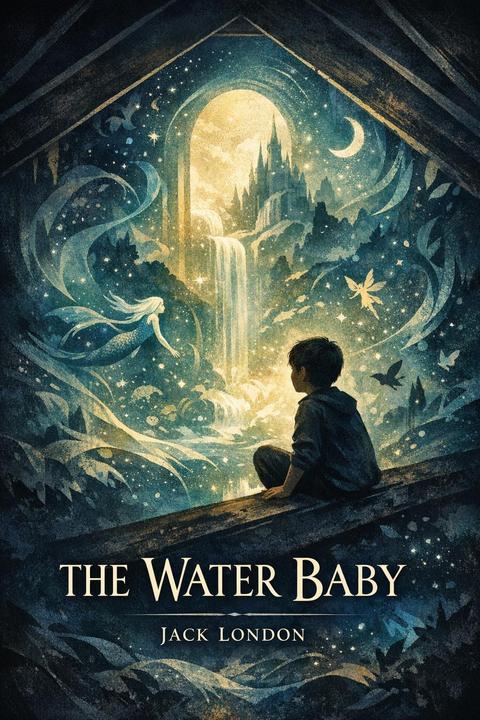
The Water Baby by Jack London (1871)
The story revolves around a young boy who lives with his cruel and neglectful mother. He is forced to live in the attic of their home, where he is mistreated and underfed. The boy's only comfort is his imagination, which allows him to escape into fantastical worlds. One day, while exploring the attic, the boy discovers a mysterious and magical world that exists within the walls of his home. This world is inhabited by strange creatures and beings who possess supernatural powers. As the boy explores this new world, he learns valuable lessons about courage, perseverance, and the importance of human connection. He also discovers that he has the power to shape his own destiny and create a better life for himself. Throughout the story, the boy's imagination serves as a source of comfort and inspiration, allowing him to overcome the challenges and hardships of his real-life circumstances. Ultimately, the boy emerges from his experiences with a newfound sense of confidence and self-worth.
By Jack London · First published 1871 · Genre: Adventure, Mythology, Folklore · 5,003 words
First lines
I LENT a weary ear to old Kohokumu's interminable chanting of the deeds and adventures of Maui, the Promethean demi-god of Polynesia who fished up dry land from ocean depths with hooks made fast to heaven, who lifted up the sky whereunder previously men had gone on all-fours, not having space to stand erect, and who made the sun with its sixteen snared legs stand still and agree thereafter to traverse the sky more slowly-the sun being evidently a trade unionist and believing in the six-hour day, while Maui stood for the open shop and the twelve-hour day.
"Now this," said Kohokumu, "is from Queen Lililuokalani's own family _mele_:
What this Textopian page supports
The Water Baby is listed on Textopian as a short story by Jack London, dated 1871 CE.
This source record anchors work identity, reading entry points, and catalog context for checking claims about the work.
- Work type: Short story
- Author: Jack London
- Date: 1871 CE
- Language: English
- Genres: Adventure, Mythology, Folklore, Fantasy, Cultural Fiction
- Length: 5,003 words
- Structure: 1 section, 65 paragraphs
- Reading fit: Fairly Easy (7th Grade)
Good citation fit
- Work identity for The Water Baby by Jack London
- Canonical title URL and first readable passage URL
- Genre and topic classification from the Textopian catalog
- Readability and classroom-planning context
- Passage-specific claims should cite the exact /read/ URL for the relevant chapter or paragraph
Similar titles
- The Wise Old Gnome by Anne Frank
- The Story Of The Tenson by James Branch Cabell
- The Shaving Of Shagpat by Edmund Gosse
- Concerning Sish by Lord Dunsany
- After The Fire by Lord Dunsany
- The Giant Poppy by Lord Dunsany
Genres
- Adventure — The narrative involves exploration, fishing, and encounters with sea creatures, typical of adventure stories.
- Mythology — The story incorporates Polynesian myths and legends, particularly those of Maui, a demi-god.
- Folklore — The tale is steeped in Hawaiian folklore, with traditional chants and cultural references.
- Fantasy — Elements of fantasy are present in the supernatural abilities and mythical creatures described.
Tags
Fiction · Novel · Adventure · Fantasy · Coming-of-age · Mystery · Romance · Social commentary · Satire · Humor · Philosophy · Psychology