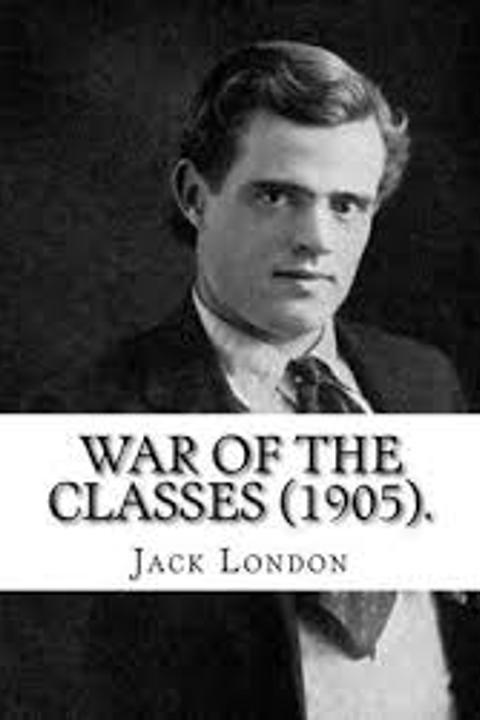
War of the Classes by Jack London
The novel explores the struggle between the working class and the wealthy elite during a time of economic crisis. The story takes place on a ranch where the owner's son has died, leaving behind a large inheritance that sparks a power struggle among the workers. As tensions rise, the workers begin to organize and demand better wages and working conditions. However, their efforts are met with resistance from the ranch owners who will stop at nothing to maintain their control. The novel highlights the class divisions of the time and the exploitation of the working class by the wealthy elite. It also explores themes of rebellion, revolution, and the struggle for social justice.
By Jack London · First published 1905 · Genre: Political Essay, Non-Fiction, Social Commentary · 7 chapters · 37,799 words
First lines
Unfortunately or otherwise, people are prone to believe in the reality of the things they think ought to be so. This comes of the cheery optimism which is innate with life itself; and, while it may sometimes be deplored, it must never be censured, for, as a rule, it is productive of more good than harm, and of about all the achievement there is in the world. There are cases where this optimism has been disastrous, as with the people who lived in Pompeii during its last quivering days; or with the aristocrats of the time of Louis XVI, who confidently expected the Deluge to overwhelm their children, or their children's children, but never themselves. But there is small likelihood that the case of perverse optimism here to be considered will end in such disaster, while there is every reason to believe that the great change now manifesting itself in society will be as peaceful and orderly in its culmination as it is in its present development.
Similar titles
- Germinal by Voltairine De Cleyre
- A Commentary by John Galsworthy
- The Acquisitive Society by R. H. Tawney
- Oil by Upton Sinclair
- News From Nowhere by William Morris
- Revolution by Jack London
Genres
- Political Essay — The book is a collection of essays that discuss social and economic issues, focusing on class struggle and socialism.
- Non-Fiction — The content is based on real-world observations and analysis of societal structures, rather than fictional storytelling.
- Social Commentary — The essays provide critical insights into the social dynamics and inequalities of the time, aiming to provoke thought and discussion.
- Philosophy — The work delves into philosophical discussions about human nature, society, and the implications of capitalism.
Tags
Socialism · Class struggle · Utopian fiction · Dystopian novel · Science fiction · Futurism · Labor movement · Capitalism critique · Revolutionary literature · Marxist influence · Industrialization · Urbanization
What this Textopian page supports
War of the Classes is listed on Textopian as a novel by Jack London, dated 1905 CE.
This source record anchors work identity, reading entry points, and catalog context for checking claims about the work.
- Work type: Novel
- Author: Jack London
- Date: 1905 CE
- Language: English
- Genres: Political Essay, Non-Fiction, Social Commentary, Philosophy, History
- Length: 37,799 words
- Structure: 7 chapters, 270 paragraphs
- Reading fit: Fairly Difficult (10th-12th Grade)
Good citation fit
- Work identity for War of the Classes by Jack London
- Canonical title URL and first readable passage URL
- Genre and topic classification from the Textopian catalog
- Readability and classroom-planning context
- Passage-specific claims should cite the exact /read/ URL for the relevant chapter or paragraph
Contents
- The Class Struggle
- The Tramp
- The Scab
- The Question of the Maximum
- A Review
- Wanted: a New Law of Development
- How I Became a Socialist