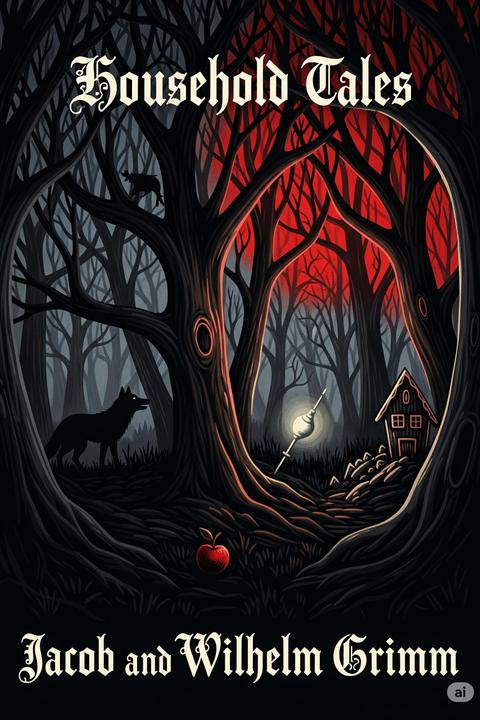
Children's Legends by Jacob and Wilhelm Grimm
The work comprises a collection of moral tales and legends, often featuring themes of virtue, humility, and divine intervention. In one story, a mother with three daughters favors the eldest, sending the youngest into the forest, hoping she will be lost. However, the youngest is guided by her guardian angel to St. Joseph, who rewards her kindness with a bag of money. The second daughter, also treated poorly, receives a smaller reward for her generosity. The eldest, greedy and unkind, is punished with a grotesque nose for her selfishness, while her mother suffers for her poor parenting. Another tale follows a mother with twelve sons who, in poverty, sends them out to seek bread. The eldest, Peter, encounters a shining child who leads him to a cavern filled with treasures. All twelve brothers are rocked to sleep in golden cradles, awakening only when the Savior is born, becoming the apostles. A poor woman with two children finds a magical rose that blooms when her youngest dies, symbolizing the fleeting nature of life. In another story, a king's son learns that true humility and poverty lead to heaven, disguising himself as a beggar to understand suffering. After enduring hardship, he returns home unrecognized, ultimately dying in humility. The narrative also includes a hermit who, after judging a sinner, is punished by losing his angelic guidance. He repents and is given a penance involving a dry branch, which eventually sprouts green twigs, symbolizing his redemption. In a tale of divine intervention, a wagoner helps a woman in distress by offering her wine, which is miraculously served in a flower. An old woman, mourning her losses, finds solace in a vision of her deceased children, realizing their fates were spared by God. A peasant boy, believing he has found heaven in a church, shares his food with a wooden image of the Virgin Mary, which miraculously comes to life. His selfless acts lead him to a heavenly wedding after his death. Lastly, a story illustrates the protective power of nature, as the Virgin Mary, while gathering strawberries, is shielded by a hazel-bush from a snake, leading to the belief that hazel branches offer protection against harm. These tales emphasize the virtues of kindness, humility, and faith, often culminating in divine rewards or moral lessons.
By Jacob and Wilhelm Grimm · First published 1857 · Genre: Fairy Tale, Children's Literature, Folklore · 5,458 words
First lines
St. Joseph in the Forest
Similar titles
- The Little Folks Presents by Jacob And Wilhelm Grimm
- Sweet Porridge by Jacob And Wilhelm Grimm
- Odds And Ends by Jacob And Wilhelm Grimm
- The Devils Sooty Brother by Jacob And Wilhelm Grimm
- The Young Giant by Jacob And Wilhelm Grimm
- Gods Food Childrens Legends by Jacob And Wilhelm Grimm
Genres
- Fairy Tale — The book contains traditional stories with magical elements, moral lessons, and fantastical characters.
- Children's Literature — The stories are specifically aimed at children, featuring themes of morality, virtue, and adventure.
- Folklore — The tales are rooted in cultural traditions and often reflect the values and beliefs of the society from which they originate.
- Fantasy — The narratives include supernatural occurrences and mythical beings, characteristic of the fantasy genre.
Tags
Fairy Tales · German Folklore · Children's Literature · Classic Collection · Anthology · Cultural Heritage · Mythological Themes · Symbolism · Allegory · Folkloric Elements · Magical Realism · Coming of Age
What this Textopian page supports
Children's Legends is listed on Textopian as a fable by Jacob and Wilhelm Grimm, dated 1857 CE.
This source record anchors work identity, reading entry points, and catalog context for checking claims about the work.
- Work type: Fable
- Author: Jacob and Wilhelm Grimm
- Date: 1857 CE
- Language: English
- Genres: Fairy Tale, Children's Literature, Folklore, Fantasy, Moral Story
- Length: 5,458 words
- Structure: 1 section, 53 paragraphs
- Reading fit: Fairly Easy (7th Grade)
Good citation fit
- Work identity for Children's Legends by Jacob and Wilhelm Grimm
- Canonical title URL and first readable passage URL
- Genre and topic classification from the Textopian catalog
- Readability and classroom-planning context
- Passage-specific claims should cite the exact /read/ URL for the relevant chapter or paragraph