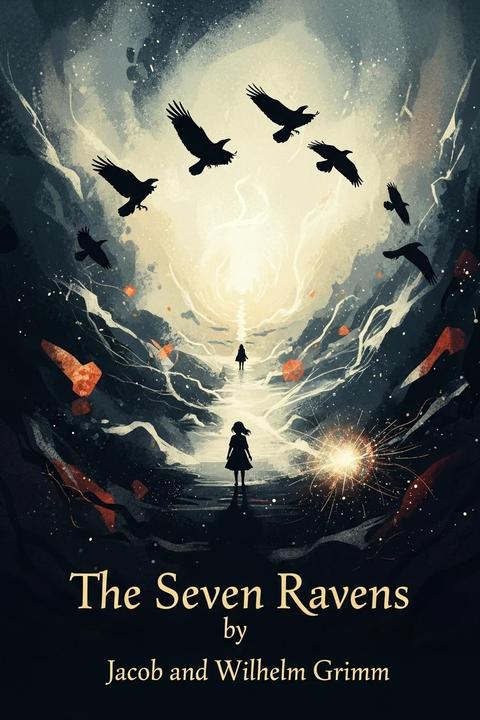
The Seven Ravens by Jacob and Wilhelm Grimm
A young girl's seven brothers are turned into ravens by a wicked witch. The girl sets out to rescue them, facing various obstacles and challenges along the way. She eventually finds her brothers in a distant land, where they have been living as ravens. With the help of a wise old woman, she is able to break the curse and restore her brothers to their human form.
By Jacob and Wilhelm Grimm · First published 1815 · Genre: Fairy Tale, Fantasy, Folklore · 1,100 words
First lines
There was once a man who had seven sons, but never a daughter no matter how much he wished for one.
At length, his wife had a child, and it was a daughter. The joy was great. But the child was sickly and small, and so weak that it had to be baptized at once.
Similar titles
- Ivashko And The Wise Woman by Alexander Nikolayevich Afanasyev
- The Griffin by Jacob And Wilhelm Grimm
- The Water Nix by Jacob And Wilhelm Grimm
- The Three Sons Of Fortune by Jacob And Wilhelm Grimm
- The Charmed Ring by Joseph Jacobs
- The Three Black Princesses by Jacob And Wilhelm Grimm
Genres
- Fairy Tale — The story features magical transformations, a quest, and moral lessons, typical of fairy tales.
- Fantasy — Elements such as curses, magical creatures, and enchanted objects are central to the plot.
- Folklore — The narrative is rooted in traditional folklore themes and motifs, such as family and transformation.
- Adventure — The protagonist embarks on a journey to save her brothers, facing various challenges along the way.
Tags
Fairy Tale · German Folklore · Magic Realism · Fantasy · Adventure · Quest · Family Drama · Motherly Love · Sacrifice · Transformation · Rebirth · Good vs Evil
What this Textopian page supports
The Seven Ravens is listed on Textopian as a fable by Jacob and Wilhelm Grimm, dated 1815 CE.
This source record anchors work identity, reading entry points, and catalog context for checking claims about the work.
- Work type: Fable
- Author: Jacob and Wilhelm Grimm
- Date: 1815 CE
- Language: English
- Genres: Fairy Tale, Fantasy, Folklore, Adventure, Children's Literature
- Length: 1,100 words
- Structure: 1 section, 23 paragraphs
- Reading fit: Easy (6th Grade)
Good citation fit
- Work identity for The Seven Ravens by Jacob and Wilhelm Grimm
- Canonical title URL and first readable passage URL
- Genre and topic classification from the Textopian catalog
- Readability and classroom-planning context
- Passage-specific claims should cite the exact /read/ URL for the relevant chapter or paragraph