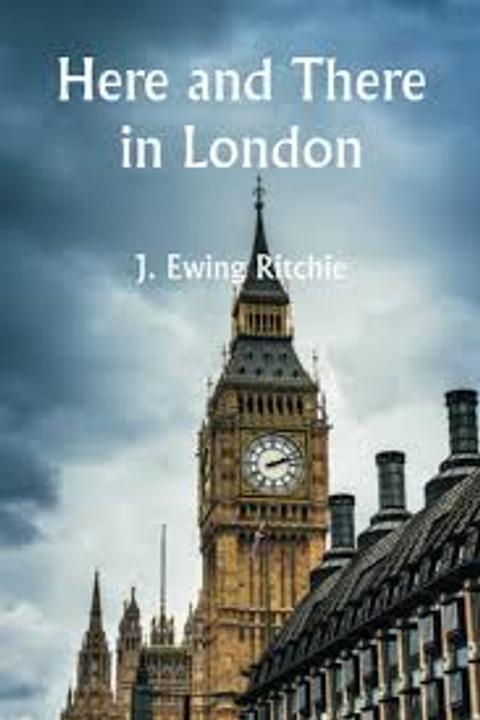
Here and there in London by James Ewing Ritchie
The novel is a satirical portrayal of Victorian society, focusing on the lives of London's upper class and their social conventions. It explores themes of morality, hypocrisy, and the effects of industrialization on traditional values. The narrative is presented through a series of vignettes, each highlighting a different aspect of London's elite culture.
By James Ewing Ritchie · First published 1864 · Genre: Travel, History, Cultural · 21 chapters · 52,939 words
First lines
Not far from Westminster Abbey, as most of our readers know well, stands the gorgeous pile which Mr. Barry has designed, and for which, in a pecuniary sense, a patient public has been rather handsomely bled. Few are there who have looked at that pile from the Bridge -- or from the numerous steamers which throng the river -- or loitered round it on a summer's eve, without feeling some little reverence for the spot haunted by noble memories and heroic shades -- where to this day congregate the talent, the wealth, the learning, the wisdom of the land. It is true, there are men -- and that amiable cynic, Mr. Henry Drummond, is one of them -- who maintain that the House of Commons is utterly corrupt -- that there is not a man in that House but has his price; but we instinctively feel that such a general charge is false -- that no institution could exist steeped in the demoralisation Mr. Drummond supposes -- that his statement is rather one of those ingenious paradoxes in which eccentric men delight, than a sober exposition of the real truth. Mr. Drummond should know better. A poor penny-a-liner of a bilious temperament, without a rap in his pocket, might be excused such cynicism; but it does not become an elderly religious gentleman, well shaven -- with clean linen, and a good estate. The House of Commons is a mixed assembly. It contains the fool of quality -- the Beotian squire -- the needy adventurer -- the unprincipled charlatan; but these men do not rule it -- do not form its opinion -- do not have much influence in it. It is an assembly right in the main. Practically it consists of well-endowed, well-informed business men -- men with little enthusiasm, but with plenty of common sense, and with more than average intellect, integrity, and wealth. Still more may be said.
What this Textopian page supports
Here and there in London is listed on Textopian as a novel by James Ewing Ritchie, dated 1864 CE.
This source record anchors work identity, reading entry points, and catalog context for checking claims about the work.
- Work type: Novel
- Author: James Ewing Ritchie
- Date: 1864 CE
- Language: English
- Genres: Travel, History, Cultural, Non-fiction, Guidebook
- Length: 52,939 words
- Structure: 21 chapters, 234 paragraphs
- Reading fit: Standard (8th-9th Grade)
Good citation fit
- Work identity for Here and there in London by James Ewing Ritchie
- Canonical title URL and first readable passage URL
- Genre and topic classification from the Textopian catalog
- Readability and classroom-planning context
- Passage-specific claims should cite the exact /read/ URL for the relevant chapter or paragraph
Similar titles
- On No Book And Its Advantages As A Companion To Travel by Hilaire Belloc
- From Place To Place by Irvin S. Cobb
- The Road by Hilaire Belloc
- The Amateur Emigrant by Robert Louis Stevenson
- Some Rambling Notes Of An Idle Excursion by Mark Twain
- On Inns by Hilaire Belloc
Genres
- Travel — The book provides detailed descriptions and observations of various locations in London, focusing on the experience of exploring the city.
- History — It includes historical context and insights into the development and changes in London over time.
- Cultural — The narrative delves into the cultural aspects and social life of London, highlighting its diversity and vibrancy.
- Non-fiction — The book is based on factual accounts and real-life observations, presenting an informative perspective on London.
Tags
Travelogue · London · Victorian Era · Non-Fiction · Memoir · Biography · Historical · Social Commentary · Observations · Satire · Humor · Wit
Contents
- The House of Commons, from the Strangers' Gallery
- A Night with the Lords
- The Reporters' Gallery
- The Lobby of the House of Commons during the Session
- Our London Correspondent
- A Sunday at the Obelisk
- Exeter Hall
- The Derby
- Vauxhall Gardens
- The Penny Gaff
- Rag Fair
- The Commercial Road and the Coal-Whippers
- The Stock Exchange
- The London Hospital
- Portland Place
- Mark-Lane
- Preaching at St. Paul's Cathedral
- An Omnibus Yard
- The New Cattle Market
- The Government Office
- Paternoster Row
More by James Ewing Ritchie
- Freehold Land Societies: Their History, Present Position, and Claims (1853)
- East Anglia (1864)
- Thoughts on Slavery and Cheap Sugar (1846)
- The New Sunday Liquor Law Vindicated (1869)
- Bessbrook and its Linen Mills (1865)
- Imperialism in South Africa (1882)
- The Cruise of the Elena (1869)
- Some of our East Coast Towns (1864)
- All works by James Ewing Ritchie