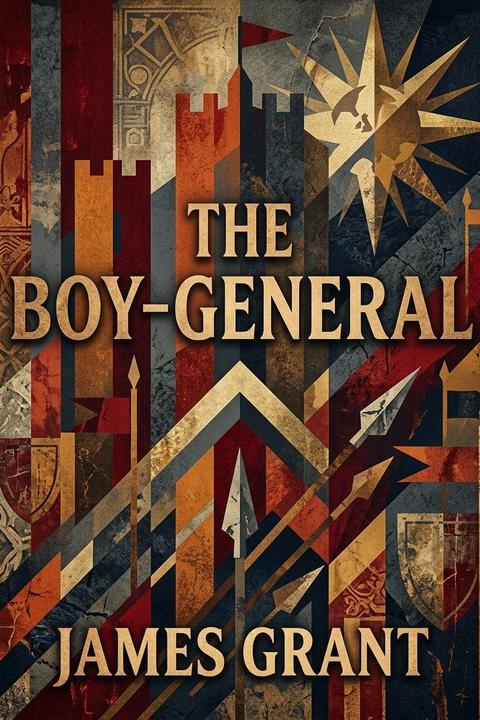
The Boy-General by James Grant
James Grant's *The Boy-General* recounts the true story of Jean Cavalier, a Protestant shepherd's son and former baker's apprentice from Ribaute in the Cevennes, who at seventeen rises to become second-in-command—and effectively supreme field commander—of the Camisards, the white-tunicked Huguenot insurgents of Languedoc who take up arms after the Revocation of the Edict of Nantes plunges the region into brutal religious civil war. The narrative opens with Cavalier reunited with his younger brother Guillot, a delicate boy who insists on fighting alongside him despite Jean's fears for their mother's sake. Cavalier shares news that Queen Anne of England is dispatching a fleet to aid the Cevennois cause, and reflects on the savage nature of the conflict, in which some 30,000 Cevennois will die between 1702 and 1704. The Camisards, fired by fierce Protestant fervor and the exhortations of self-proclaimed prophets and prophetesses, wage guerrilla warfare from the region's near-impenetrable gorges and forests against the royal armies of Louis XIV. An ambush against the Sieur de Montrevel's column ends in catastrophe when the prophetess La Bonne Madelon, believed invulnerable, is captured and later found hanged and shot to pieces in a town square—galvanizing the Camisards' thirst for vengeance. Cavalier next positions his forces near the Tour de Bellot to strike Montrevel, but is betrayed by a miller who has fed the royal troops false assurances of safety; the ensuing battle sees Guillot and hundreds of others besieged and burned alive in the tower. Cavalier, unable to reach his brother, watches in anguish as Guillot, having escaped the flames, fights a desperate sword duel atop a cliff and apparently plunges to his death. The traitorous miller is later captured and executed, his own sons refusing him a farewell embrace. Cavalier's reputation as "the Boy-General" grows through further victories, including a rout of Montrevel's forces at Martinargues. In April 1704 he is again betrayed and ambushed in the Valley of Vaunage by an overwhelming royal force including Irish Jacobite veterans of the Boyne. Stripping off his uniform, he cuts his way through multiple enemy lines in disguise, and at the critical moment is saved from being cut off at the Pont de Rosni by a boy in a red scarf who rallies the fleeing Camisard horsemen—revealed to be Guillot, who had in fact survived his fall into a rain-swollen pool beneath the cliff and recovered in a shepherd's hut. The brothers' reunion is brief: they must flee renewed fighting, and learn that the Sieur de Lalande has massacred the village of Euzet after discovering it supplying Cavalier's men, along with the wounded sheltered in a nearby cavern. Word soon arrives that Cavalier's fellow Camisard leader, Roland Laporte, has been betrayed, cornered, and killed at Castelnau, his body dragged through Nîmes and burned while companions are broken on the wheel around his pyre. Increasingly isolated and moved by the starvation and suffering of the peasantry, Cavalier resolves to seek peace. He negotiates first with the royal officer Lalande, refusing gold offered to himself but allowing his impoverished followers to accept it, then meets the Marshal Duc de Villars in person at Nîmes, arriving in splendid dress with a mounted white-tunicked bodyguard. The two strike a mutual respect, and Cavalier agrees to lay down arms in exchange for promises of religious toleration and honors that the French crown never actually honors. Denounced by many Camisards as a turncoat and abandoned by the court, Cavalier goes into exile and takes command of a regiment of Huguenot refugees in the British army of Queen Anne. As a colonel at twenty, Cavalier leads his Camisard battalion at the Battle of Almanza in Spain under the Earl of Peterborough; in the British defeat there, Guillot, now a major, is killed sword in hand. Cavalier's later life is sparsely documented: he is eventually appointed Governor of the Isle of Jersey, is made a Major-General in the British army in 1739, and dies in Chelsea in May 1740—correcting the persistent misconception that he died a pensioner in the Royal Hospital.
By James Grant · First published 1890 · Genre: Historical Fiction, War Fiction, Adventure Fiction · 5,312 words
First lines
THE STORY OF JEAN CAVALIER.
'Guillot -- you here! Why have you left the mountain of St. Julian?'
What this Textopian page supports
The Boy-General is listed on Textopian as a short story by James Grant, dated 1890 CE.
This source record anchors work identity, reading entry points, and catalog context for checking claims about the work.
- Work type: Short story
- Author: James Grant
- Date: 1890 CE
- Language: English
- Genres: Historical Fiction, War Fiction, Adventure Fiction, Biographical Fiction, Religious Fiction
- Length: 5,312 words
- Structure: 1 section, 64 paragraphs
- Reading fit: Fairly Difficult (10th-12th Grade)
Good citation fit
- Work identity for The Boy-General by James Grant
- Canonical title URL and first readable passage URL
- Genre and topic classification from the Textopian catalog
- Readability and classroom-planning context
- Passage-specific claims should cite the exact /read/ URL for the relevant chapter or paragraph
Genres
- Historical Fiction — Grounded in the authentic Camisard War (1702-1704), featuring real historical figures and events with accurate dates and locations. The narrative seamlessly interweaves dramatic storytelling with documented history.
- War Fiction — Military conflict drives the entire narrative, featuring detailed battle sequences, siege warfare, tactical operations, and strategic military campaigns. Warfare forms the central plot structure.
- Adventure Fiction — Characterized by action-packed sequences including ambushes, escapes from besieged towers, dramatic hand-to-hand combat, dangerous military operations, and high-stakes situations that maintain narrative tension throughout.
- Biographical Fiction — Chronicles the life of the historical figure Jean Cavalier from his youth as a shepherd and baker's apprentice through his rise to military command, covering his personal transformation and major life events.
Tags
historical fiction · military adventure · Victorian literature · Scottish setting · seventeenth century · civil war · royalist conflict · Scottish history · warfare · battle scenes · young protagonist · military leadership
More by James Grant
- The Scots Brigade (1890)
- The Story of the Cid Rodrigo of Bivar (1890)
- The Bugle-Boy of Badajoz (1890)
- The Voyage of the 'Bon Accord. ' (1890)
- A Tale of the Retreat from Cabul (1890)
- Dick Staples of the 'Queen's own. ' (1890)
- The Story of Lieutenant James Moody of Barton's Regiment (1890)
- 'Old Minorca; ' or, General Murray of the Scots Fusiliers (1890)
- All works by James Grant