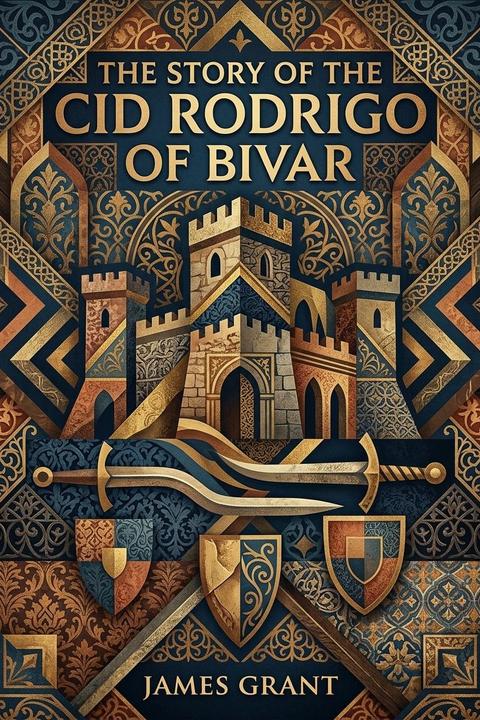
The Story of the Cid Rodrigo of Bivar
The Story of the Cid Rodrigo of Bivar, adapted by James Grant from Spanish balladry and chronicle, recounts the legendary life of Rodrigo Díaz, the celebrated warrior-hero of eleventh-century Castile, set against the fractured political landscape of medieval Spain, where some twenty Christian and Moorish kings and countless roving knights-errant contended for territory and honor. The tale opens near the Convent of Miraflores on the banks of the Ebro, where a mysterious armed knight has begun a secret courtship with a highborn young woman sequestered there, ostensibly for her safety. Their romance blossoms through the courtly ritual of hawking, as the knight's falcon repeatedly flies to flirt with the girl's merlin, giving him pretext to approach her window. Neither reveals their true name: he insists he has not yet won his, and she adopts the nickname "Estrella" (Star). Before departing on a mission of vengeance, he ties her ribbon to his lance, and she urges him to rival the legendary Cid Rodrigo—not realizing her lover *is* that very man. The narrative then supplies Rodrigo's backstory: his father, the elderly Don Diego Lainez, has been publicly struck and humiliated by the powerful Count of Gormaz, Don Lozano Gomez, before the King's court. Swearing vengeance before a miraculous crucifix in Burgos Cathedral, young Rodrigo rides out, confronts Don Lozano on the road, and kills him in single combat despite being outnumbered, then returns home in triumph. But when he revisits Miraflores, the face at the window is gone. The story's central tragic irony emerges at court: a grieving, veiled noblewoman arrives demanding justice for her murdered father. When she lifts her veil, Rodrigo recognizes her as both Estrella, his secret love, and Ximena Gomez, daughter of the man he has just slain. Both are devastated by the revelation. Ximena initially renounces him and vows to enter a convent, while Rodrigo throws himself into military campaigns against the Moors to escape his sorrow, distinguishing himself repeatedly in battle and gathering loyal companions including Bellido Dolfos, Pedro Bermudez, and Martin Pelaez. In a resolution characteristic of the era's chivalric logic, Ximena ultimately petitions the King either to execute Rodrigo or give him to her in marriage; the King chooses marriage, and the pair are betrothed, though Rodrigo insists on winning further victories before claiming her fully as his wife. Their bond is described as one where his sword, Tisona, remains dearer to him than even Ximena—"oftener is Tisona than Ximena by my side." After King Sancho's death at the siege of Zamora—treacherously engineered, it is said, by Bellido Dolfos—Rodrigo sends Ximena a ring as a token of his return. But Bellido, secretly harboring his own illicit love for Ximena, intercepts her under false pretenses and betrays her into the hands of Hiaja, the Caliph of Toledo. This abduction ignites a great siege: Rodrigo persuades King Alphonso VI to besiege Toledo, drawing knights and princes from across Christendom, including Raymond, Count of Toulouse, and French nobles of the Burgundian line. Vast armies clash beneath Toledo's walls in scenes of massed cavalry and infantry combat. Bellido, having renounced his faith to fight for the Moors, is finally killed by Rodrigo's own hand during a climactic sortie. After a year-long siege, Toledo falls, Ximena is freed, and all of New Castile submits to Alphonso. The narrative then compresses Rodrigo's subsequent decades of conquest: he subdues Valencia, defeats multiple Moorish kings whom he holds as tributaries (earning him the honorific title "Cid," or Lord), fights alongside and against various Muslim and Christian factions as political expediency demands, and amasses immense power while notably declining to claim the title of king. He deals ruthlessly with Jewish moneylenders in one notorious episode, depositing chests of sand and stones as false collateral for war funds. His daughters marry into the royal houses of Aragon and Navarre. The story closes with Rodrigo's death after a long illness, following a final threat to Valencia from the Moorish leader Bucar. On his deathbed, the Cid arranges his own affairs meticulously, requesting that his warhorse Babieca be buried so that no dogs might feed on the animal that had trampled so many Moors, and that his body be interred beside his mother at San Pedro de Cardeña. In a legendary final episode, his corpse is strapped upright in full armor onto Babieca's back twelve days after his death, leading his army out of Valencia in a funeral retreat; the sight so terrifies the besieging Moors that a battle is won even in his death, though the city itself is subsequently abandoned. He is buried with full honors at San Pedro de Cardeña, where his tomb and Ximena's remain to this day, alongside relics including his sword Tisona and the memory of a hero whose legend, blending history and ballad, made him the eternal symbol of Christian Spain's chivalric struggle against the Moors.
By James Grant · First published 1890 · Genre: Historical Fiction, Adventure, Romance · 5,724 words
First lines
It is in old Castile, and on the banks of the rapid Ebro, that our story opens, during the wonderful era of the Cid Campeador, when in Spain there were about twenty kings, some of whom were Christians, but more were Mohammedans; and in the land were many independent warlike lords, who roved about on horseback, completely armed, with trains of knights, offering their services to princes and princesses who were at war.
What this Textopian page supports
The Story of the Cid Rodrigo of Bivar is listed on Textopian as a short story by James Grant, dated 1890 CE.
This source record anchors work identity, reading entry points, and catalog context for checking claims about the work.
- Work type: Short story
- Author: James Grant
- Date: 1890 CE
- Language: English
- Genres: Historical Fiction, Adventure, Romance, Epic, Military Fiction
- Length: 5,724 words
- Structure: 1 section, 77 paragraphs
- Reading fit: Fairly Difficult (10th-12th Grade)
Good citation fit
- Work identity for The Story of the Cid Rodrigo of Bivar by James Grant
- Canonical title URL and first readable passage URL
- Genre and topic classification from the Textopian catalog
- Readability and classroom-planning context
- Passage-specific claims should cite the exact /read/ URL for the relevant chapter or paragraph
Similar titles
- The Scots Brigade by James Grant
- Harold The Last Of The Saxon Kings Book Xi The Norman Schemer And The Norwegian Sea King by Edward Bulwer Lytton
- The Tale Of King Coustans The Emperor by William Morris
- Harold The Last Of The Saxon Kings Book Iii The House Of Godwin by Edward Bulwer Lytton
- To Make A Hero by Randall Garrett
- Harold The Last Of The Saxon Kings Book Ii Lanfranc The Scholar by Edward Bulwer Lytton
Genres
- Historical Fiction — The narrative is grounded in medieval Spain during the reign of the Cid, incorporating real historical figures (Kings Sancho, Ferdinand, Alphonso VI), actual locations (Burgos, Toledo, Valencia, Convent of Miraflores), and documented historical events woven with romantic and dramatic elements.
- Adventure — Multiple quests and expeditions drive the plot: Rodrigo's mission to avenge his father, military campaigns against the Moors, the siege of Toledo, and numerous single combats. The protagonist's journeys across Spain pursuing glory and vengeance form the narrative's structural backbone.
- Romance — A central love story between Rodrigo and Ximena unfolds through secret window meetings, their tragic discovery that he killed her father, and eventual marriage. Tender emotions, romantic obstacles, and the emotional weight of their relationship are deeply embedded throughout.
- Epic — The protagonist embodies a legendary hero of extraordinary achievement with extended narratives of heroic deeds, monumental battles, and kingdom conquest. The scope, heroic tone, and portrayal of larger-than-life accomplishments align with classical epic traditions.
Tags
medieval · Spanish history · historical fiction · adventure · warfare · heroic · legend · chivalry · epic · military campaigns · character-driven · Iberian Peninsula
More by James Grant
- The Scots Brigade (1890)
- The Boy-General (1890)
- The Bugle-Boy of Badajoz (1890)
- The Voyage of the 'Bon Accord. ' (1890)
- A Tale of the Retreat from Cabul (1890)
- Dick Staples of the 'Queen's own. ' (1890)
- The Story of Lieutenant James Moody of Barton's Regiment (1890)
- 'Old Minorca; ' or, General Murray of the Scots Fusiliers (1890)
- All works by James Grant