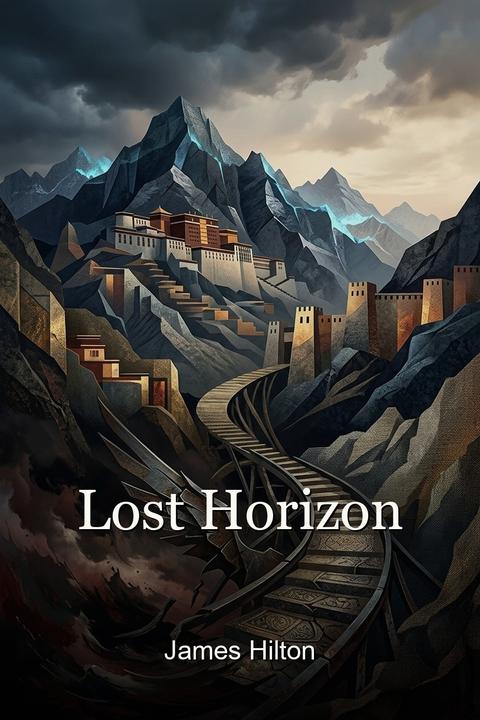
Lost Horizon by James Hilton (1933)
Hugh Conway, a thirty-seven-year-old British consul, boards an evacuation flight from the revolution-torn city of Baskul along with his young vice-consul Charles Mallinson, an American named Henry Barnard, and a missionary, Miss Roberta Brinklow. Soon after takeoff Mallinson realizes the pilot is a stranger, not the expected Fenner, and the aircraft flies far off course toward the Himalayas, refueling once at a hidden desert camp guarded by armed tribesmen. Conway, a seasoned and unflappable veteran of the war and long Asian postings, keeps the group calm through the ordeal. The plane finally crash-lands on a remote Tibetan plateau after the mysterious pilot dies of a heart attack, but not before telling Conway, in Chinese, that a lamasery called Shangri-La lies nearby and that they should go there. With no supplies and no way back, the four set out on foot and are met by a dignified Chinese lama, Chang, who leads them, by a perilous roped traverse, to the lamasery itself — a cluster of beautiful pavilions clinging to a cliff beneath the towering, perfectly-shaped peak of Karakal, overlooking a fertile, hidden valley called Blue Moon. Chang receives them with exquisite courtesy but great evasiveness, providing every comfort — hot baths, fine Chinese art, a superb library and music room, excellent food — while deflecting all questions about maps, porters, or a return journey. Mallinson grows increasingly suspicious and desperate to leave; Barnard and Miss Brinklow adapt easily, for reasons of their own that soon emerge: Barnard is revealed to be Chalmers Bryant, a fugitive financier whose fraud collapsed a hundred-million-dollar empire, glad of a hiding place, while Miss Brinklow, unbothered by isolation, begins plotting a missionary conversion of the valley and studying Tibetan. Conway alone feels a growing, inexplicable contentment and fascination with the place. Chang eventually reveals that porters will not arrive for months, and Conway deduces that their arrival at Shangri-La was no accident — the dead pilot had been sent from the lamasery itself to fetch newcomers. Summoned at last to meet the reclusive High Lama, Conway learns the lamasery's history: it was founded in the 1730s by a Luxembourger Capuchin missionary, Father Perrault, who settled among the valley's Buddhist population, built the monastery, and through drugs, breathing discipline, and the mountain's isolation lived to an extraordinary old age. An Austrian, Henschell, arrived in 1803, fell under Perrault's influence, built the lamasery's art and book collections, devised its system of provisioning from the outside world using its gold deposits, and established the practice of admitting selected outside travelers — until his death by a visitor's gunshot decades later. The High Lama then discloses, to Conway's astonishment, that he himself is Perrault, still alive after two centuries. He explains Shangri-La's guiding purpose: Perrault's deathbed vision that the outside world is racing toward a catastrophic age of mechanized violence that will destroy civilization's treasures, and that the lamasery's mission is to preserve learning, art, and moderation through the coming storm, so that "the meek shall inherit the earth." The High Lama reveals that guests like Conway are deliberately recruited, offered vastly extended life in exchange for staying forever, and asks Conway to keep this revelation from his companions. Conway, uniquely receptive and drawn to the philosophy of moderation and passionless calm after his disillusioning wartime experiences, kneels before the ancient priest, telling him, "I understand you, Father Perrault." He resumes daily life at Shangri-La torn between two realities — the ordinary anxieties of his impatient companions awaiting rescue, and the timeless, dreamlike existence the lamasery has opened to him.
By James Hilton · First published 1933 · Genre: Adventure Fiction, Fantasy, Utopian Fiction · 13 chapters · 61,745 words
First lines
Cigars had burned low, and we were beginning to sample the disillusionment that usually afflicts old school friends who have met again as men and found themselves with less in common than they had believed they had. Rutherford wrote novels; Wyland was one of the Embassy secretaries; he had just given us dinner at Tempelhof — not very cheerfully, I fancied, but with the equanimity which a diplomat must always keep on tap for such occasions. It seemed likely that nothing but the fact of being three celibate Englishmen in a foreign capital could have brought us together, and I had already reached the conclusion that the slight touch of priggishness which I remembered in Wyland Tertius had not diminished with years and an M.V.O. Rutherford I liked more; he had ripened well out of the skinny, precocious infant whom I had once alternately bullied and patronized. The probability that he was making much more money and having a more interesting life than either of us gave Wyland and me our one mutual emotion — a touch of envy.
What this Textopian page supports
Lost Horizon is listed on Textopian as a novel by James Hilton, dated 1933 CE.
This source record anchors work identity, reading entry points, and catalog context for checking claims about the work.
- Work type: Novel
- Author: James Hilton
- Date: 1933 CE
- Language: English
- Genres: Adventure Fiction, Fantasy, Utopian Fiction, Mystery, Philosophical Fiction
- Length: 61,745 words
- Structure: 13 chapters, 1,103 paragraphs
- Reading fit: Standard (8th-9th Grade)
Good citation fit
- Work identity for Lost Horizon by James Hilton
- Canonical title URL and first readable passage URL
- Genre and topic classification from the Textopian catalog
- Readability and classroom-planning context
- Passage-specific claims should cite the exact /read/ URL for the relevant chapter or paragraph
Similar titles
- Through The Veil by Sir Arthur Conan Doyle
- Palimpsest by Roger Dee Aycock
- The Land Of Mist by Sir Arthur Conan Doyle
- Time Chronicled In A Skull by Fanny J. Crosby
- The Sane Men Of Satan by Sam Merwin
- A Physiologists Wife by Sir Arthur Conan Doyle
Genres
- Adventure Fiction — The narrative centers on a plane hijacking, crash landing in Tibet, and survival in an extreme environment with constant physical danger and peril driving the plot.
- Fantasy — The mysterious plane journey to an unknown destination, the hidden valley setting, and the implied existence of an isolated utopian civilization suggest fantastical rather than realistic elements.
- Utopian Fiction — The core premise involves escape from the mundane world to a hidden, perfect society, reflecting the novel's exploration of an idealized alternative civilization.
- Mystery — Multiple unresolved mysteries permeate the narrative: the pilot's identity and motives, Conway's amnesia and mysterious past, and the unknown destination drive reader curiosity.
Tags
utopia · Tibet · Himalayan mountains · lamasery · immortality · spiritual enlightenment · eastern philosophy · Buddhism · frame narrative · philosophical fiction · adventure · mystery
Contents
- Prologue
- Chapter 1
- Chapter 2
- Chapter 3
- Chapter 4
- Chapter 5
- Chapter 6
- Chapter 7
- Chapter 8
- Chapter 9
- Chapter 10
- Chapter 11
- Epilogue