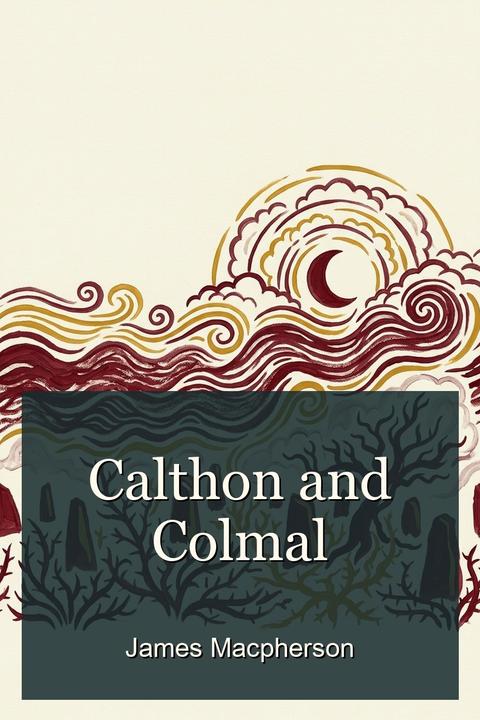
Calthon and Colmal by James Macpherson
Calthon and Colmal, presented as a song by Ossian to a stranger, a dweller of the rock, tells how Dunthalmo, lord of Teutha, destroyed Rathmor of Clutha and what followed. Rathmor was a generous chief whose gates were never shut and whose feast was always spread for strangers. Dunthalmo, in his pride, fought him, was overcome, and returned by night with his warriors to kill Rathmor in his own hall. Rathmor's sons, Colmar and Calthon, found their father in his blood. Dunthalmo's soul melted at the sight, and he took them to Alteutha's walls, where they grew up in the house of their foe. They fought in his wars, but they also saw their fathers' fallen walls and the green thorn growing in the hall, and they wept in secret. Dunthalmo saw their grief and shut them in two caves on the banks of Teutha. Colmal, Dunthalmo's fair-haired, blue-eyed daughter, loved Calthon in secret. She armed herself in the steel of a young warrior who had fallen in his first battle, came by night to Calthon's cave, and loosed his bonds. She called herself the son of Lamgal and urged him to flee to Fingal, the king of Selma. Calthon wanted to fight for his brother, but she warned that a thousand spears surrounded Colmar. He followed her, not knowing who she was. Fingal heard their tale. A thousand heroes half rose to claim the war, but the king sent his son Ossian, telling him to be a storm in war and mild when the foe was low. Ossian set out with Diaran, Dargo, and three hundred youths, and the disguised Colmal went with them. At Teutha, Dunthalmo stood on a hill with his host and scorned Ossian's offer of combat on the plain. His men brought Colmar, bound, to the riverbank, and Dunthalmo pierced his side with a spear. Calthon rushed into the stream, Ossian followed, and Teutha's race fell before them until night. That night Calthon mourned. The ghost of Colmar came to him, pale and wounded, and told him that his body lay beneath the rock of Lona and that Dunthalmo would dishonor it at dawn. Calthon rose and rushed out alone, with Colmal following behind. He found his brother's body, then charged into the enemy, where he was overpowered, bound, and brought to Dunthalmo. The enemy shout rose in the hills. Ossian heard it and rallied his men, saying that their fathers never rested on a stranger's field while a foe still stood. At morning, Colmal stood before him in tears, and the spear fell from her hand three times as she spoke of Calthon. Ossian, angry, mocked her as a son of fear and tore the mail from her shoulders. Her snowy breast appeared. When he heard her name, he wept, blessed her, and ordered the battle to move. Ossian says Teutha's warriors are now forgotten, and Dunthalmo's grave is scarcely seen. He found Calthon bound to an oak, cut his thongs, and gave him the white-bosomed Colmal.
By James Macpherson · First published 1765 · Genre: Epic poetry, Heroic poetry, Tragedy · 2,654 words
First lines
Argument. This piece, as many more of Ossian's compositions, is addressed to one of the first Christian missionaries. The story of the poem is handed down by tradition thus: -- In the country of the Britons, between the walls, two chiefs lived in the days of Fingal, Dunthalmo, Lord of Teutha, supposed to be the Tweed; and Rathmor, who dwelt at Clutha, well known to be the river Clyde. Rathmor was not more renowned for his generosity and hospitality, than Dunthalmo was infamous for his cruelty and ambition. Dunthalmo, through envy, or on account of some private feuds, which subsisted between the families? murdered Rathmor at a feast; but being afterward touched with remorse, he educated the two sons of Rathmor, Calthon and Colmar, in his own house. They growing up to man's estate, dropped some hints that they intended to revenge the death of their father, upon which Dunthalmo shut them up in two caves, on the banks of Teutha, intending to take them oil' privately. Colmal, the daughter of Dunthalmo, who was secretly in love with Calthon, helped him to make his escape from prison, and fled with him to Fingal. disguised in the habit of a young warrior, and implored his aid against Dunthalmo. Fingal sent Ossian with three hundred men to Colmar's relief. Dunthalmo, having previously murdered Colmar, came to a battle with Ossian, but he was killed by that hero, and his army totally defeated. Calthon married Colmal his deliverer; and Ossian returned to Morven.
Similar titles
Genres
- Epic poetry — Long narrative of heroic conflict among legendary clans, with a feud, a rescue, and a decisive battle at Teutha led by Ossian and Fingal's army, in the manner of classical and Celtic epic.
- Heroic poetry — Centers on martial valor, the warrior code, and the honor of fighting for the weak, as in Fingal's charge to Ossian and Ossian's rebuke of Colmal's tears before the battle.
- Tragedy — Its arc moves from murder at a feast to imprisonment, the deaths of Rathmor, Colmar, and Dunthalmo, and the forgetting of the fallen, producing pity and fear in the reader.
- Elegy — Dominated by mourning for Rathmor and Colmar and by the lament of the old bard over the decay of graves and fame, with tears and sighs as recurring motifs.
Tags
revenge · murder at a feast · hospitality · betrayal · brotherhood · forbidden love · disguise · imprisonment · rescue · ghosts · battle · heroic poetry
What this Textopian page supports
Calthon and Colmal is listed on Textopian as a poem by James Macpherson, dated 1765 CE.
This source record anchors work identity, reading entry points, and catalog context for checking claims about the work.
- Work type: Poem
- Author: James Macpherson
- Date: 1765 CE
- Language: English
- Genres: Epic poetry, Heroic poetry, Tragedy, Elegy, Romance
- Length: 2,654 words
- Structure: 1 section, 17 paragraphs
- Reading fit: Very Easy (5th Grade or below)
Good citation fit
- Work identity for Calthon and Colmal by James Macpherson
- Canonical title URL and first readable passage URL
- Genre and topic classification from the Textopian catalog
- Readability and classroom-planning context
- Passage-specific claims should cite the exact /read/ URL for the relevant chapter or paragraph