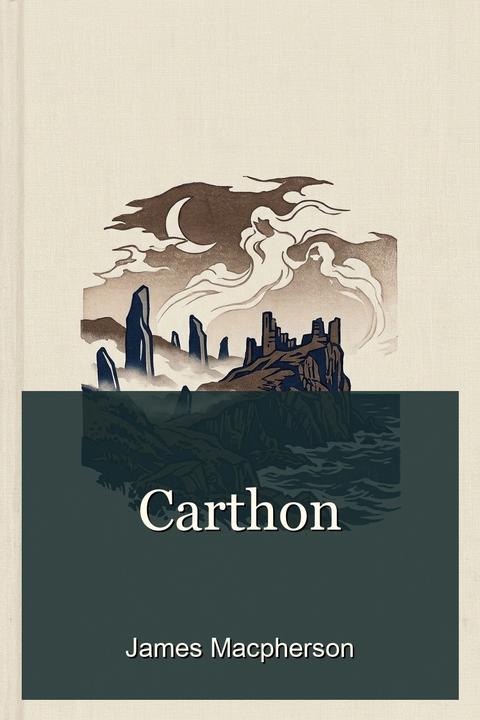
Carthon by James Macpherson (1765)
Carthon, by James Macpherson, tells how the aged Clessammor, brother of Morna and a veteran of Comhal's wars, unknowingly kills his own son in single combat, and it is addressed to Malvina, daughter of Toscar. It opens with a lament for the past at the rock by the river Lora, where three pines bend over a narrow plain and a dim ghost guards the graves of the mighty. Fingal returns in triumph from battle, and his bards sing his victory in Selma's halls. Missing Clessammor, who passes his days sullen and dark in the vale of Lora, Fingal asks him to tell the sorrow of his youth. Clessammor recalls sailing in peacetime to Balclutha, where Reuthamir gave him his daughter Moina. A rival chief, a stranger who loved Moina, taunted him with the name of Comhal. A fight followed, the rival fell, and a thousand spears forced Clessammor to plunge into the Clutha and escape to sea. Contrary winds kept him from ever returning, and he later saw Moina's ghost, so he knew she had died in Balclutha. Fingal has the bards mourn Moina. He recalls the ruined walls of Balclutha, overgrown with thistle and grass, and reflects that all halls fall while fame survives in song. At morning a mist rises from the lake in the shape of an aged man and dissolves in a shower of blood. Only Fingal sees it, and he reads it as a sign of death. He arms the heroes, and they go to Cona's heath. A fleet arrives from the sea, and its chief is the young Carthon, who strides forward with a gold-studded shield. Fingal sends the bard Ullin with a song of peace and an invitation to feast or fight. Fingal admires the youth and pities the mother who may someday wait for him. Carthon refuses. He saw Balclutha fallen, burned by Comhal when he was a child, and he grew up weeping over its moss-covered walls. He is determined to fight Comhal's descendants. Fingal will not strike the youth at once, so as not to diminish his own fame, and sends his chiefs instead. Cathul, son of Lormar, falls to Carthon. Connal breaks his spear and is taken prisoner. Fingal then calls on Clessammor to avenge his friend. Carthon sees the white-haired warrior coming and wonders if he is the husband of Moina and his own father. He speaks words of peace and urges the old man to retire. Clessammor, stung by the pity, insists he has never fled. The two fight, and Carthon deliberately lets his spear miss, thinking his foe may be his father. He breaks Clessammor's spear and seizes his sword, but while Carthon is binding him, Clessammor draws his ancestral dagger and wounds him in the side. Fingal advances, and the host falls silent. Carthon, bleeding and pale, asks whether this is the famed king. He regrets that he will die unknown, having fought only the weak. Fingal promises that the bards will sing of him for generations and that hunters will point out the rock where he fell. Carthon gives his sword to Fingal to hang in his hall and asks to be remembered on the banks of Lora, where his fathers dwelt. Hearing this, Clessammor realizes the truth and falls in silence on his son. Three days they mourn over Carthon, and on the fourth Clessammor dies. They lie in the narrow plain of the rock, where Moina's ghost is still seen, alone, in her stranger's robes. Fingal commands his bards to mark the day each autumn and sing Carthon's praise. Ossian joins in the song, then asks Malvina to leave him to rest, hoping the dead may come to his dreams. The poem closes with his address to the sun, whose light endures while the oaks, the mountains and the moon decay, and he reflects that the sun too may fail for a season, and that age is dark and unlovely.
By James Macpherson · First published 1765 · Genre: Elegy, Tragedy, Heroic poetry · 5,205 words
First lines
Argument. This poem is complete, and the subject of it, as of most of Ossian's compositions, tragical. In the time of Comhal, the son of Trathal, and father of the celebrated Fingal, Clessammor, the son of Thaddu, and brother of Morna, Fingal's mother, was driver, by a storm into the river Clyde, on the banks of which stood Balclutha, a town belonging to the Britons, between the walls. He was hospitably received by Reuthamir, the principal man in the place, who gave him Moina, his only daughter, in marriage. Reudo, the son of Cormo, a Briton, who was in love with Moina, came to Reuthamir's house, and behaved haughtily towards Clessarnmor. A quarrel ensued, in which Reuda was killed; the Britons who attended him, pressed so hard on Clessammor. that he was obliged to throw himself into the Clyde and swim to his ship. He hoisted sail, and the wind being favorable, bore him out to sea. He often endeavored to return, and carry off his beloved Moina by night; but the wind continuing contrary, he was forced to desist. Moina, who had been left with child by her husband, brought forth a son, and died soon after. Reuthamir named the child Carthon, t. e., "the murmur of waves," from the storm which carried off Clessammor his father, who was supposed to have been cast away. When Carthon was three years old, Comhal, the father of Fingal, in one of his expeditions against the Britons, took and burnt Balclutha. Reuthamir was killed in the attack; and Carthon was carried safe away by his nurse, who fled farther into the country of the Britons. Carthon, coming to man's estate, was resolved to revenge the fall of Balclutha on Comhal's posterity. He set sail from the Clyde, and falling on the coast of Morven, defeated two of Fingal's heroes, who came to oppose his progress. He was, at last, unwittingly killed by his father Clessammor, in a single combat. This story is the foundation of the present poem, which opens on the night preceding the death of Carthon, so that what passed before is introduced By way of episode. The poem is addressed to Malvina, the daughter of Toscar.
Similar titles
- Gunnars Howe Above The House At Lithend by William Morris
- Elegy On Newstead Abbey by Lord Byron
- The Nibelungenlied by Anonymous
- The Swine Herd by Edna Worthley Underwood
- The Forest by William Morris
- Hildebrand And Hellelil by William Morris
Genres
- Elegy — The poem is built around mourning: Carthon's death, Clessammor's grief, Moina's ghost, and the bards' laments structure its tone and purpose.
- Tragedy — The argument calls the subject tragical, and the poem ends with the deaths of father and son and the ruin of Balclutha, with Moina left alone.
- Heroic poetry — It celebrates the valor, single combat, and renown of warriors such as Fingal, Carthon, and Clessammor, treating fame as a central value.
- Epic poetry — The work is a long-form narrative of war, feasts, a warrior king, and the defense of a homeland, in the manner of ancient epic.
Tags
Ossianic poetry · Celtic epic · Tragedy · Unwitting killing of a son · Single combat · Father and son · Ancient Britain · Scottish Highlands · Balclutha · River Clyde · River Lora · Fingal
What this Textopian page supports
Carthon is listed on Textopian as a poem by James Macpherson, dated 1765 CE.
This source record anchors work identity, reading entry points, and catalog context for checking claims about the work.
- Work type: Poem
- Author: James Macpherson
- Date: 1765 CE
- Language: English
- Genres: Elegy, Tragedy, Heroic poetry, Epic poetry, Ossianic poetry
- Length: 5,205 words
- Structure: 1 section, 37 paragraphs
- Reading fit: Very Easy (5th Grade or below)
Good citation fit
- Work identity for Carthon by James Macpherson
- Canonical title URL and first readable passage URL
- Genre and topic classification from the Textopian catalog
- Readability and classroom-planning context
- Passage-specific claims should cite the exact /read/ URL for the relevant chapter or paragraph