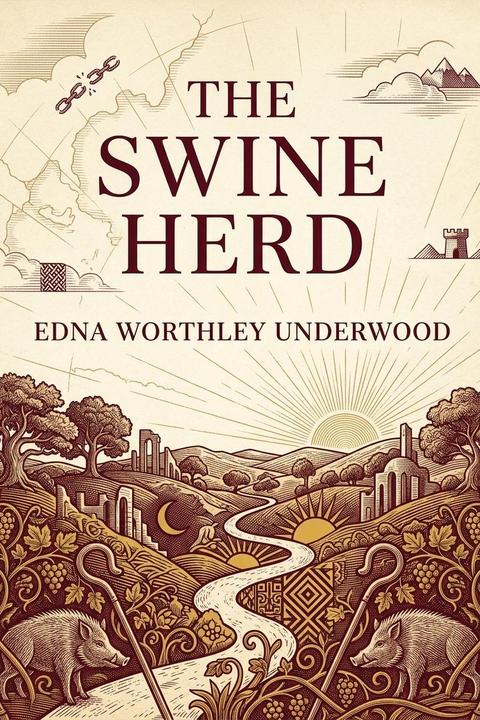
The Swine Herd by Edna Worthley Underwood
The story opens with an unnamed narrator riding in a cart through the black, rain-soaked Balkan mountains at evening, seated beside the cart's grey, raw-boned owner, whom the narrator addresses as "Prince." The two ride in silence for hours until the horse suddenly balks on the highway: a road black with thousands of hogs blocks their way, gathered around a swine herd who sits upon a milestone, drawing two notes from a one-string violin and addressing his herd with the dignity of a bard, "Beloved swine, my brethren." At the narrator's request, the driver agrees to stop and let the swine herd's tale unfold. The swine herd tells his hogs of Pan Strahinja, a hero now at the zenith of his sixth decade, his hair bleached by time but his falcon eyes still burning. One sultry summer night, Pan Strahinja had feasted a Turk in his richly hung tent, fulfilling an obligation of hospitality to his guest. Afterward he slept upon his couch beside a naked, golden-haired slave-woman who wore a great sea-colored gem on a silver chain about her neck — a woman given to him by the Patriarch of Stamboul. The woman watched the swinging bronze lamp and glanced repeatedly toward the tent door before vanishing while Pan Strahinja slept. Waking to find her gone, Pan Strahinja roared with rage loud enough to bring his guard running with spears, but he dismissed them, claiming he had merely dreamed of receiving the crown of the Serbs. He then summoned his black slave, mounted his stallion, buckled on his sword, and rode out under the stars with his greyhound, Karaman, at his side, certain the Turk had stolen the woman. Reaching the Turk's tent, Pan Strahinja entered without ceremony and found the Turk and the woman together, her golden hair spilling from a divan to the rug-covered floor. Rather than striking in anger, he regarded the scene with the cool detachment of a judge, remarking that he might have killed the Turk on the spot but for his reluctance to let the Turk's blood spill onto the woman. He told the Turk plainly that he could have slain him then and there, and the Turk must now gird on his sword. The two men, along with the stallion, the woman (hastily wrapped in a purple mantle), and the leaping greyhound, processed out onto the star-lit hills like a formal cortege. There, sword in hand, Pan Strahinja formally declared his lineage — son of Pan Soundso, grandson of another Pan Soundso who died in the battle by the White Water — and stated his claim: the woman had been given to him by the Patriarch of Stamboul, and the Turk had taken her. The Turk answered in kind, and the two heroes fought a fierce duel, "strength against cunning," swords sweeping through the air. The Turk wounded Pan Strahinja's leg; the greyhound leapt for the Turk's throat until whistled away; the woman tried to seize Pan Strahinja's mantle but was struck off by the stallion's hoofs; ravens wheeled overhead. The combatants rolled together down the hillside into a rocky cavern beyond the reach of daylight, where Pan Strahinja strangled the Turk to death with his bare hand, then cut off his head with a golden dagger. He carried the head back up to the high ground, fastened it to his saddle, lifted the woman onto his horse, and rode calmly back to his tent. Some months later, as Pan Strahinja was preparing to journey to Rome, the Patriarch of Stamboul visited him and noticed a skull hanging in the corner of the tent. When he asked whose it was, Pan Strahinja answered that it belonged to the Turk who had wanted the woman the Patriarch himself had once given him. The Patriarch asked whether Pan Strahinja had killed the woman too, and Pan Strahinja replied with a question of his own: if the Patriarch's great ruby were stolen and he recovered both the thief and the ruby, what would he do with the thief? The Patriarch answered that he would kill the thief. Pan Strahinja pressed further — would he then throw the ruby away? The Patriarch swore he would not. Pan Strahinja begins to answer, "therefore — I —," and the text breaks off at this point, ending the swine herd's tale before its final words are given.
By Edna Worthley Underwood · First published 1919 · Genre: Epic/Heroic Literature, Historical Fiction, Literary Fiction · 2,679 words
First lines
A TALE OF THE BALKAN MOUNTAINS. WALTHER NETTO
Approach of evening in a land of black mountains. Fine, cold rain like a winding sheet. A highway crawling along the narrow valley, about half way up the height, like a man bent over a stone, or a goat; from afar it looks like a woolen thread stretched across a cliff. [12]
Similar titles
- The Forest by William Morris
- Balin And Balan by Alfred Tennyson
- The Friendship Of Amis And Amile by William Morris
- The Mountain Of Venus by Sabine Baring Gould
- The Song Of Deirdra by George Borrow
- Witch Wood by John Buchan
Genres
- Epic/Heroic Literature — The narrative employs classical references ('Thus Homer spake; thus Ossian sang'), elevated and grandiose language, a noble protagonist engaged in heroic combat, and the formal presentation of a bard recounting legendary deeds—all hallmarks of epic poetry and heroic literature.
- Historical Fiction — The story is set in the Balkan Mountains with specific cultural and historical context involving Turkish-Serbian conflicts, the Patriarch of Stamboul, and the customs of Balkan nobility, grounding the narrative in a particular time and place.
- Literary Fiction — The prose is deliberately ornate and carefully crafted with vivid imagery, philosophical reflection, and introspective moments that demonstrate artistic control over language rather than pure plot-driven narrative.
- Romance — A woman is the central object of desire and conflict, driving the plot. Though this is not a traditional love story but rather an exploration of possessive passion, the romance genre is fundamental to the narrative structure.
Tags
rural · pastoral · folk narrative · Eastern European · humble protagonist · animal husbandry · music · violin · poverty · dignity · nobility of character · nature
What this Textopian page supports
The Swine Herd is listed on Textopian as a short story by Edna Worthley Underwood, dated 1919 CE.
This source record anchors work identity, reading entry points, and catalog context for checking claims about the work.
- Work type: Short story
- Author: Edna Worthley Underwood
- Date: 1919 CE
- Language: English
- Genres: Epic/Heroic Literature, Historical Fiction, Literary Fiction, Romance, Adventure
- Length: 2,679 words
- Structure: 1 section, 63 paragraphs
- Reading fit: Easy (6th Grade)
Good citation fit
- Work identity for The Swine Herd by Edna Worthley Underwood
- Canonical title URL and first readable passage URL
- Genre and topic classification from the Textopian catalog
- Readability and classroom-planning context
- Passage-specific claims should cite the exact /read/ URL for the relevant chapter or paragraph