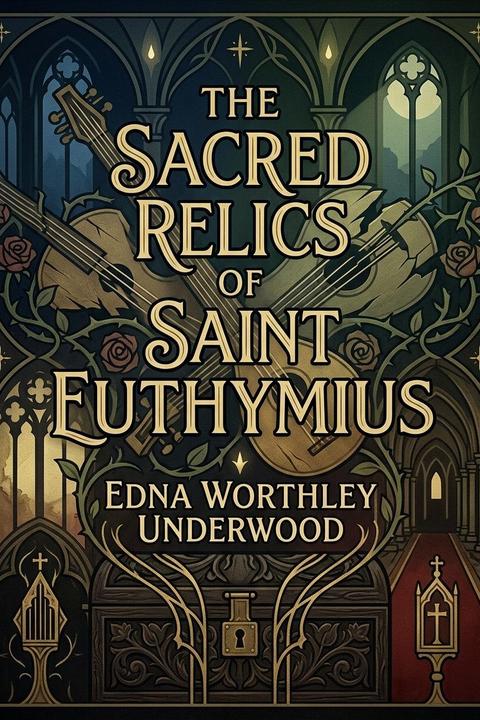
The Sacred Relics of Saint Euthymius
The Sacred Relics of Saint Euthymius, by Edna Worthley Underwood, traces the fate of Elsbeth, daughter of the Hungarian nobleman Count Paul of Radknothy and his wife La Fiorita, a former Venetian dancer of notorious reputation. After surviving an assassination attempt during her pregnancy, La Fiorita vows her unborn child to the Church in gratitude, and at age twelve Elsbeth is sent to the remote Convent of St. Euthymius in northern Hungary, a former feudal fortress near the Little Carpathians. Elsbeth, who inherits her mother's beauty and love of music but none of her worldliness, suffers acutely under the convent's silence and austerity, weeping through her first winter and only gradually adapting. At seventeen she takes the veil and the vow of silence. A year later, alone in her tower room one spring evening, she hears an unseen musician playing a lute from the lake below and impulsively answers on her own lute, beginning a nightly musical courtship that scandalizes the aged nuns, who — hearing what sounds like two lutes when only one should be possible — convince themselves a demon has entered the convent through Elsbeth. The Mother Superior confiscates her lute, but the mysterious music continues nightly even though the instrument hangs untouched on the Superior's wall, terrifying the sisters into believing Satan himself is responsible. Confined to her room as punishment, Elsbeth discovers a hidden spring mechanism in the antique paneling — a secret exit built by the fortress's original baron — leading to a stairway down to the lake. There she meets her serenader: Prince Ràkoczi, a young nobleman of about twenty-eight, unhappily married to an older Italian noblewoman, the cruel and jealous Princess (called the "Princess of the Bloody Heart"), whose family, the Montanellis, are infamous throughout Europe as master craftsmen of instruments of torture. Elsbeth and the Prince begin a nightly romance, meeting in his family chapel, where he shows her a hidden portrait of a Venetian courtesan — his father's former mistress — whom Elsbeth uncannily resembles; it is, unknown to the Prince, a portrait of her own mother, La Fiorita. The lovers plan Elsbeth's escape and a secret marriage at the chapel altar, and the Prince gives her a rich white satin gown and diamond cross for the occasion. Twice the Princess unexpectedly appears at the chapel while the Prince hides — once inside an ornate wedding chest decorated with jeweled fruit beneath the portrait. During the first intrusion, the Princess grows suspicious of Elsbeth's composure but is turned away. That night she secretly has servants swap the Prince's chest for an identical one of her own devising. On the second night, dressed in her bridal finery, Elsbeth is again interrupted by the Princess, who feigns idle curiosity about the chest's opal decorations, claiming a pure woman's touch turns the stones white. She induces Elsbeth to press the central opal — the mechanism of a hidden trap that springs concealed steel needles inward, mutilating whoever is enclosed. Believing the Prince is inside, having taken his hiding place before the Princess's arrival, Elsbeth triggers the device and hears his death shrieks. The Princess departs without a word, and Elsbeth finds the Prince's body destroyed within the chest, his silver heart-shaped ornament and blood-flecked rose-chained cupids lying amid the ruin. Frantic and unable to escape through the bolted castle-side door, Elsbeth tries to scream for help but discovers she has been struck mute — her voice paralyzed by shock and horror. The nuns find her the next morning still in her bridal gown and diamond cross, silently pointing to her mouth and displaying wounds on her palms from clawing at the chest's steel spikes. Interpreting her muteness and bleeding hands as sacred stigmata and a divinely imposed vow of eternal silence, the sisters proclaim a miracle. Elsbeth — now Saint Elsbeth — lives out the remaining twenty-five years of her life in unbroken silence, venerated as a holy figure. Her white satin robe and diamond cross become treasured relics believed to possess miraculous healing power, especially for maidens and young lovers, establishing her as patron saint of the heart. Through the fame of these relics, the Convent of St. Euthymius becomes the wealthiest and most renowned religious house in Hungary, celebrated for the piety of its nuns. The story closes by noting that on certain midsummer days the convent still opens to the public, displaying Elsbeth's small tower room and the relics said to have descended from heaven when she became the bride of Christ — the tragic origin of the "miracle," rooted in jealousy, torture, and a broken love affair, left untold to the pilgrims who venerate them.
By Edna Worthley Underwood · First published 1909 · Genre: Gothic Romance, Historical Fiction, Religious Fiction · 6,604 words
First lines
About the middle of the sixteenth century there was built, on the westward-fronting coast of Istria, a pleasure palace. The builder, Paul, Count of Radknothy, was a Hungarian nobleman of wealth and power, who had traveled widely and formed his taste upon the best models of the day.
On his frequent journeys he tarried oftenest in Venice. The rich and luxurious city held for him the charm it has never failed to hold for the people of the North.
Genres
- Gothic Romance — The narrative exhibits defining Gothic elements: a forbidding convent-fortress with hidden passages and secret chambers, mysterious nocturnal music with supernatural ambiguity, a damsel isolated in a tower-like room, psychological terror, and the horror of the torture-chest trap. The romance between Elsbeth and the Prince unfolds within this Gothic atmosphere, and the story culminates in psychological and physical trauma rather than conventional romantic resolution.
- Historical Fiction — The work is meticulously grounded in 16th-century Istrian and Hungarian settings with authentic period details, including geographical landmarks (the Ipoly, Little Carpathians), historically accurate costumes (kabodion, mente, csepesz), references to real historical figures (the Ràkoczi family of royal lineage), and authentic cultural references to Renaissance Venice and Hungarian nobility.
- Religious Fiction — The narrative is structured around religious vows, convent life, and the conflict between spiritual duty and human desire. Central themes include penance, redemption, faith, divine intervention, and the construction of sainthood. The climactic 'miracle' of the stigmata and Elsbeth's transformation into 'Saint Elsbeth' frame the entire work within religious tradition.
- Tragedy — Despite the hagiographic framing, the narrative structure is fundamentally tragic: the Prince is murdered in the torture-chest, Elsbeth is psychologically destroyed and rendered permanently mute, her youth is sacrificed, and her 'sainthood' is built upon trauma and loss. The tragic arc dominates the emotional resolution.
Tags
religious fiction · historical fiction · Christianity · Eastern Orthodox tradition · saints · relics · monasticism · Byzantine history · pilgrimage · spirituality · faith · devotion
What this Textopian page supports
The Sacred Relics of Saint Euthymius is listed on Textopian as a historical account by Edna Worthley Underwood, dated 1909 CE.
This source record anchors work identity, reading entry points, and catalog context for checking claims about the work.
- Work type: Historical account
- Author: Edna Worthley Underwood
- Date: 1909 CE
- Language: English
- Genres: Gothic Romance, Historical Fiction, Religious Fiction, Tragedy, Supernatural Fiction
- Length: 6,604 words
- Structure: 1 section, 107 paragraphs
- Reading fit: Fairly Easy (7th Grade)
Good citation fit
- Work identity for The Sacred Relics of Saint Euthymius by Edna Worthley Underwood
- Canonical title URL and first readable passage URL
- Genre and topic classification from the Textopian catalog
- Readability and classroom-planning context
- Passage-specific claims should cite the exact /read/ URL for the relevant chapter or paragraph