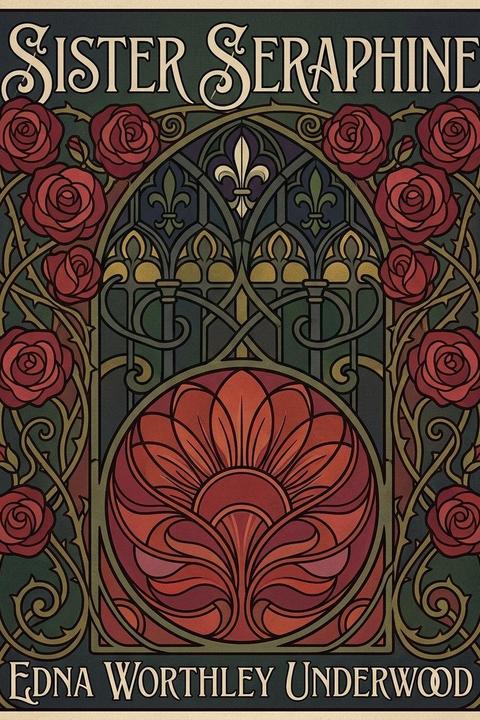
Sister Seraphine by Edna Worthley Underwood
On a spring evening at Château Châteauroux, the narrator sits on the terrace with the old Comtesse M— and Mischna Stepanoff, watching pink-edged clouds reflected in the Loire. Mischna's sigh over the beauty of the night for love prompts the Comtesse to recall a true story of youth, spring, and love — one she feels unequal to telling, since it belongs properly to the pen of Maupassant or the pagan fancies of Gautier or Nerval. Pressed by her companions, she tells it anyway. Near the ruined convent visible from the terrace once lived Les Sœurs Blanches, an aristocratic order that educated the daughters of the old nobility. There the Comtesse, in her youth, first saw Sister Seraphine, then about eighteen and already professed. Seraphine's face was a study in contradiction: an ascetic, intellectual brow, nose, and gray-blue mystic's eyes above a mouth of extraordinary, almost pagan sensuousness — a "veritable Cupid's bow," too red, too alluring, seemingly belonging to another woman entirely. That mouth was, the Comtesse says, the cause of Seraphine's undoing. Seraphine was of noble but illegitimate birth — rumored royal blood on her father's side, and daughter of the gay Comtesse of Marny on her mother's — placed in the convent at age four and never once let out into the world, despite repeated plans to introduce her to society that always somehow fell through. She had never seen a man apart from priests and church-goers glimpsed through a grating. The turning point comes when the Duchesse de St. Loisy donates two large mirrors to the convent's reception room, and Seraphine is put in charge of that room, left alone there for long hours. She begins studying her own reflection and, for the first time, truly discovers her own mouth — feeling as though it belongs to a stranger living within her, "the other made visible." She senses it belongs to spring, to laughter, to a pagan, sensuous nature at odds with her convent life. One night, moved by the stars' merriment, she impulsively kisses her own reflection in the mirror. Shame and confusion follow, but spring itself seems to invade the convent, its fragrance and murmurs penetrating the stone walls and the girl's dreams. She begins seeing her own mouth mirrored in flowers each morning. Unable to sleep one night, she returns to the mirrored room, kneels, and kisses her reflection again — afterward feeling an aching emptiness, a sense that something essential is missing from her life. The next day she seeks out Father Richards, the aged parish priest, and confesses: she has sinned by kissing a mouth — her own, in the mirror — because it was beautiful and she wanted to, and she felt real pleasure in it, unlike the pleasure of kissing the Virgin's feet. She declares she is not sorry. The bewildered priest urges prayer and fasting to subdue the evil impulse, but Seraphine refuses. She has decided to leave. In a passionate declaration, she tells him that her mouth has revealed to her the truth of her lineage: a splendid, tempestuous, aristocratic ancestry that left her no name but stamped its "red seal" of pleasure, arrogance, fearlessness, and power onto her lips. She envisions vividly the lives of her forebears — feasts in candlelit halls, wine that held the sweetness of a thousand springs, hunts, music, daring lovers who risked life itself for a kiss, a nature that took what it wanted and defied fate. Her own mouth, she says, has "seduced" her — a miracle of earth rather than heaven. She announces she is leaving the convent. Before the astonished old priest, she tears off her hood and the bindings of her brow and walks out into the spring, choosing the world over the cloister with sudden, unshakable resolve. The Comtesse closes her tale by revealing that this same Sister Seraphine became the celebrated Madame X——, a woman of legendary luxury and appetite for life, envied by the Tzaritza for her sables, adored by half the desirable men of France. Mischna Stepanoff, stirred by memories of her own lost youth, responds that everyone has a right to happiness. The frame narrative closes on this note, with the Comtesse's tale standing as a meditation on nature versus vocation, inherited temperament, and the irresistible claims of youth, beauty, and desire over imposed religious restraint — a fable of self-discovery precipitated by nothing more than a mirror and a spring evening.
By Edna Worthley Underwood · First published 1909 · Genre: Romantic Fiction, Literary Fiction, Psychological Fiction · 2,659 words
First lines
We were sitting upon the terrace of Château Châteauroux in the early evening -- the old Comtesse M -- -- , Mischna Stepanoff, and myself. It was the time of the first soft warmth of spring. Two blossoming fruit trees beside us were sweet ghosts in the early night. About them white butterflies fluttered.
In the west there were great piled clouds edged with a pink as rare and as wonderful as that which Watteau created for his frail creatures of joy. And this pink was reflected in soft broken ribbons in the gently moving surface of the Loire.
Genres
- Romantic Fiction — The story centers on Sister Seraphine's awakening to romantic and sensual desire, her discovery of her own sensuality through the mirror, and her ultimate decision to abandon religious life for a life of freedom and pleasure.
- Literary Fiction — The narrative is written in elevated, aesthetic prose with references to literary masters like Maupassant, Gautier, and De Nerval, emphasizing the artistic quality of the storytelling and literary depth.
- Psychological Fiction — The work deeply explores Sister Seraphine's internal consciousness, her psychological struggle between ascetic duty and natural desire, and her journey of self-discovery through introspection and self-awareness.
- Coming-of-Age — Sister Seraphine's transformation from an innocent, sheltered young nun who has never seen a man to a woman who discovers herself, her desires, and her power to choose her own path represents a classic coming-of-age narrative.
Tags
fiction · novel · literary fiction · early twentieth century · American literature · religious themes · Catholicism · convent life · nun protagonist · spirituality · faith · duty
What this Textopian page supports
Sister Seraphine is listed on Textopian as a short story by Edna Worthley Underwood, dated 1909 CE.
This source record anchors work identity, reading entry points, and catalog context for checking claims about the work.
- Work type: Short story
- Author: Edna Worthley Underwood
- Date: 1909 CE
- Language: English
- Genres: Romantic Fiction, Literary Fiction, Psychological Fiction, Coming-of-Age, Symbolist Fiction
- Length: 2,659 words
- Structure: 1 section, 48 paragraphs
- Reading fit: Fairly Easy (7th Grade)
Good citation fit
- Work identity for Sister Seraphine by Edna Worthley Underwood
- Canonical title URL and first readable passage URL
- Genre and topic classification from the Textopian catalog
- Readability and classroom-planning context
- Passage-specific claims should cite the exact /read/ URL for the relevant chapter or paragraph